Many individuals aspire to become property millionaires. They immerse themselves in books, seminars, and courses, each with their own pace – some favoring quick success, while others opt for a slower, steadier approach. What’s your preference?
But caution is warranted. Sadly, many who aspire to property wealth end up with a different outcome – becoming “property millionhairs” instead. Take Jerry, for example (not his real name). Despite a net income of RM5K, he impulsively purchased five properties at once, enticed by promises of a RM200k cashback per unit. With five units, he envisioned instant wealth. However, blinded by the prospect of millionaire status, he overlooked critical details, such as the absence of the cashback clause in the contract.
To realize his dream, Jerry enlisted his girlfriend’s help to secure mortgage approval, as his income alone wasn’t sufficient. The terms seemed promising – the cashback would be disbursed upon the bank’s final payment release, just a few months away. Jerry was ecstatic, anticipating wealth raining down on him.
When the cashback arrived, Jerry felt like royalty. His eyes gleamed with newfound riches, and he indulged in extravagant purchases – a RM300k car, luxury watches, jewelry, and more. He also spent a substantial sum renovating his properties for potential tenants.
Yet, eight months later, reality set in. Jerry’s million was dwindling rapidly, with vacant units generating no income to offset his hefty RM12k monthly mortgage payments. Facing financial ruin, he discovered his properties were valued 40% below their purchase price, rendering them unsellable without further financial strain.
Do you want to emulate Jerry’s fate? Consider these warnings:
Packages like Jerry’s often involve properties with poor marketability.
Jerry’s scheme of securing multiple loans or called compression method with a single income is fraudulent and can lead to legal consequences.
Jerry may have salvaged some funds, but others haven’t been as fortunate. I’ve encountered individuals on the brink of bankruptcy, struggling to provide for their families, a heartbreaking reality.
Banks are now more vigilant, scrutinizing loan applications meticulously to prevent such misfortunes. Yet, at the heart of it lies human greed, fueled by promises of grandeur.
For me, prudence reigns supreme. I advocate for careful planning, eschewing shortcuts for a methodical approach. If I can’t cover at least 12 months of mortgage payments, I refrain from purchasing, no matter how enticing the property. Financial responsibility dictates my decisions. To everyone out there, heed this advice: stay within your means. When deals seem too good to be true, exercise caution. Protect your financial well-being, for our lives are invaluable.
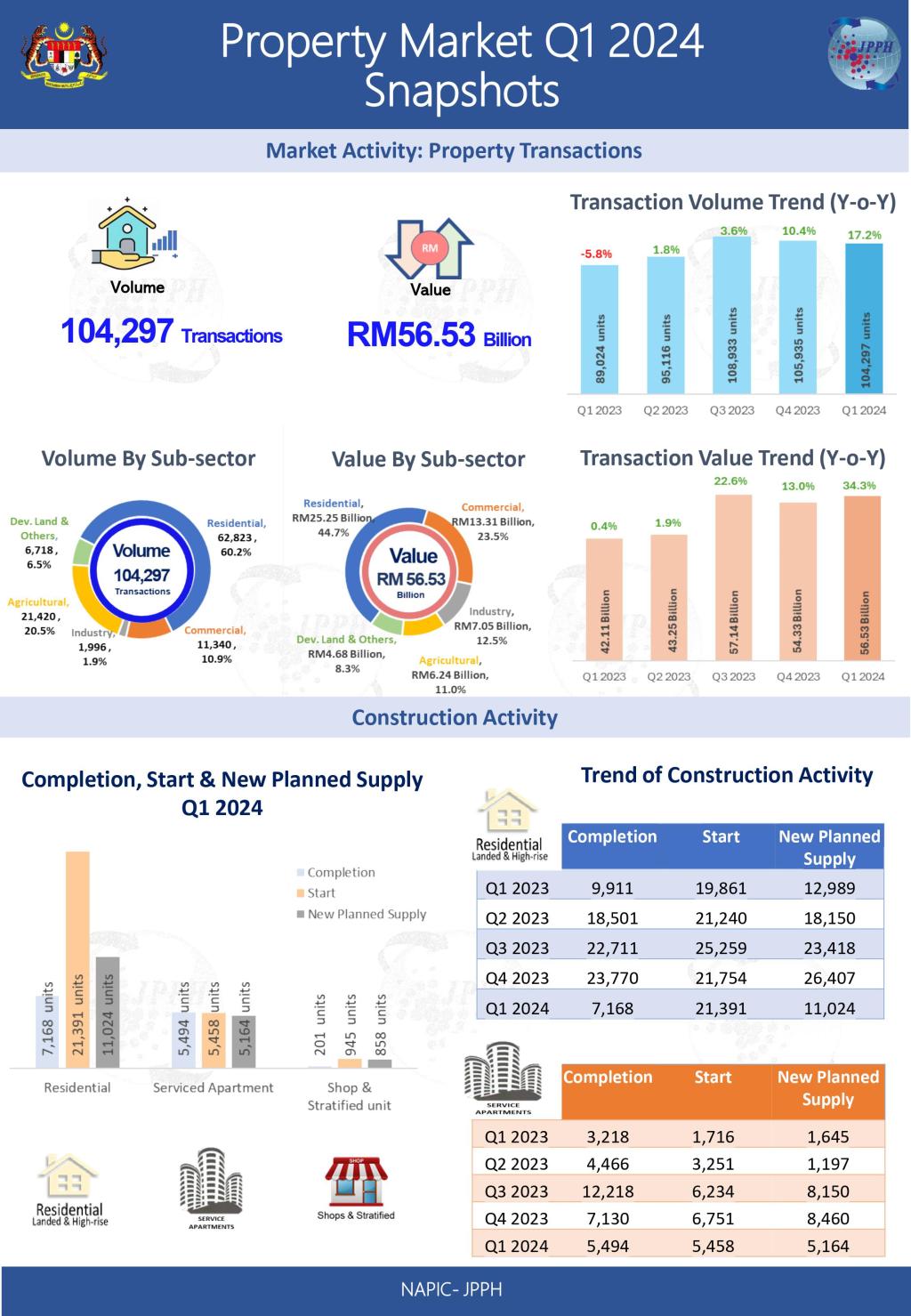
Malaysia’s real estate market continues to thrive, with 104,297 transactions valued at RM56.53 billion recorded in the first quarter of 2024 (1Q24). This marks a 34.3% increase from the same period in 2023, which saw 89,024 transactions worth RM42.11 billion.
“The government aims to ensure that economic planning, which integrates catalytic projects with inclusive development, will sustain long-term growth in the real estate market,” Amir Hamzah remarked in a statement today.
Valuation and Property Services Department director-general Abdul Razak Yusak attributed the strong performance to significant increases in transactions across all subsectors, particularly commercial real estate (up 51.5%) and agricultural land (up 64.2%).
“Government initiatives, such as extending the stamp duty exemption for first home purchases up to RM500,000 until December 2025, have been pivotal in boosting the real estate market,” he added.
In terms of subsector growth, commercial real estate led with a 33.4% increase, followed by residential at 16.6%, agricultural at 13.7%, and development land at 10.7%.
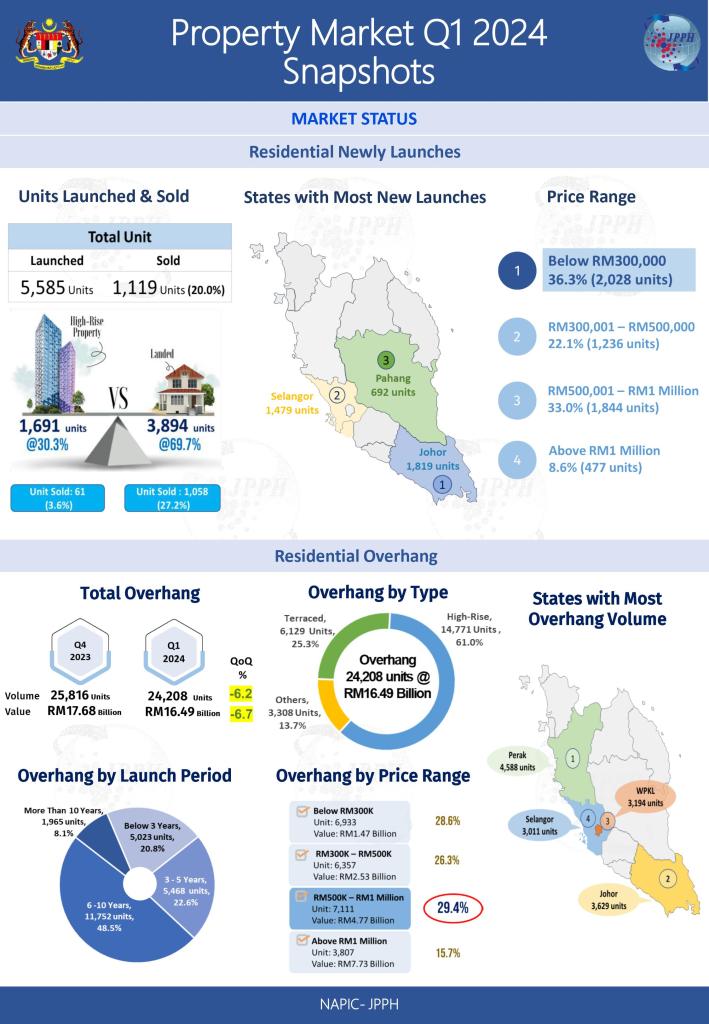
Additionally, the number of unsold completed residential properties (overhang) decreased to 24,208 units valued at RM16.49 billion, compared to 25,816 units valued at RM17.68 billion in the fourth quarter of 2023 (4Q23).
“Preliminary data for the Malaysian House Price Index (MHPI) in 1Q24 showed a slight increase to 216.9 points (RM467,997 per unit), reflecting an annual growth rate of 0.5%. Most states experienced moderate growth between 0.5% and 4.6%, except for Kuala Lumpur, Penang, Perak, Melaka, and Sarawak,” Abdul Razak noted.
For many Malaysians, their savings for retirement primarily reside in the Employees Provident Fund (EPF). Each month, employees see 11% of their salary deposited into their EPF savings, while employers add another 13%. Traditionally, 70% of these funds are allocated to Account 1, with the remaining 30% placed in Account 2. Account 1 is inaccessible until retirement, while Account 2 permits withdrawals for medical expenses, education, or home purchases.
Starting May 11, 2024, individuals under 55 will encounter changes. A third account, dubbed Akaun Fleksibel (Flexible), will be introduced. Account 1 is renamed Akaun Persaraan (Retirement), and Account 2 becomes Akaun Sejahtera (Wellbeing). This restructuring aims to enhance financial planning for retirement and address long-term challenges while providing for immediate financial needs through Akaun Fleksibel.
With the activation of Akaun Fleksibel, 75% of contributions must be retained in Akaun Persaraan, while Akaun Sejahtera receives 15%, leaving 10% for Akaun Fleksibel. Contributors may transfer funds from Akaun Sejahtera to Akaun Fleksibel between May 12 and August 31, based on specific criteria.
For balances exceeding RM3,000 in Akaun Sejahtera, a formula based on fractions is used for transfers. For instance, a portion of Akaun Sejahtera can be moved to Akaun Fleksibel, with the remainder redistributed between Akaun Persaraan and Akaun Sejahtera.
For balances below RM3,000 in Akaun Sejahtera, contributors can transfer up to RM1,000 to Akaun Fleksibel, with the remainder retained in Akaun Sejahtera. Those with less than RM1,000 may transfer their entire balance to Akaun Fleksibel.
Transfers and withdrawals can be processed via the KWSP i-Akaun app or EPF branches, with disbursements directly to the contributor’s bank account.
This move offers flexibility but also raises concerns about potential misuse. While it enables access to funds for emergencies, there’s a risk of frivolous spending. EPF advises contributors to exercise prudence and responsibility. Ultimately, whether this move is beneficial or detrimental depends on how effectively individuals manage their finances and utilize the newfound flexibility.
What do you think of this move? Is it for the better or for worse?
In the picture, what do you think I am doing? Praying for the money to drop
I do not really depend on these. I don’t think money will suddenly drop from the sky or hoping for a miracle to happen. If a car were to break down, you will need a mechanic to fix the problem. He will have to follow a series of steps in doing repair and to make sure your car is running again.
Likewise, in mortgage approval you cannot wait for miracle things to happen. To me, luck have nothing to do on mortgage approval. Many borrowers and agents, prefer to photocopy many stacks of financial documents and give to every bank they know off or can find and submit to them for approval. Is this the right way?
Do you know that every time your documents are submitted, the banks will record and send to Bank Negara which in turn will update the Central Credit Information System (CCRIS) every month? No matter whether your loan is approved or rejected it will be updated on the last page of your record. Let’s say Bank A rejects your loan, Bank B,C and D also rejects but Bank E actually can approve your loan but seeing so many banks rejected your loan the chances are they will also reject your loan.
Never expose yourself. Every bank have different approval criteria. Some banks might not like you but some does. I have a case once, his Debt Service Ratio is very high at 150% in which is higher than the normal 70-85%. Either the banks rejects or do not want to waste time processing his case. I reviewed his documents and to cut things short, I managed to get 70% loan approval. This case is a fine example where the borrower will have to do the following:
Do a Know yourself (KYS) test.
Check your credit status
Check which bank is suitable for you.
You will have to do more work on the last step. You will need to find out each bank approval criteria and also the different types of documents for approval. You are not buying a RM1,000 property but hundreds or even millions worth of property. It is good to do a research first. It is hard to go back when your loan had been rejected. It is easier to diagnose a problem first.
After all the searching, surveying and checking, you have finally found your perfect home. Now comes the hardest part. The property is not yours to call home yet. Unless you buy it in cash, like most homebuyers, you would need to rely on a bank loan to turn your dream into reality.
Applying for a home loan can be quite nerve-wracking especially for first-time home buyer. What’s more, it can be very frustrating if the application is unsuccessful. If your loan is rejected, it’s not the end of the world, but it is human nature to put the blame on someone else. In a way, pointing the finger may also help you understand why your application was rejected, and what you can do differently in your next attempt. We have made a list of the top 3 contenders for the blame game:
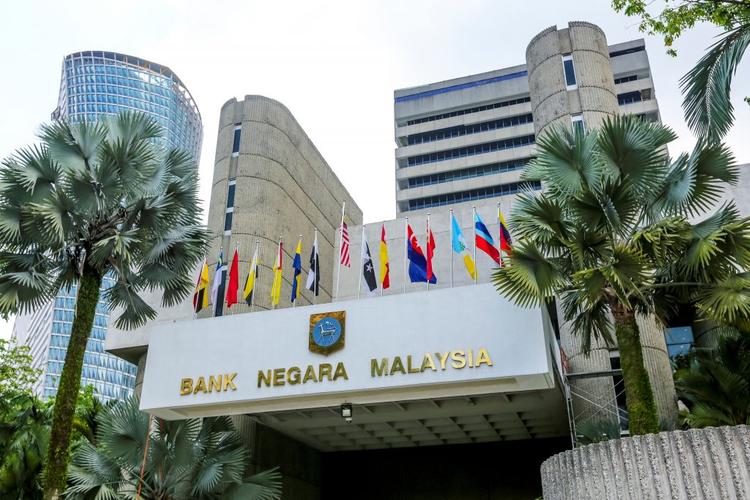
Plenty of people blame Bank Negara Malaysia (BNM) for the many loan rejections in Malaysia. Are they the culprit, though? Well, BNM is the one making all the loan policies in Malaysia and most people may feel that the ever-tightening policies are making it more difficult to borrow from banks.
However, we need to look at this from another point perspective. If BNM did not have all these policies in place, we will most likely face a subprime mortgage crisis, as what occurred in the USA in 2008. How did this crisis come about? This happens when banks get greedy and start lending to anyone, even to borrowers who have a history of low credit scores and problems with debt. In time, these high-risk borrowers will default on their loan repayment and this will have a ripple effect and evolve into a national issue.
The Solution: Keep tabs on Bank Negara Malaysia’s latest borrowing regulations
With the country’s current slow but fluctuating economic growth, it’s beneficial to keep yourself updated with the latest Bank Negara Malaysia (BNM) borrowing regulations and not depend on word of mouth from friends or relatives.
Prior to that, homeowners were allowed to get their homes refinanced for up to 90% of their value with a maximum repayment tenure of 35 years and were able to use the cashed-out portion for investments. But in the 2014 revision, BNM capped the tenure of personal loans at 10 years.
So why does this matter? Well, take this example: your existing home loan with Bank A is RM400,000 and perhaps because of lower interest rates, you want to refinance your home for RM550,000 at Bank B. The additional RM150,000 would be classified as a personal loan and the 10-year repayment tenure would kick in.
This means that the DSR of the cashed-out portion would be calculated using the 10-year tenure, resulting in a much higher DSR and thereby affecting your overall credit score and potentially leading to your loan application getting rejected.
Besides that, BNM recently shared that many banks were using unfair T&Cs in housing loan contracts. BNM has assured that it will be releasing a set of standard T&Cs soon to keep Financial Service Providers in check – where they must act in good faith by ensuring the fairness of contract terms, provide clear and concise product information as well as offer appropriate advice/recommendation based on the needs and financial circumstances of loan applicants.
As a savvy consumer, you would want to equip yourself with these standards once it is out and study your rights as a financial consumer before approaching a bank for a home loan.
Therefore, we must remember that under BNM, we have a prudent and balanced lending policy. We need it to protect our country. Best to think again before pushing the blame onto BNM.
If we do not blame BNM, can we blame the banks instead? After all, they are the ones who approve or reject the loans. Let’s try this – put yourself in the bank’s shoes. Say you are the lender, and your friend the borrower, wants to borrow RM50,000 from you. You know that your friend earns RM5,000 a month. Each month, most of his money goes into paying off his debts. The big question here is, will you lend the money to him? The risk of not getting your money back is very high. Logically, most people would think twice or not even consider lending their friend that sum of money. A bank thinks the same way – they are not a charity, but a profit-driven organization who are accountable to their shareholders.
Some banks have their own internal policies in lending on top of the existing BNM policies – such as having their own scoring system. As different banks have different lending policies you need to know which bank is the most suitable one for you by conducting your own research and comparison. But do keep in mind that even before they look at your documents, they will first check your credit rating. If your rating is low, it’s not hard to see why your application may be rejected immediately. Do you still think we should be blaming the banks?
But do keep in mind that even before they look at your documents, they will first check your credit rating. If your rating is low, it’s not hard to see why your application may be rejected immediately.
The Solution: Determine the best bank DSR (which will match your DSR)
To reduce the chances of getting your home loan application rejected, you should first calculate your Debt to Service ratio (DSR), which is the calculation of your debt against your monthly income.
DSR = (Total commitment ÷ Nett Income) x 100
One of the most common reasons why banks would reject a home loan application is if the applicant’s DSR is above the bank’s maximum allowable DSR. This can get tricky as every bank will have its own respective guidelines for the maximum allowable DSR that they are willing to accept.
It could be affected by various factors such as income, age, qualifications and even your net worth. The most ideal DSR range would be between 50%-60% as it would hit below the maximum allowable DSR of many banks and thus the likelihood of loan approval would increase.
If your DSR is the reason why your loan application was rejected, don’t worry! You can start improving your DSR by either reducing your current debts or by consolidating your unsecured loans and credit card bills. Check out LoanCare, which calculates and uses your DSR to help you compare home loan products across at least 10 banks in Malaysia.
3. The borrowers
How about if we blame ourselves, the borrowers? Plenty of people are laden with debts from credit cards, personal loans, luxury cars and such. Would it be fair to ask the banks to lend them more money? The risk of non-repayment is very high.
The Solution: Determine your CCRIS report pitfalls
If your home loan is denied, the first thing you want to do is to check your CCRIS report. However, these days it’s rare to find anyone who isn’t aware that they must first check their credit score via The Central Credit Reference Information System (CCRIS). This system reflects your past 12 months of credit activities and shows the bank whether you are a good or bad paymaster.
However, the buck does not stop at having a great credit score. There are other factors which might skew your report. For instance, there is always the question, “If my loan is declined, when can I apply again?”
Did you know that all of your loan rejections are also reflected in your CCRIS? This can prove to be fatal for those that cast a wide net by submitting loan applications to multiple banks. Banks would usually be aware of any prior rejections via their CCRIS record, and thus, applicants would have to wait between 3-6 months before attempting to apply for another loan.
As such, it’s wise to improve your credit score before your next attempt. If you have multiple credit cards and loans attached to your name, making timely payments could help show that you are able to manage your commitments and are a good paymaster.
Besides that, zero obligations are not necessarily a good thing either. Keep in mind that banks would also be reluctant to approve your loan application if your CCRIS report is blank or ‘clean’ – where there are no credit cards/loan/overdraft facilities under your name. Better to have at least one active credit facility with timely payments to prove to the bank that you are able to take on and handle debt obligations responsibly.
The Next Step: Prepare at least 6 months of documentation
After fixing your credit score, the next thing you want to do to prove to the bank that you will be a good paymaster is to prepare at least 6 months’ worth of documentation. Regardless of whether you are a salaried employee or a freelancer, keeping meticulous records of all your financial documents is especially beneficial as the bank requires proof of financial capability.
In order to make your life much easier when it is time to submit your loan application, it’s advisable to keep on hand a record of the latest 6 months’ documentation of the following:
(a) EA Form/Form BE/Form B: Always file and pay your income taxes within the prescribed dateline.
(b) Salary slip/proof of income: Banks will require a continuous monthly record of your proof of income whether it’s salary slips or business banking statements. As such, make sure that your records are well organised with every month accounted for.
(c) EPF statements: This will not be a problem if you are a salaried employee as both you and your employer are required by law to make monthly contributions to your EPF. However, if you are a freelancer, consider making voluntary monthly contributions as a way to boost your credit portfolio.
(d) Bank account statements: Having either a current account or a separate saving account with a steady and consistent balance is another method that can help bolster your image as a responsible and credible borrower.
Starting an Airbnb business can be a profitable venture if approached strategically. Airbnb offers an alternative, often more affordable, option for accommodation compared to traditional hotels. Before diving in, consider the following tips to ensure your success in the Airbnb business:
1. Location Matters
The location of your Airbnb property plays a significant role in its success. Here are some factors to consider:
Accessibility/Convenience: Choose a location that is easy to access, with good transport links.
Proximity to Attractions: Being near popular tourist spots, business districts, airports, and transport hubs can make your property more attractive.
Amenities Nearby: Guests often appreciate being close to restaurants, shopping centers, and convenience stores.
Neighborhood Safety: A safe, welcoming neighborhood can encourage repeat visits.
While prime locations are desirable, properties in less popular areas can still thrive if they offer unique features or experiences.
2. Regulations and Legalities
Understanding the laws and regulations surrounding short-term rentals in your area is essential:
Local Laws: Research the local rules regarding Airbnb rentals. In some places, regulations are strict or outright ban short-term rentals.
Property Type: Commercial properties may be more accommodating for Airbnb purposes. Check with property management if you’re allowed to operate an Airbnb.
Compliance: Follow local rules to avoid legal issues and ensure the long-term success of your business.
Staying informed about changes in local regulations is crucial for operating an Airbnb business legally.
3. Know Your Target Market
Identifying your target market will help guide your decisions:
Types of Guests: Determine whether you want to cater to tourists, business travelers, families, or other specific groups.
Property Setup: Tailor your property and its amenities to the needs and preferences of your target market.
Understanding your guests’ needs will help you design a property that appeals to them, improving your chances of bookings and positive reviews.
Sign Up for Homestay Pro online Masterclass by Miichael Yeoh
4. Amenities and Services
Providing desirable amenities can enhance your property’s appeal:
Basic Amenities: Offer essentials such as Wi-Fi, toiletries, and kitchen supplies.
Added Comfort: Consider including features like a swimming pool, gym, or recreation areas.
Pricing: Properties with more amenities can typically command higher rental rates, but be mindful of pricing relative to nearby options.
Balancing price and amenities can make your property more attractive to potential guests, leading to more bookings.
By keeping these tips in mind and staying attentive to trends and feedback, you can increase your chances of building a successful Airbnb business.
Financial planning is the cornerstone of a secure and prosperous future. It involves setting realistic goals, creating a roadmap to achieve them, and making informed decisions about your money. Whether you’re just starting your career or nearing retirement, having a solid financial plan in place is essential for building wealth, managing risks, and achieving financial independence. In this article, we’ll explore the key components of financial planning and provide actionable tips to help you navigate your financial journey with confidence.
1. Assess Your Current Financial Situation: The first step in financial planning is to assess your current financial situation. Take stock of your income, expenses, assets, and liabilities. Create a detailed budget to track your spending habits and identify areas where you can save money. Calculate your net worth by subtracting your liabilities from your assets. This snapshot of your finances will help you understand where you stand and identify areas for improvement.
2.Set SMART Financial Goals: Once you have a clear understanding of your financial situation, it’s time to set SMART (Specific, Measurable, Achievable, Relevant, Time-bound) financial goals. Whether it’s buying a home, saving for your children’s education, or planning for retirement, clearly define your goals and prioritize them based on their importance and urgency. Break down each goal into smaller, manageable milestones to track your progress along the way.
3.Create a Budget and Stick to It: A budget is a powerful tool that helps you allocate your income towards your financial goals while ensuring that you live within your means. Start by listing your fixed expenses such as rent/mortgage, utilities, and loan payments, then allocate a portion of your income towards savings and investments. Be mindful of discretionary spending and look for opportunities to cut unnecessary expenses. Regularly review and adjust your budget as your financial situation changes.
4. Build an Emergency Fund: Life is unpredictable, and unexpected expenses can derail your financial plans if you’re not prepared. That’s why it’s crucial to build an emergency fund to cover unforeseen expenses such as medical emergencies, car repairs, or job loss. Aim to save at least three to six months’ worth of living expenses in a liquid, accessible account like a savings account or money market fund. Having an emergency fund provides peace of mind and financial security during challenging times.
5. Manage Debt Wisely: Debt can be a significant obstacle to achieving your financial goals if not managed wisely. Prioritize paying off high-interest debt such as credit cards and personal loans to minimize interest payments and improve your financial health. Consider consolidating debt or negotiating lower interest rates to accelerate your debt repayment journey. Avoid taking on new debt unless absolutely necessary and use credit responsibly to build a positive credit history.
6. Invest for the Future: Investing is a powerful wealth-building tool that allows your money to grow over time through the power of compounding. Determine your risk tolerance and investment objectives, then develop a diversified investment portfolio tailored to your goals and timeline. Consider investing in a mix of stocks, bonds, mutual funds, and other asset classes to spread risk and maximize returns. Regularly review and rebalance your portfolio to ensure it remains aligned with your objectives.
7. Plan for Retirement: Retirement may seem far off, but it’s never too early to start planning for your golden years. Take advantage of employer-sponsored retirement plans such as 401(k)s or IRAs to save for retirement tax-efficiently. Contribute enough to qualify for employer matching contributions and increase your contributions over time as your income grows. Consider working with a financial advisor to develop a personalized retirement plan and explore options such as annuities or pension plans to supplement your retirement income.
8. Protect Yourself and Your Loved Ones: Insurance is an essential component of financial planning that provides protection against unforeseen events such as illness, disability, or death. Review your insurance coverage regularly to ensure it adequately protects you and your loved ones. Consider policies such as health insurance, life insurance, disability insurance, and long-term care insurance based on your needs and circumstances. Don’t overlook estate planning, including drafting a will and establishing powers of attorney to protect your assets and ensure your wishes are carried out.
Financial planning is a lifelong journey that requires diligence, discipline, and adaptability. By following these key principles and incorporating them into your financial strategy, you can take control of your finances, build wealth, and achieve your long-term goals. Remember that financial planning is not a one-time event but a continuous process that evolves with your life circumstances. Stay proactive, stay informed, and stay committed to securing your financial future.
What exactly is a reverse mortgage, and could it be introduced in Malaysia? This financial product, which has been in use in the West for quite some time, allows senior citizens who own property to leverage it for a loan without the burden of monthly repayments. Instead of the borrower making payments to the bank, the bank pays the borrower based on a percentage of the property’s value, typically around 50 to 60%. Repayment is due upon the borrower’s passing, property sale, or refinancing.
How does the bank pay me?
Homeowners can choose one of three ways to obtain their borrowing from the bank: a fixed monthly payment with a predetermined number of months/years of payout, a lump sum payment upfront, or a combination of both.
Who owns the house?
Just like any mortgage taken from the bank, you are still the owner of the house. You mortgage the property to take out a loan. The agreement will terminate when the borrower passes away, sells the house, or refinances with another bank.
How much does it cost?
Here are some of the costs that you will need to pay: legal fees, valuation fees, mortgage insurance, and monthly maintenance fees. Depending on the bank you apply to, some will advance the costs and put them into the loan.
Pros and Cons of Reverse Mortgage: In any mortgage borrowing, there are advantages and disadvantages. Borrowers are advised to choose wisely when applying.
Pros:
You do not need to pay monthly installments.
Funds can help with living expenses such as medical bills and debt repayment.
The fund can help homeowners enjoy their retirement.
With the fund, homeowners will be able to maintain their current lifestyle.
Cons:
The closing costs, such as legal fees and insurance, can be steep.
The property will be mortgaged with the bank.
Will Reverse Mortgage come to Malaysia?
Banks need a healthy mortgage portfolio, and reverse mortgage could provide them with a new avenue to expand their products. Currently, in Malaysia, it is under Cagamas (Mortgage Corporation of Malaysia) and is called Skim Saraan Bercagar (SSB) and SSB Islamic (SSB-i).
Here are the criteria for borrowers:
a) Malaysian
b) 55 years old and above
c) Owner or joint owners of a residential property
d) For a joint loan, the joint borrower can be a partner, parent, sibling, or child, subject to age limit
Do take note of the property criteria:
a) Residential property in Malaysia held in Borrower’s or joint borrowers’ name(s).
b) For a joint Skim Saraan Bercagar Loan, joint ownership of property is required.
c) Property must be owner-occupied and be the primary place of residence.
d) Freehold property or leasehold property with remaining lease tenure not less than 90 years
e) Free from encumbrances such as mortgage and other financial liabilities.
For more detailed information on SSB and SSB-i, interested individuals can visit https://ssb.cagamas.com.my/. It’s essential to thoroughly understand the terms and conditions before applying for a reverse mortgage.