Kuala Lumpur, 10 July 2025 — Bank Negara Malaysia (BNM) has announced a reduction in the Overnight Policy Rate (OPR) by 25 basis points, bringing it down from 3.00% to 2.75%. This move comes amid ongoing efforts to support economic growth and ease financial conditions for households and businesses.
But what does this really mean for everyday Malaysians? And how does it affect your home loan or car loan?
Let’s break it down.
🔎 What Is the OPR?
The OPR is the interest rate at which banks lend money to one another overnight. When BNM adjusts the OPR, it influences Base Lending Rate (BLR) ,Base Rate (BR) and Standardise Base Rate (SBR) used by banks to determine the interest on loans and savings.
Let’s compare how the OPR cut affects a typical housing loan of RM500,000 over 30 years.
Assume a floating interest rate of:
Before: 4.00% (based on 3.00% OPR)
After: 3.75% (after 2.75% OPR cut)
🔹 Before OPR Cut (4.00%)
Loan amount: RM500,000
Tenure: 30 years
Interest rate: 4.00%
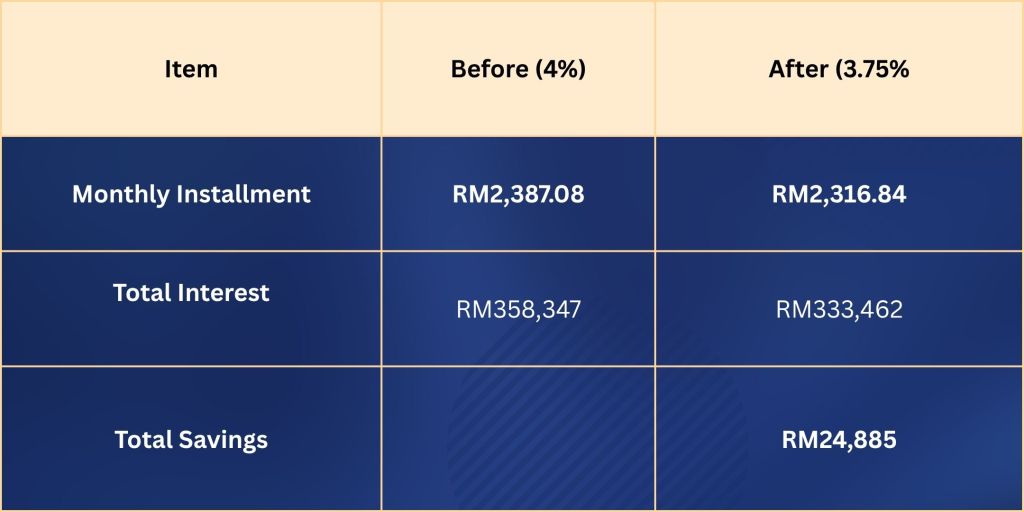
Monthly instalment: RM2,387.08
Total interest over 30 years: RM358,347
🔻 After OPR Cut (3.75%)
Loan amount: RM500,000
Tenure: 30 years
Interest rate: 3.75%
Monthly instalment: RM2,316.84
Total interest over 30 years: RM333,462
💡 You Save:
Monthly: RM70.24
Over 30 Years: RM24,885 in interest!
📌 Summary:
📉 Impact Beyond Housing Loans
The OPR cut doesn’t just affect home loans. It also impacts:
Car Loans – Lower monthly repayments
Personal Loans – Cheaper borrowing
Business Loans – Reduced financing costs
However, fixed-rate loans (such as some hire purchase loans) are generally not affected by OPR changes.
🏦 Why Did BNM Cut the OPR?
BNM’s Monetary Policy Committee cited the need to:
Support domestic economic activity
Manage downside risks from global uncertainties
Encourage spending and investment
With inflation under control and growth momentum slowing, the rate cut is intended to provide a cushion and maintain financial stability.
📊 Conclusion: A Relief for Borrowers
If you’re repaying a floating-rate loan, this OPR cut could offer welcome breathing space in your monthly budget. For potential homebuyers, it’s a good time to recalculate affordability and consider locking in better financing packages.
🔍 Tip: Contact your bank to check how the OPR cut affects your current loan rate. You may also explore refinancing options for better savings.
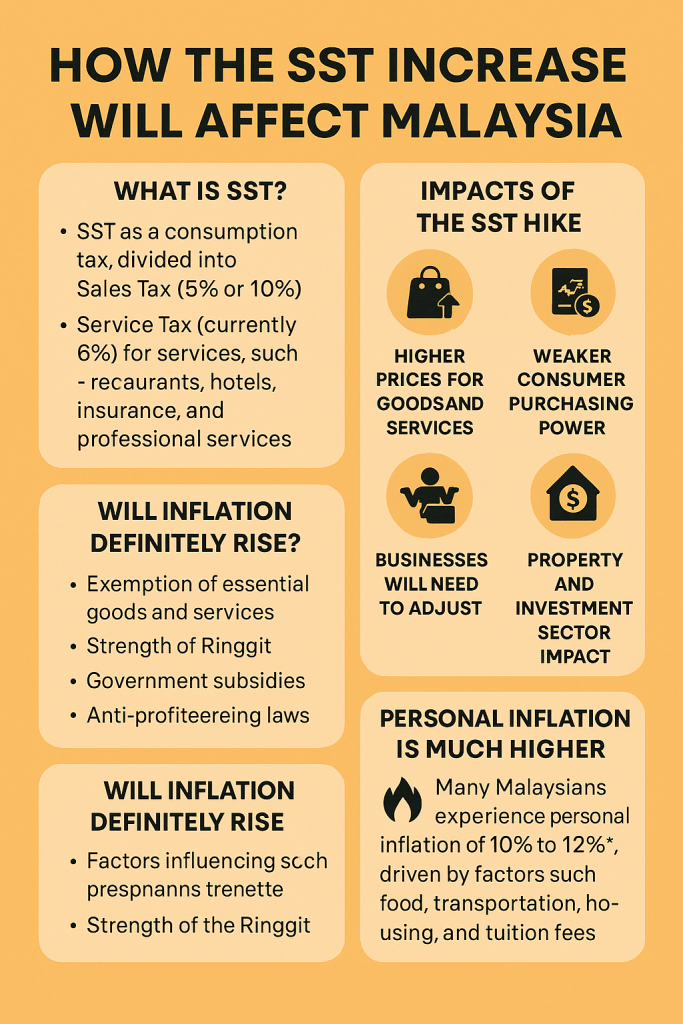
Starting July 1, 2025, the Malaysian government officially raised the Sales and Services Tax (SST) from 6% to 8%, aiming to increase national revenue and reduce fiscal deficits. While basic necessities and certain essential services remain exempt, many sectors — including construction, legal, professional, and property-related services — are now affected. This tax adjustment is expected to have ripple effects across various industries, especially the property market, which is already facing affordability challenges.
This article examines how the SST hike impacts the property industry, giving practical examples and offering insights into how buyers, developers, and investors might respond.
1. Scope of SST Increase in the Property Sector
The SST increase does not apply directly to the sale of residential properties, which are exempt from SST. However, indirect costs will go up due to increased service charges in the construction, legal, and property management sectors. These cost increments will eventually be transferred to end buyers and tenants, especially in commercial and high-rise residential developments.
2. Areas Affected in Property Development
Here’s a breakdown of how the 2% SST increase affects the property ecosystem:
Service Type
Base
Old SST (6%)
New SST (8%)
Architect/Engineer Fees
RM100,000
RM106,000
RM108,000
Legal/Stamping Services
RM20,000
RM21,200
RM21,600
Renovation/Interior Fit-Out
RM150,000
RM159,000
RM162,000
Property Management Services
RM50,000
RM53,000
RM54,000
Advertising & Marketing
RM30,000
RM31,800
RM32,400
Example: A developer constructing a new serviced apartment project incurs around RM5 million in professional and management fees. Under the previous 6% SST, the tax was RM300,000. Now, it’s RM400,000 — a 33% increase in SST cost, which could result in higher launch prices to maintain developer margins.
3. Impact on Property Developers
Higher Development Cost: Most developers will face a 5–8% increase in overall project costs when combined with inflation and compliance costs.
Price Adjustment Pressure: Developers may either absorb the cost (lowering margins) or pass it to consumers — likely raising launch prices, especially in urban areas.
Delay in New Launches: Some developers may delay project launches until market conditions stabilize.
4. Impact on Homebuyers
Although SST is not directly charged on residential property purchases, buyers may feel the pinch in several ways:
Higher Property Prices: Due to rising development and marketing costs.
Increased Renovation Expenses: Renovation and interior design are service-based industries and are now charged 8% SST.
Increased Maintenance Fees: Management services in condos or commercial buildings may increase, translating to higher monthly maintenance charges for owners and tenants.
5. Impact on Real Estate Investors
Investors will also be affected indirectly:
Lower Rental Yield: If property prices go up but rental rates remain stagnant, net returns will shrink.
Higher Operational Costs: Especially for those managing short-term rentals or Airbnb units (cleaning, advertising, renovation services all now taxed at 8%).
Buyer Caution: Investors may delay purchases or switch to lower-risk assets like REITs or landed residential properties outside city centers.
6. Outlook and Strategies
Despite the challenges, the SST increase may drive some positive changes:
Developers may adopt cost-efficiency technologies to maintain affordability.
Buyers may turn to subsale markets, which are less affected by SST-related costs.
Investors may focus on cash-flow-positive properties, especially those with low operating costs.
Conclusion
The SST increase from 6% to 8% might seem modest on paper, but its cascading effect across the property value chain is real. While residential property sales remain tax-exempt, associated services — from construction to maintenance — will become costlier. As developers adjust pricing and investors reassess risk, Malaysia’s property market may experience a short-term slowdown but could stabilize as the market adapts.
Final Thought For both buyers and investors, 2024–2025 will require careful financial planning and a close eye on property pricing trends. Understanding the real costs behind the price tag is more important than ever.
Bank Negara Malaysia (BNM) has recently announced a reduction in the Statutory Reserve Requirement (SRR) ratio from 2% to 1%. This move is part of a broader strategy to ensure sufficient liquidity in the financial system, supporting economic growth amidst current economic challenges. But what exactly does this mean, and how will it impact individuals and businesses? Let’s break it down.
Understanding SRR
The Statutory Reserve Requirement (SRR) is the percentage of a bank’s total deposits that must be kept as reserves with Bank Negara Malaysia. Essentially, it is a tool used by the central bank to control the money supply in the economy. When the SRR is lowered, banks are required to hold less money in reserve, thereby freeing up more funds that can be lent out to businesses and individuals.
Why Did BNM Reduce the SRR?
The reduction in the SRR by 1% is expected to release approximately RM19 billion into the banking system, effective from 17 May 2025. This significant injection of liquidity aims to provide banks with more funds for lending and to stimulate economic activities during this period of economic uncertainty.
The reduction in the SRR from 2% to 1% is aimed at increasing liquidity in the banking system. By allowing banks to keep less money in reserve, more funds become available for lending purposes. This is particularly crucial during periods of economic uncertainty when businesses and individuals may require more financial support. It also helps to reduce the cost of funds for banks, potentially leading to lower interest rates.
How Does This Impact Us?
More Accessible Loans: With more liquidity in the banking system, banks are more likely to offer loans to businesses and individuals. This can facilitate personal loans, home loans, and business financing, making it easier for borrowers to access funds.
Lower Interest Rates: When banks have more funds to lend, competition among banks may increase, potentially leading to a reduction in lending rates. This is beneficial for borrowers seeking to refinance existing loans or take new loans.
Impact on Savings and Fixed Deposits: On the flip side, while borrowers may benefit from lower interest rates, depositors may see a decrease in interest rates on their savings accounts and fixed deposits as banks adjust their rates to manage the increased liquidity.
Business Expansion and Investment: With more funds available for lending, businesses may find it easier to obtain financing for expansion, investments, or operational costs. This can stimulate economic activity and potentially lead to job creation.
Potential Risks and Considerations
While the reduction in SRR can stimulate lending and economic growth, it is essential to consider potential risks. Increased lending could lead to higher household debt if borrowers overextend themselves. Additionally, excessive liquidity could contribute to asset bubbles if funds are channeled into speculative investments.
Conclusion
The reduction in SRR from 2% to 1% by Bank Negara Malaysia is a strategic move to increase liquidity and stimulate economic activity. While this creates more lending opportunities and potentially lower interest rates, it is crucial for borrowers to exercise caution and assess their financial capacity before taking on additional debt. Similarly, depositors should monitor interest rate trends to make informed decisions regarding their savings and investments.
Did you know that 70% of Malaysians exhaust their EPF savings within just five years of retirement?
This is a shocking reality, but it doesn’t have to be yours. Without proper financial and mortgage planning, many people find themselves struggling with rising living costs, increasing debt, and an uncertain future.
Many people believe that simply saving money in a bank or relying on EPF will be enough to sustain them after retirement. However, with inflation, economic uncertainties, and an increasing cost of living, savings alone are not enough. To secure your financial future, you need a smart strategy that builds wealth while you sleep—and that’s where financial and mortgage planning come in.
If you want to retire rich, not broke, it’s time to take control of your financial future!
The Importance of Financial & Mortgage Planning
1️⃣ Your Salary Alone is Not Enough
Many Malaysians rely solely on their salaries as their primary source of income. However, depending only on salary comes with risks: ❌ Job insecurity – What happens if you lose your job or your business slows down? ❌ Limited earning potential – Salary increments may not keep up with rising expenses. ❌ No long-term wealth creation – Once you stop working, your income stops too.
By understanding financial planning and leveraging mortgages, you can turn your income into wealth-building assets like property investments that generate passive income.
✅ Smart financial planning ensures that your money works for you, not the other way around.
2️⃣ The Rising Cost of Living & Inflation
The price of food, petrol, housing, and healthcare has been rising every year. What seems affordable today might be out of reach in the next five or ten years.
📌 Example: 12 years ago, a property in Kuala Lumpur cost RM300,000. Today, the same property is worth RM600,000. If you had bought it back then, you would have gained RM300,000 in capital appreciation.
Now imagine if you had invested in properties over the years—how much wealth would you have built?
This is why financial planning and leveraging mortgages for property investment is crucial. The sooner you start, the better you can protect yourself from inflation and rising costs.
3️⃣ Using Mortgages as a Wealth-Building Tool
Many people see mortgages as a burden. But in reality, a mortgage is one of the most powerful financial tools you can use to build wealth.
Here’s how: ✅ Leverage: With a mortgage, you can own high-value properties with only a fraction of the cost upfront. ✅ Passive Income: By renting out your properties, you create a steady income stream that covers loan repayments and generates profit. ✅ Capital Appreciation: Over time, property values tend to increase, helping you build long-term wealth.
4️⃣ Securing Your Retirement with Smart Investments
Many retirees face financial struggles because they failed to plan early. Without a steady stream of passive income, they depend entirely on their savings, which can deplete quickly.
A well-structured mortgage plan can help you own multiple properties that generate rental income. This means that by the time you retire, you’ll have a steady cash flow to support your lifestyle—without relying on savings alone!
How to Start Planning Your Financial Future Today
🔹 Understand how mortgages work – Learn how to maximize loan approvals and use mortgages to grow your wealth. 🔹 Invest in the right properties – Avoid costly mistakes and find properties that give high returns. 🔹 Create multiple income streams – Secure your future with passive income from real estate investments.
Final Thought: The Best Time to Invest is NOW!
Many people delay financial planning, thinking they have plenty of time. But the truth is, the longer you wait, the harder it becomes to build wealth.
💡 The best time to invest was yesterday. The second-best time is NOW!
🚀 Don’t wait until it’s too late. Take charge of your financial future today!
After two days of insightful discussions, expert sharing, and valuable networking, the Real Estate Summit 2025 (RES2025) has officially concluded! This event brought together some of the most renowned experts in real estate, finance, and investment, providing participants with actionable insights into the property market, financial planning, and smart investment strategies for 2025.
We were honored to welcome participants from Malaysia, the Philippines, Singapore, the USA, Germany, and many other countries. The diversity of attendees enriched discussions and created a vibrant learning environment.
A Heartfelt Thank You to Our Participants & Speakers
First and foremost, we extend our deepest gratitude to all participants for attending RES2025. Your enthusiasm and eagerness to learn made this event truly impactful.
A special appreciation to our distinguished speakers, whose expertise and insights played a crucial role in the success of RES2025:
🔹 Dato’ Sri Gavin Tee – A real estate expert who shared his forecast on the 2025 property market and upcoming investment opportunities. 🔹 Richard Oon – A taxation and financial planning specialist who guided participants on tax-saving strategies and financial management for property investors. 🔹 Dr. Daniele Gambero – A respected market analyst who discussed real estate trends, mortgage challenges, and investment potential in 2025. 🔹 Dr. Elane Goh – A finance and investment strategist who shared her insights on wealth creation through property investments and financial planning. 🔹 WK Ng – A seasoned property investor who transitioned from the corporate world to full-time investing, providing real-life success strategies. 🔹 KW Wong – A PropTech innovator and Secretary-General of the Malaysia PropTech Association, who spoke about the digital transformation of the rental market. 🔹 Charles Tan – A leading property market analyst who offered valuable perspectives on Malaysia’s evolving real estate landscape. 🔹 Miichael Yeoh – A mortgage and financial expert, who emphasized the importance of planning before making any major investment decisions.
Your dedication and willingness to share your knowledge made RES2025 a game-changing event for all attendees.
Special thanks to our co-organiser POLA Malaysia and our media partners Property Hunter and kopiandproperty.
Key Takeaways from RES2025
Throughout the two-day summit, participants gained powerful insights into the property industry, with topics covering:
✔️ Where to Invest in 2025 – Discovering high-potential investment hotspots. ✔️ Real Estate Market Trends – Adapting to economic shifts and evolving regulations. ✔️ Financial Planning & Taxation – Understanding tax incentives, financial structures, and mortgage strategies. ✔️ Mortgage Market 2025 – The latest developments in home financing and lending policies. ✔️ PropTech Innovations – The rise of digital property platforms and the impact on buying, selling, and renting. ✔️ Investment Strategies – How to build a profitable real estate portfolio.
As Miichael Yeoh emphasized in his session: “Plan first before making your next move.” Strategic financial and investment planning is essential to achieving long-term success in real estate.
The Power of Networking & Knowledge Sharing
Beyond expert talks, RES2025 provided an invaluable opportunity for participants to connect with industry leaders, experienced investors, and like-minded individuals. The event fostered an environment where attendees could exchange ideas, gain exclusive insights, and build meaningful professional relationships.
Looking Forward: What’s Next?
The success of RES2025 reaffirms GM Training Academy’s commitment to empowering individuals with property education and financial literacy. We believe that informed decisions lead to successful investments, and we are dedicated to helping investors, homeowners, and professionals navigate the ever-changing real estate market.
🚀 Upcoming Initiatives:
✅ More masterclasses and training workshops ✅ Exclusive webinars featuring top industry experts ✅ Property investment study tours ✅ Advanced financial and mortgage planning courses
Stay Connected & Keep Learning
📢 Missed RES2025? No worries! Stay connected with us for upcoming programs that will continue to provide valuable industry insights and expert guidance.
Once again, THANK YOU to all our participants and speakers for making RES2025 a grand success! We look forward to seeing you at our next event.
As of January 2025, Bank Negara Malaysia (BNM) has maintained the Overnight Policy Rate (OPR) at 3.00%, a position held since May 2023.
Understanding the Overnight Policy Rate (OPR)
The OPR is the benchmark interest rate at which banks lend to one another overnight. Set by BNM, it serves as a primary monetary policy tool to regulate liquidity, control inflation, and sustain economic growth.
Implications of an OPR Increase
When BNM raises the OPR, it signals an intent to tighten monetary policy. The effects of such an increase include:
Higher Borrowing Costs: Banks typically respond to an OPR hike by raising their base rates, leading to increased interest rates on loans and mortgages. This results in higher monthly repayments for borrowers.
Enhanced Savings Returns: Conversely, depositors may benefit from higher interest earnings on savings and fixed deposits, encouraging increased savings.
Controlled Inflation: Elevated borrowing costs can dampen consumer spending and business investments, helping to moderate demand-pull inflation.
Currency Appreciation: Higher interest rates can attract foreign investment, potentially strengthening the Malaysian ringgit.
Impact on Property Market: Increased interest rates may lead to higher mortgage costs, potentially cooling property demand and affecting market dynamics.
Recent Economic Context
In the third quarter of 2024, Malaysia’s economic growth slowed to 5.3% from 5.9% in the previous quarter, influenced by reduced oil and gas production. Despite this, robust household spending and increased investments provided support.
BNM’s Monetary Policy Stance
BNM has maintained the OPR at 3.00% since May 2023, citing positive economic growth and steady inflation. Economists anticipate that the central bank will keep the OPR unchanged until at least 2026, aligning with current economic assessments.
Interest Rate Impact Example
Let’s look at an example of how interest rates affect property loans. Assume you’re borrowing RM500,000 for 30 years:
Current Interest Rate (4.5%): Monthly repayment is approximately RM2,533.43.
If OPR Increases by 25 Basis Points (4.75%): Monthly repayment rises to around RM2,608.82.
Impact: This increase of RM75.39 per month adds up to RM27,140.40 over the loan’s term.
This illustrates why understanding interest rates and their potential changes is crucial for planning your finances.
Conclusion
An increase in Malaysia’s OPR has multifaceted effects, influencing borrowing costs, savings returns, inflation, currency value, and the property market. Understanding these dynamics is crucial for individuals and businesses to make informed financial decisions in response to monetary policy changes.
Purchasing or investing in property is one of the most significant financial decisions a person can make. While the prospect of owning a piece of real estate can be exciting, it’s also fraught with risks and complexities. Here are eight compelling reasons why educating yourself before taking the plunge is crucial:
1. Understanding the Market
The property market is dynamic, influenced by factors such as economic conditions, interest rates, and government policies. Without proper knowledge, you might buy at the wrong time or in the wrong location, potentially leading to financial losses. Education helps you grasp market cycles and trends, enabling informed decisions.
2. Avoiding Costly Mistakes
From overpaying for a property to falling victim to scams, the risks of making costly mistakes are high for uninformed buyers. Learning about property valuation, legal processes, and common pitfalls can save you from financial heartache.
3. Maximizing Investment Returns
Investing in property isn’t just about buying a house or apartment; it’s about choosing assets that will appreciate in value or generate steady rental income. Understanding key metrics such as ROI (Return on Investment) and cash flow can help you identify profitable opportunities.
4. Navigating Legal and Financial Complexities
Property transactions involve a maze of legal and financial considerations. From understanding loan agreements to navigating tax implications and zoning laws, there’s a lot to learn. A lack of knowledge could lead to delays or even legal troubles.
5. Building Confidence
The more you know, the more confident you’ll feel about your decisions. Knowledge reduces fear and uncertainty, empowering you to negotiate effectively, choose wisely, and stick to your long-term goals.
6. Identifying Red Flags
Not all properties are created equal. Structural issues, poor location, and hidden costs can turn a dream investment into a nightmare. Learning to conduct due diligence and property inspections ensures you spot potential problems early.
7. Accessing Better Financing Options
Understanding how mortgages and loans work can save you thousands of dollars over the life of your investment. Learning about different financing options and how to improve your creditworthiness can lead to better interest rates and loan terms.
8. Planning for the Future
Property investment is a long-term commitment. Learning helps you align your investment choices with your financial goals, whether it’s building wealth, securing passive income, or preparing for retirement. Knowledge enables strategic planning that benefits you in the long run.
Conclusion
Investing time and effort into learning before buying or investing in property is an investment in itself. It equips you with the tools and insights needed to make smart, informed decisions that align with your financial aspirations. Remember, in the world of property, knowledge isn’t just power; it’s profit.
Five New Taxes Could Be Introduced in Malaysia’s Budget 2024 on 18th October: Key Highlights and Concerns
As Budget 2024 approaches, there are talks that the government may introduce five new taxes designed to address various social, environmental, and economic issues. If implemented, these taxes could bring significant changes to consumer behavior, corporate practices, and wealth distribution. Here are the five proposed taxes:
1. Unhealthy Food Tax
In a bid to tackle Malaysia’s rising obesity and health-related problems, the government plans to impose a tax on foods high in fat, sugar, and calories. This includes fast food, snacks, and baked goods—products often linked to unhealthy lifestyles.
According to the 2023 National Health and Morbidity Survey, 54.4% of Malaysians are considered overweight, raising alarms about the long-term burden on the healthcare system. The goal of this tax is to discourage the consumption of unhealthy foods and encourage better dietary choices. Funds collected could potentially be channeled into public health campaigns and nutritional education programs.
2. Carbon Pricing Tax
To align with Malaysia’s long-term environmental goals, including achieving net-zero carbon emissions by 2050, the government may introduce a carbon pricing tax. This tax would target industries and businesses that emit large quantities of greenhouse gases, encouraging them to reduce their carbon footprint.
The tax could be implemented through mechanisms like a carbon tax or an Emission Trading System (ETS). By placing a financial cost on carbon emissions, businesses would have incentives to adopt greener technologies and practices. This would help Malaysia transition toward a more sustainable and environmentally friendly economy.
3. Inheritance Tax
A proposed inheritance tax could be aimed at preventing the accumulation of unproductive wealth within a small segment of the population. This tax would target wealth passed down through generations without significantly contributing to the broader economy.
The objective is to promote wealth equality by taxing large inheritances. The revenue could be used to fund public services or social programs aimed at reducing the wealth gap. However, this tax could be controversial, especially among families who view property and assets as a legacy for future generations.
* Updated 14/10/2024
Anthony Loke States Inheritance Tax Won’t Be Included in Budget 2025. “Government policies only become official if they are presented in parliament, and so far, there has been no discussion regarding inheritance tax.”
4. High-Value Goods Tax (HVGT)
The High-Value Goods Tax is designed to target high-income earners by imposing taxes on luxury goods and services. Items such as high-end vehicles, expensive jewelry, designer products, and other luxury items would be subject to this tax.
The goal is to redistribute wealth by generating revenue from luxury consumption and using it to support social programs or economic development. This could also serve to narrow the wealth gap by ensuring that affluent individuals contribute more to public finances.
5. Artificial Intelligence (AI) Tax
In recognition of the growing role of technology and innovation in economic development, the government may introduce an AI tax. This tax would primarily target companies developing and deploying artificial intelligence technologies, aiming to ensure that the tech industry contributes to the country’s growth.
Revenue from the AI tax could support research and development in high-tech industries, positioning Malaysia as a leader in the global AI market. This tax could create a financial framework for innovation, fostering the next generation of technological advancements.
Property Sector Concerns: The Inheritance Tax
While the above taxes aim to address a wide range of issues, the proposed inheritance tax raises specific concerns, particularly in the property market. Many property buyers and investors see real estate as a legacy—something to pass on to their children and future generations. If an inheritance tax is imposed, beneficiaries would be subject to taxation when they inherit property. This could complicate the process of transferring wealth and assets across generations, especially if the property needs to be sold to pay off the tax.
Is It Fair to Property Buyers?
From a property investor’s point of view, this tax could be perceived as unfair. Many people buy real estate not only as an investment but as a way to secure their family’s financial future. They plan to pass down property to their heirs, building a generational legacy. If this tax is implemented, beneficiaries might face an additional financial burden when inheriting property, potentially reducing the long-term value of real estate investments.
Moreover, some might argue that such a tax could discourage property investment altogether, as the future tax implications would make it less appealing to hold on to real estate for the long term.
Will It Affect Future Generations?
Yes, an inheritance tax would undeniably affect future generations. It could reduce the wealth that families can pass down, especially if property values increase significantly. Heirs may have to sell the property to cover the tax liability, which could diminish the intention of leaving behind a lasting legacy. This could be especially difficult for middle-income families who have worked hard to acquire property as a form of security for their descendants.
A Personal Perspective
This is just my point of view, and I understand that others may not agree. In my opinion, an inheritance tax could have unintended consequences, particularly for those in the property market who want to ensure their investments benefit future generations. While wealth equality is important, there needs to be a balance, so the tax does not disproportionately impact those who have saved or invested in property with long-term goals in mind.
What are your thoughts on this? Do you believe such a tax is necessary, or would it be too burdensome on property buyers and their families?
Check out the latest article on how Budget 2025 impacts the property sector
Many people are enthusiastic about making money from property investment. After all, who wouldn’t want a reliable safety net for the future? Property can indeed offer financial security, but this is only true if you plan properly and do your due diligence before buying. While it may sound lucrative, without the correct approach, it can quickly turn into a financial disaster.
I recall an incident that starkly highlights this point. After one of my seminars organized by a property developer, a couple in their 30s approached me. They shared a heartbreaking story: they had declared bankruptcy and had a 6-year-old child to care for. Their downfall began when they followed advice from a so-called property expert and started purchasing properties beyond their financial means. The rental income from these properties was either too low or non-existent, and they couldn’t find tenants. To make matters worse, the so-called expert was nowhere to be found, leaving the couple to face the harsh realities alone.
What lesson can we draw from this? The pursuit of wealth through property investment can sometimes turn into a nightmare, even if you believe such misfortune won’t happen to you.
Let’s rewind a bit. Had this couple engaged in proper financial planning, their situation might have been very different. A crucial aspect of financial planning is understanding your monthly income against your expenses. Personally, I wouldn’t consider purchasing a property unless I had at least 12 months of installment payments saved in advance, especially if I had to take a loan from the bank. There is much more to financial planning, but diving into the details would be lengthy. The key takeaway is this: invest within your capacity. Don’t let greed drive your decisions, as it might be too late to turn back once you’re down that road.
The desire to become a successful property millionaire is understandable, but it’s essential to think carefully before making such a bold step.
I hope this article opens your eyes to the realities of property investment.
If you need expert advice on your property investment journey, please email us at info@miichaelyeoh.com.
Many individuals aspire to become property millionaires. They immerse themselves in books, seminars, and courses, each with their own pace – some favoring quick success, while others opt for a slower, steadier approach. What’s your preference?
But caution is warranted. Sadly, many who aspire to property wealth end up with a different outcome – becoming “property millionhairs” instead. Take Jerry, for example (not his real name). Despite a net income of RM5K, he impulsively purchased five properties at once, enticed by promises of a RM200k cashback per unit. With five units, he envisioned instant wealth. However, blinded by the prospect of millionaire status, he overlooked critical details, such as the absence of the cashback clause in the contract.
To realize his dream, Jerry enlisted his girlfriend’s help to secure mortgage approval, as his income alone wasn’t sufficient. The terms seemed promising – the cashback would be disbursed upon the bank’s final payment release, just a few months away. Jerry was ecstatic, anticipating wealth raining down on him.
When the cashback arrived, Jerry felt like royalty. His eyes gleamed with newfound riches, and he indulged in extravagant purchases – a RM300k car, luxury watches, jewelry, and more. He also spent a substantial sum renovating his properties for potential tenants.
Yet, eight months later, reality set in. Jerry’s million was dwindling rapidly, with vacant units generating no income to offset his hefty RM12k monthly mortgage payments. Facing financial ruin, he discovered his properties were valued 40% below their purchase price, rendering them unsellable without further financial strain.
Do you want to emulate Jerry’s fate? Consider these warnings:
Packages like Jerry’s often involve properties with poor marketability.
Jerry’s scheme of securing multiple loans or called compression method with a single income is fraudulent and can lead to legal consequences.
Jerry may have salvaged some funds, but others haven’t been as fortunate. I’ve encountered individuals on the brink of bankruptcy, struggling to provide for their families, a heartbreaking reality.
Banks are now more vigilant, scrutinizing loan applications meticulously to prevent such misfortunes. Yet, at the heart of it lies human greed, fueled by promises of grandeur.
For me, prudence reigns supreme. I advocate for careful planning, eschewing shortcuts for a methodical approach. If I can’t cover at least 12 months of mortgage payments, I refrain from purchasing, no matter how enticing the property. Financial responsibility dictates my decisions. To everyone out there, heed this advice: stay within your means. When deals seem too good to be true, exercise caution. Protect your financial well-being, for our lives are invaluable.