In every country, additional fees are typically involved when purchasing property as a foreigner. Malaysia is no exception, and these fees vary from state to state. Let’s focus on Penang.
The fees involved depend on whether you’re purchasing secondary property on the island or the mainland. Here’s a breakdown of the fees applicable:
Property Type
Location
Strata (Min)
Landed (Min)
Island
RM 1,000,000
RM 3,000,000
Mainland
RM 500.000
RM 1,000,000
State Consent
State Consent (Individual)
RM 10,000 (Residential)
RM 20,000 (Commercial)
State Consent (Company)
RM 20,000 (Residential)
RM40,000 (Commercial)
State Levy
RM 1 mil to RM1.5 mil
1.5% of purchase price
RM 1.5 mil above
3.0% of purchase price
Please be aware that the figures provided are accurate as of the time of writing and may be subject to change in the future.
Investing in property can be lucrative, but it requires careful planning and consideration. Based on my experience in the industry, I’ve seen many success stories as well as horror tales of financial loss and even bankruptcy. To avoid pitfalls, you must prepare thoroughly. Here are seven critical factors to consider before investing in property:
1. Objective
Define Your Goals: Have a clear investment objective. Determine whether you’re looking for short-term gains or long-term investments.
Rental Strategy: Decide how you plan to rent out the property. Is it for long-term tenants or short-term rentals like Airbnb?
Return on Investment (ROI): Set a target ROI that aligns with your risk tolerance. Remember, higher risk typically comes with higher returns. Personally, I prefer calculated risks with an average return.
2. Financial Planning
Affordability: Assess your financial situation meticulously. Don’t overextend yourself by buying properties beyond your affordability level.
Savings: My rule of thumb is to have at least 12 months of bank installments saved before purchasing a property. This cushion helps avoid financial stress.
Budgeting: Carefully calculate your income and expenses to ensure you can manage the investment without compromising your financial stability.
3. Bank Loan Eligibility
Pre-Approval: Understand how much the bank is willing to lend before committing to a purchase. Getting pre-approved for a loan can prevent future disappointments.
Creditworthiness: Ensure your financial records and credit score are in good shape to qualify for better loan terms. Banks favor prudent borrowers.
4. Demographics
Population Density: Choose locations with a high population density to ensure demand for your property.
Target Audience: Consider who your potential renters or buyers will be. A property in a well-populated area is more likely to attract tenants and buyers.
5. Infrastructure
Accessibility: Ensure the property has good access to roads, public transport, and essential services. Lack of infrastructure can make it difficult to rent or sell the property later.
Local Development Plans: Check with the local council for any planned infrastructure developments that could enhance the property’s value.
6. Pulling Demand
Market Demand: Avoid properties in areas with little to no demand. Research the local market and industries to understand who will be your customers.
Economic Activity: Proximity to thriving industries or business hubs can increase rental and resale value.
7. Future Prospects
Growth Potential: Investigate the area’s future growth prospects. Look for upcoming developments, planned amenities, and general economic outlook.
Long-Term Viability: Ensure the location has the potential for long-term growth, making it easier to rent or sell the property in the future.
Investing in property is not just about buying; it’s about making informed decisions based on thorough research and strategic planning. By considering these seven factors, you can mitigate risks and increase your chances of a successful investment.
Many individuals aspire to become property millionaires. They immerse themselves in books, seminars, and courses, each with their own pace – some favoring quick success, while others opt for a slower, steadier approach. What’s your preference?
But caution is warranted. Sadly, many who aspire to property wealth end up with a different outcome – becoming “property millionhairs” instead. Take Jerry, for example (not his real name). Despite a net income of RM5K, he impulsively purchased five properties at once, enticed by promises of a RM200k cashback per unit. With five units, he envisioned instant wealth. However, blinded by the prospect of millionaire status, he overlooked critical details, such as the absence of the cashback clause in the contract.
To realize his dream, Jerry enlisted his girlfriend’s help to secure mortgage approval, as his income alone wasn’t sufficient. The terms seemed promising – the cashback would be disbursed upon the bank’s final payment release, just a few months away. Jerry was ecstatic, anticipating wealth raining down on him.
When the cashback arrived, Jerry felt like royalty. His eyes gleamed with newfound riches, and he indulged in extravagant purchases – a RM300k car, luxury watches, jewelry, and more. He also spent a substantial sum renovating his properties for potential tenants.
Yet, eight months later, reality set in. Jerry’s million was dwindling rapidly, with vacant units generating no income to offset his hefty RM12k monthly mortgage payments. Facing financial ruin, he discovered his properties were valued 40% below their purchase price, rendering them unsellable without further financial strain.
Do you want to emulate Jerry’s fate? Consider these warnings:
Packages like Jerry’s often involve properties with poor marketability.
Jerry’s scheme of securing multiple loans or called compression method with a single income is fraudulent and can lead to legal consequences.
Jerry may have salvaged some funds, but others haven’t been as fortunate. I’ve encountered individuals on the brink of bankruptcy, struggling to provide for their families, a heartbreaking reality.
Banks are now more vigilant, scrutinizing loan applications meticulously to prevent such misfortunes. Yet, at the heart of it lies human greed, fueled by promises of grandeur.
For me, prudence reigns supreme. I advocate for careful planning, eschewing shortcuts for a methodical approach. If I can’t cover at least 12 months of mortgage payments, I refrain from purchasing, no matter how enticing the property. Financial responsibility dictates my decisions. To everyone out there, heed this advice: stay within your means. When deals seem too good to be true, exercise caution. Protect your financial well-being, for our lives are invaluable.
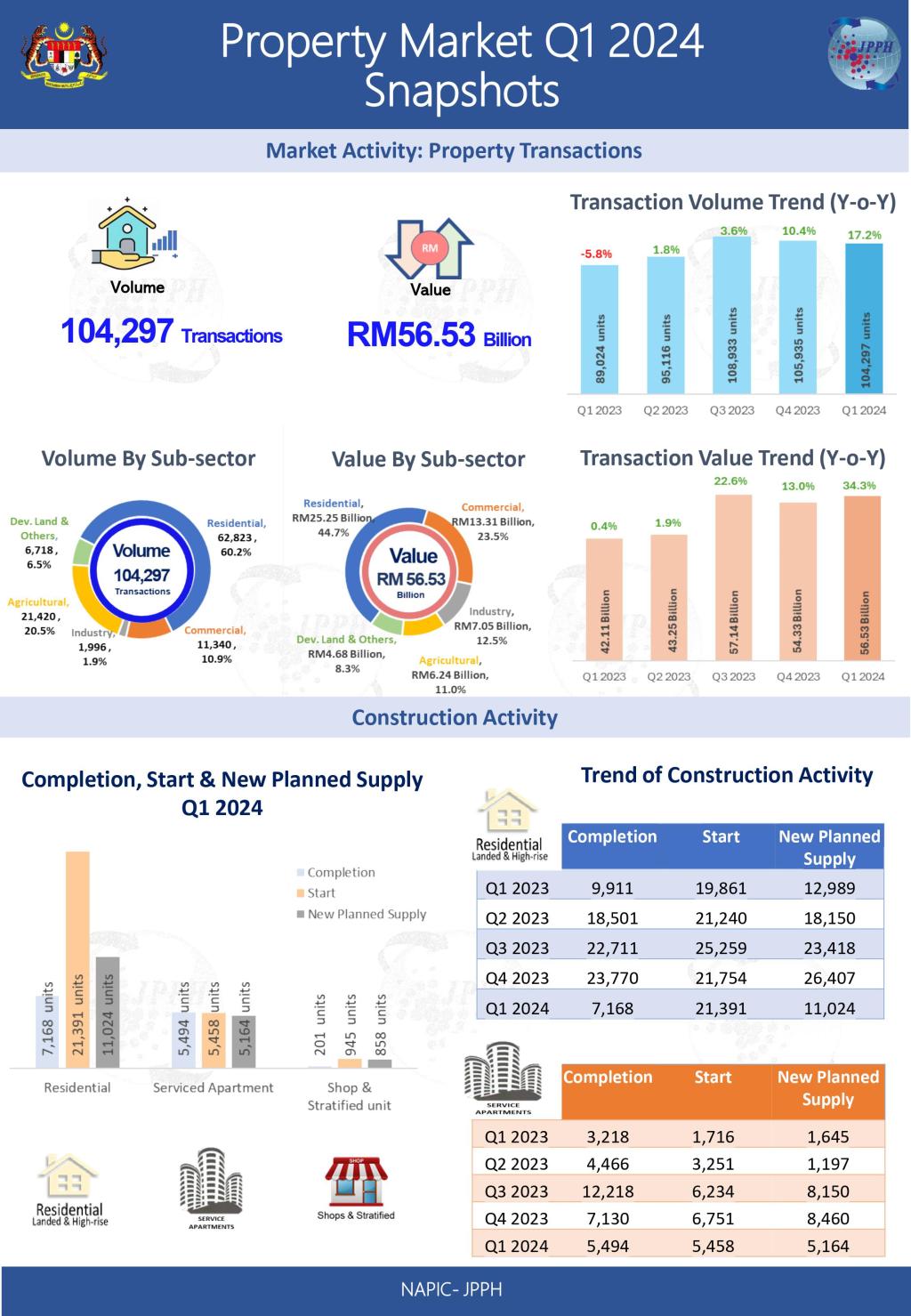
Malaysia’s real estate market continues to thrive, with 104,297 transactions valued at RM56.53 billion recorded in the first quarter of 2024 (1Q24). This marks a 34.3% increase from the same period in 2023, which saw 89,024 transactions worth RM42.11 billion.
“The government aims to ensure that economic planning, which integrates catalytic projects with inclusive development, will sustain long-term growth in the real estate market,” Amir Hamzah remarked in a statement today.
Valuation and Property Services Department director-general Abdul Razak Yusak attributed the strong performance to significant increases in transactions across all subsectors, particularly commercial real estate (up 51.5%) and agricultural land (up 64.2%).
“Government initiatives, such as extending the stamp duty exemption for first home purchases up to RM500,000 until December 2025, have been pivotal in boosting the real estate market,” he added.
In terms of subsector growth, commercial real estate led with a 33.4% increase, followed by residential at 16.6%, agricultural at 13.7%, and development land at 10.7%.
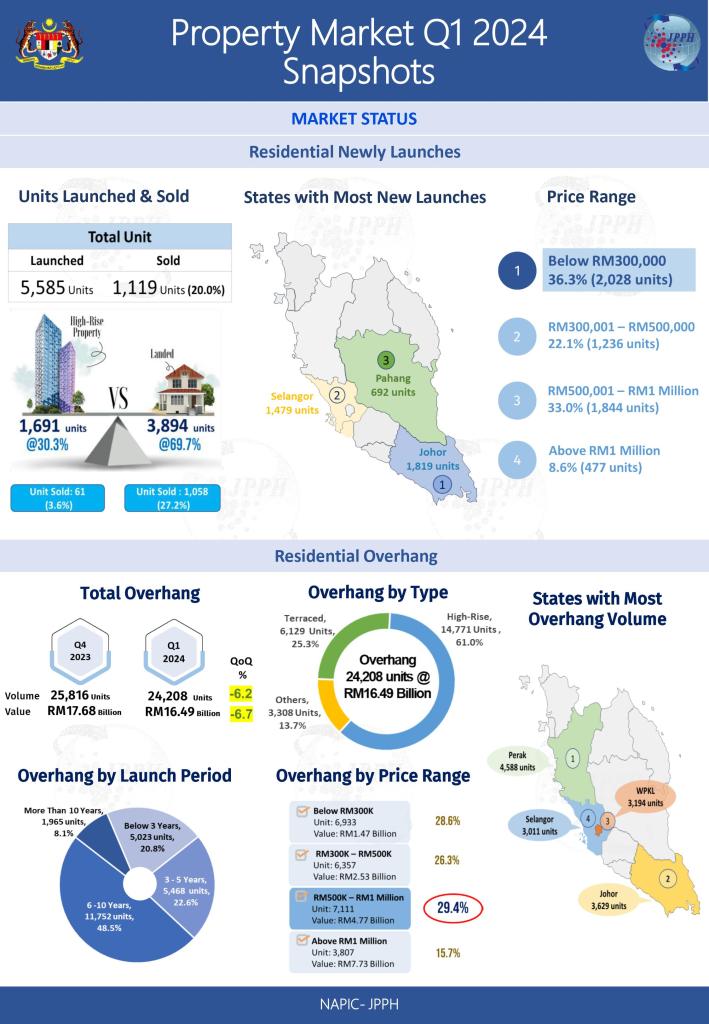
Additionally, the number of unsold completed residential properties (overhang) decreased to 24,208 units valued at RM16.49 billion, compared to 25,816 units valued at RM17.68 billion in the fourth quarter of 2023 (4Q23).
“Preliminary data for the Malaysian House Price Index (MHPI) in 1Q24 showed a slight increase to 216.9 points (RM467,997 per unit), reflecting an annual growth rate of 0.5%. Most states experienced moderate growth between 0.5% and 4.6%, except for Kuala Lumpur, Penang, Perak, Melaka, and Sarawak,” Abdul Razak noted.
For many Malaysians, their savings for retirement primarily reside in the Employees Provident Fund (EPF). Each month, employees see 11% of their salary deposited into their EPF savings, while employers add another 13%. Traditionally, 70% of these funds are allocated to Account 1, with the remaining 30% placed in Account 2. Account 1 is inaccessible until retirement, while Account 2 permits withdrawals for medical expenses, education, or home purchases.
Starting May 11, 2024, individuals under 55 will encounter changes. A third account, dubbed Akaun Fleksibel (Flexible), will be introduced. Account 1 is renamed Akaun Persaraan (Retirement), and Account 2 becomes Akaun Sejahtera (Wellbeing). This restructuring aims to enhance financial planning for retirement and address long-term challenges while providing for immediate financial needs through Akaun Fleksibel.
With the activation of Akaun Fleksibel, 75% of contributions must be retained in Akaun Persaraan, while Akaun Sejahtera receives 15%, leaving 10% for Akaun Fleksibel. Contributors may transfer funds from Akaun Sejahtera to Akaun Fleksibel between May 12 and August 31, based on specific criteria.
For balances exceeding RM3,000 in Akaun Sejahtera, a formula based on fractions is used for transfers. For instance, a portion of Akaun Sejahtera can be moved to Akaun Fleksibel, with the remainder redistributed between Akaun Persaraan and Akaun Sejahtera.
For balances below RM3,000 in Akaun Sejahtera, contributors can transfer up to RM1,000 to Akaun Fleksibel, with the remainder retained in Akaun Sejahtera. Those with less than RM1,000 may transfer their entire balance to Akaun Fleksibel.
Transfers and withdrawals can be processed via the KWSP i-Akaun app or EPF branches, with disbursements directly to the contributor’s bank account.
This move offers flexibility but also raises concerns about potential misuse. While it enables access to funds for emergencies, there’s a risk of frivolous spending. EPF advises contributors to exercise prudence and responsibility. Ultimately, whether this move is beneficial or detrimental depends on how effectively individuals manage their finances and utilize the newfound flexibility.
What do you think of this move? Is it for the better or for worse?
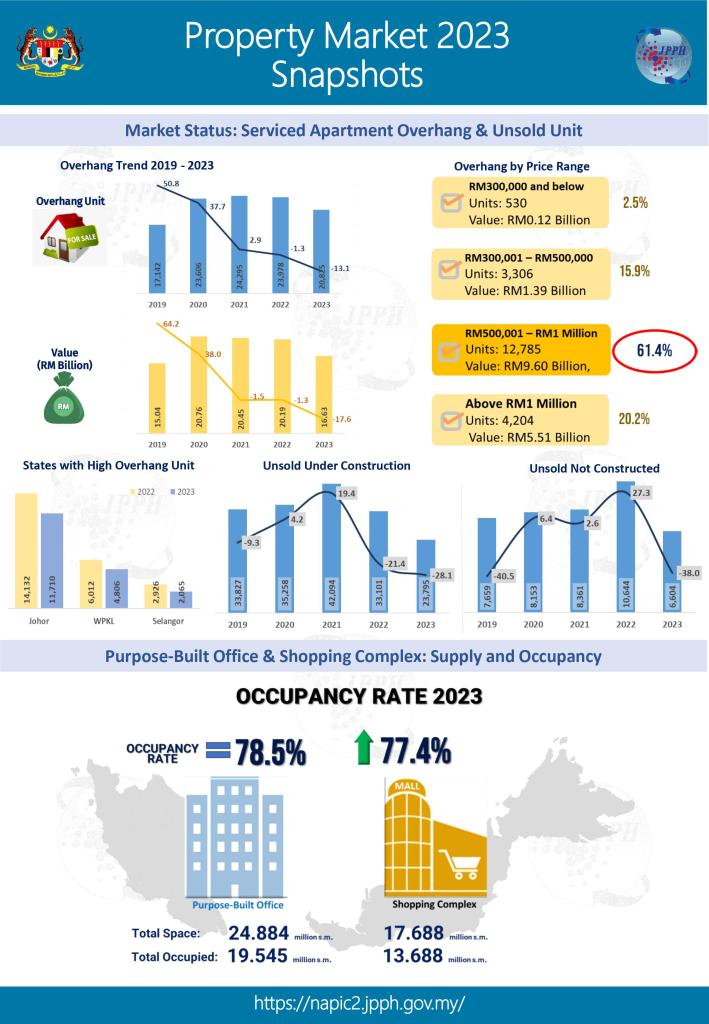
In 2023, Malaysia’s property market surged, boasting more than 399,000 transactions totaling nearly RM200 billion, marking a notable 2.5% uptick in transactions and a substantial 9.9% increase in overall value compared to the previous year.
Good news, there is a promising decline in unsold residential properties, dropping to 26,000 units valued at RM17.7 billion from 28,000 units worth RM18.41 billion in 2022.
Further buoying this optimism, the Valuation and Property Management Department (JPPH) reported a palpable uptrend in property transactions across various subsectors. Residential transactions saw a notable 7.1% increase, while commercial, industrial, agricultural, and development land and other subsectors experienced growth rates of 17.5%, 13.1%, 4.6%, and 13.8%, respectively, compared to 2022.
Moreover, JPPH noted a significant uptick in new residential launches, up by 4.4% to 56,526 units in 2023 compared to 54,118 units in 2022. Impressively, these launches exhibited improved sales performance, with a surge to 40.4% from 36% in the previous year.
Meanwhile, the Malaysia House Price Index (MHPI) registered at 216.5 points (equating to RM467,144 per unit) in 2023, indicating moderate annual growth of 3.2%. This stable growth trajectory underscores the resilience and attractiveness of Malaysia’s property market amidst evolving economic dynamics.
Here are the Property Market 2023 snapshot by JPPH
In the picture, what do you think I am doing? Praying for the money to drop
I do not really depend on these. I don’t think money will suddenly drop from the sky or hoping for a miracle to happen. If a car were to break down, you will need a mechanic to fix the problem. He will have to follow a series of steps in doing repair and to make sure your car is running again.
Likewise, in mortgage approval you cannot wait for miracle things to happen. To me, luck have nothing to do on mortgage approval. Many borrowers and agents, prefer to photocopy many stacks of financial documents and give to every bank they know off or can find and submit to them for approval. Is this the right way?
Do you know that every time your documents are submitted, the banks will record and send to Bank Negara which in turn will update the Central Credit Information System (CCRIS) every month? No matter whether your loan is approved or rejected it will be updated on the last page of your record. Let’s say Bank A rejects your loan, Bank B,C and D also rejects but Bank E actually can approve your loan but seeing so many banks rejected your loan the chances are they will also reject your loan.
Never expose yourself. Every bank have different approval criteria. Some banks might not like you but some does. I have a case once, his Debt Service Ratio is very high at 150% in which is higher than the normal 70-85%. Either the banks rejects or do not want to waste time processing his case. I reviewed his documents and to cut things short, I managed to get 70% loan approval. This case is a fine example where the borrower will have to do the following:
Do a Know yourself (KYS) test.
Check your credit status
Check which bank is suitable for you.
You will have to do more work on the last step. You will need to find out each bank approval criteria and also the different types of documents for approval. You are not buying a RM1,000 property but hundreds or even millions worth of property. It is good to do a research first. It is hard to go back when your loan had been rejected. It is easier to diagnose a problem first.
Bank Negara Malaysia (BNM) has announced today (9th May 2024) that the Overnight Policy Rate (OPR) will remain steady at 3%. This rate has remained unchanged since May 2023, marking a year of consistent monetary policy.
The monetary policy meets six times annually to deliberate on the OPR.
Source: BNM
Looking ahead , there is uncertainty surrounding whether the OPR will stay at 3% or increase further. Historically, the highest OPR since April 2015 was 3.50%, and the lowest was 1.75% in July 2020 during the COVID-19 pandemic. Typically, changes in the OPR are made in increments of 25 basis points (0.25%).
As for the likelihood of an OPR increase this year, it appears unlikely that there will be a reduction in the near future. Instead, the OPR will either hold steady or increase depending on several factors:
EPF Withdrawals: Starting May 11, 2024, contributors to the Employees Provident Fund (EPF) can withdraw from Account 3 at any time, potentially leading to RM25 billion (around 1.3% of GDP) in withdrawals. This could result in increased demand-driven inflation.
Civil Service Salary Hike: There may be a raise in civil service salaries by over 13% beginning in December, which could also contribute to inflationary pressures.
Fuel Subsidy Rationalization: Implementation of fuel subsidy rationalization could occur in 2025 or earlier, which may further increase inflation risk.
Given these factors, my prediction is that the OPR is likely to remain unchanged at 3% this year, but it could increase in 2025 due to inflationary pressures. This would allow BNM to maintain stability in the economy while also addressing any potential inflation concerns.
Have you ever considered the impact of public transportation on the property market? Your guess is likely similar to mine—it tends to drive property prices up. Some people believe they should wait to purchase property until a project is complete, but that usually means paying higher prices. My advice is to buy when the project is in the planning stage, as prices are generally lower.
The latest development in Penang is the Mutiara Line light rail transit (LRT) project, which is on track despite a few amendments to the original plan. The adjustment to the LRT route is to extend the line from Penang Island to Penang Sentral via an elevated track above the sea, which is good news for residents on the mainland and property investors alike.
According to the latest report from MRT Corp, the route will begin at Penang Sentral on the mainland and head to the first proposed station on Penang Island at Macallum. From Macallum, the route will pass through Komtar, Jalan Gurdwara, Solok Sungai Pinang, Sungai Pinang, Jelutong Timur, and continue to Silicon Island.
Penang LRT Line (Unofficial)
The above is the detailed proposal and locations of LRT stations in Penang. There are a total of 22 stations along the line. Imagine what will happen to property prices going forward along the line and nearby the stations?
GEORGE TOWN, Jan 9 2025
GEORGE TOWN, Jan 9— This year marks the final edition of the iconic Pesta Pulau Pinang at Tapak Pesta Sungai Nibong, as plans are underway to relocate the event to a new venue next year.
The decision to move is driven by the incorporation of part of the festival site into the Mutiara Light Rail Transit (LRT) Line project. The 2025 edition is expected to be the last held at this historic location.
Despite the change in venue, the festival’s significance as a vibrant celebration for Penangites will remain unchanged, symbolizing both the state’s progress and its rich cultural traditions.
Without a doubt, your mortgage represents one of the most significant financial commitments you’ll undertake. Over its lifespan, the interest paid to the bank alone can skyrocket into tens of thousands. Consider this: by adhering to a 30-year home loan term, you may ultimately shell out twice the original loan amount in total.
Did you know that within the first five years of a 30-year loan, you’re likely to reduce only about 7% of the principal? Even by the 20th year, you might still be grappling with less than half. It’s high time to reclaim control over your loan and expedite its repayment to save substantial sums in interest.
Gone are the days of rigid loan structures prevalent from the 1960s to the 1990s. Today, borrowers have access to a plethora of tools and flexible bank policies, enabling them to slash down loan tenures.
The sooner you bid farewell to your home loan, the sooner you’ll inch closer to retirement and debt-free living. While myriad methods exist to accelerate repayment, not all may be a perfect fit for your situation. It’s imperative to conduct thorough research and select the strategies best aligned with your needs.
Here are some actionable ways to expedite home loan repayment:
Making Extra Payments: Witness the magic unfold by utilizing a mortgage calculator to see how even modest additional monthly payments can drastically reduce interest and hasten home loan repayment. Remember, every dollar directed towards the principal shrinks the interest burden and speeds up loan clearance
Refinance: Take advantage of prevailing lower interest rates by refinancing your loan. Use a mortgage calculator to gauge potential interest savings, but don’t forget to factor in associated costs like penalties and legal fees.
Negotiate Interest Rate Adjustments: Keep a keen eye on interest rate fluctuations and consider negotiating with your bank for a reduction. Maintaining current installment amounts despite rate reductions can substantially reduce repayment years
Utilize Flexi Mortgages: Explore flexible mortgage options like the Flexi Mortgage or Money Merge Account, where daily interest calculations and account consolidation accelerate principal reduction, thus shortening loan tenure.
Interest Rate Adjustments: Strategize responses to fluctuating interest rates by either increasing monthly installments to maintain repayment duration or maintaining installments to reduce repayment years.
EPF Withdrawals: Tap into your EPF Account II to swiftly reduce principal and expedite loan repayment. This can even be arranged on a monthly basis for added convenience. In Malaysia it is called EPF or Employee Provident Fund. Its a retirement saving account.
Continuous Monitoring and Adjustment: Regularly monitor your loan progress and financial situation, adjusting strategies as needed to optimize repayment efficiency.
Bi-Weekly Payments: Divide your monthly installment into bi-weekly payments, effectively making 13 monthly payments annually. This simple adjustment can shave off at least four years from a typical 30-year loan term, although availability may vary by region. Please take note that not every country has this package.
By diligently implementing these strategies, you can significantly alleviate the burden of your home loan and pave the way towards financial freedom.
After all the searching, surveying and checking, you have finally found your perfect home. Now comes the hardest part. The property is not yours to call home yet. Unless you buy it in cash, like most homebuyers, you would need to rely on a bank loan to turn your dream into reality.
Applying for a home loan can be quite nerve-wracking especially for first-time home buyer. What’s more, it can be very frustrating if the application is unsuccessful. If your loan is rejected, it’s not the end of the world, but it is human nature to put the blame on someone else. In a way, pointing the finger may also help you understand why your application was rejected, and what you can do differently in your next attempt. We have made a list of the top 3 contenders for the blame game:
Plenty of people blame Bank Negara Malaysia (BNM) for the many loan rejections in Malaysia. Are they the culprit, though? Well, BNM is the one making all the loan policies in Malaysia and most people may feel that the ever-tightening policies are making it more difficult to borrow from banks.
However, we need to look at this from another point perspective. If BNM did not have all these policies in place, we will most likely face a subprime mortgage crisis, as what occurred in the USA in 2008. How did this crisis come about? This happens when banks get greedy and start lending to anyone, even to borrowers who have a history of low credit scores and problems with debt. In time, these high-risk borrowers will default on their loan repayment and this will have a ripple effect and evolve into a national issue.
The Solution: Keep tabs on Bank Negara Malaysia’s latest borrowing regulations
With the country’s current slow but fluctuating economic growth, it’s beneficial to keep yourself updated with the latest Bank Negara Malaysia (BNM) borrowing regulations and not depend on word of mouth from friends or relatives.
Prior to that, homeowners were allowed to get their homes refinanced for up to 90% of their value with a maximum repayment tenure of 35 years and were able to use the cashed-out portion for investments. But in the 2014 revision, BNM capped the tenure of personal loans at 10 years.
So why does this matter? Well, take this example: your existing home loan with Bank A is RM400,000 and perhaps because of lower interest rates, you want to refinance your home for RM550,000 at Bank B. The additional RM150,000 would be classified as a personal loan and the 10-year repayment tenure would kick in.
This means that the DSR of the cashed-out portion would be calculated using the 10-year tenure, resulting in a much higher DSR and thereby affecting your overall credit score and potentially leading to your loan application getting rejected.
Besides that, BNM recently shared that many banks were using unfair T&Cs in housing loan contracts. BNM has assured that it will be releasing a set of standard T&Cs soon to keep Financial Service Providers in check – where they must act in good faith by ensuring the fairness of contract terms, provide clear and concise product information as well as offer appropriate advice/recommendation based on the needs and financial circumstances of loan applicants.
As a savvy consumer, you would want to equip yourself with these standards once it is out and study your rights as a financial consumer before approaching a bank for a home loan.
Therefore, we must remember that under BNM, we have a prudent and balanced lending policy. We need it to protect our country. Best to think again before pushing the blame onto BNM.
If we do not blame BNM, can we blame the banks instead? After all, they are the ones who approve or reject the loans. Let’s try this – put yourself in the bank’s shoes. Say you are the lender, and your friend the borrower, wants to borrow RM50,000 from you. You know that your friend earns RM5,000 a month. Each month, most of his money goes into paying off his debts. The big question here is, will you lend the money to him? The risk of not getting your money back is very high. Logically, most people would think twice or not even consider lending their friend that sum of money. A bank thinks the same way – they are not a charity, but a profit-driven organization who are accountable to their shareholders.
Some banks have their own internal policies in lending on top of the existing BNM policies – such as having their own scoring system. As different banks have different lending policies you need to know which bank is the most suitable one for you by conducting your own research and comparison. But do keep in mind that even before they look at your documents, they will first check your credit rating. If your rating is low, it’s not hard to see why your application may be rejected immediately. Do you still think we should be blaming the banks?
But do keep in mind that even before they look at your documents, they will first check your credit rating. If your rating is low, it’s not hard to see why your application may be rejected immediately.
The Solution: Determine the best bank DSR (which will match your DSR)
To reduce the chances of getting your home loan application rejected, you should first calculate your Debt to Service ratio (DSR), which is the calculation of your debt against your monthly income.
DSR = (Total commitment ÷ Nett Income) x 100
One of the most common reasons why banks would reject a home loan application is if the applicant’s DSR is above the bank’s maximum allowable DSR. This can get tricky as every bank will have its own respective guidelines for the maximum allowable DSR that they are willing to accept.
It could be affected by various factors such as income, age, qualifications and even your net worth. The most ideal DSR range would be between 50%-60% as it would hit below the maximum allowable DSR of many banks and thus the likelihood of loan approval would increase.
If your DSR is the reason why your loan application was rejected, don’t worry! You can start improving your DSR by either reducing your current debts or by consolidating your unsecured loans and credit card bills. Check out LoanCare, which calculates and uses your DSR to help you compare home loan products across at least 10 banks in Malaysia.
3. The borrowers
How about if we blame ourselves, the borrowers? Plenty of people are laden with debts from credit cards, personal loans, luxury cars and such. Would it be fair to ask the banks to lend them more money? The risk of non-repayment is very high.
The Solution: Determine your CCRIS report pitfalls
If your home loan is denied, the first thing you want to do is to check your CCRIS report. However, these days it’s rare to find anyone who isn’t aware that they must first check their credit score via The Central Credit Reference Information System (CCRIS). This system reflects your past 12 months of credit activities and shows the bank whether you are a good or bad paymaster.
However, the buck does not stop at having a great credit score. There are other factors which might skew your report. For instance, there is always the question, “If my loan is declined, when can I apply again?”
Did you know that all of your loan rejections are also reflected in your CCRIS? This can prove to be fatal for those that cast a wide net by submitting loan applications to multiple banks. Banks would usually be aware of any prior rejections via their CCRIS record, and thus, applicants would have to wait between 3-6 months before attempting to apply for another loan.
As such, it’s wise to improve your credit score before your next attempt. If you have multiple credit cards and loans attached to your name, making timely payments could help show that you are able to manage your commitments and are a good paymaster.
Besides that, zero obligations are not necessarily a good thing either. Keep in mind that banks would also be reluctant to approve your loan application if your CCRIS report is blank or ‘clean’ – where there are no credit cards/loan/overdraft facilities under your name. Better to have at least one active credit facility with timely payments to prove to the bank that you are able to take on and handle debt obligations responsibly.
The Next Step: Prepare at least 6 months of documentation
After fixing your credit score, the next thing you want to do to prove to the bank that you will be a good paymaster is to prepare at least 6 months’ worth of documentation. Regardless of whether you are a salaried employee or a freelancer, keeping meticulous records of all your financial documents is especially beneficial as the bank requires proof of financial capability.
In order to make your life much easier when it is time to submit your loan application, it’s advisable to keep on hand a record of the latest 6 months’ documentation of the following:
(a) EA Form/Form BE/Form B: Always file and pay your income taxes within the prescribed dateline.
(b) Salary slip/proof of income: Banks will require a continuous monthly record of your proof of income whether it’s salary slips or business banking statements. As such, make sure that your records are well organised with every month accounted for.
(c) EPF statements: This will not be a problem if you are a salaried employee as both you and your employer are required by law to make monthly contributions to your EPF. However, if you are a freelancer, consider making voluntary monthly contributions as a way to boost your credit portfolio.
(d) Bank account statements: Having either a current account or a separate saving account with a steady and consistent balance is another method that can help bolster your image as a responsible and credible borrower.