LHDN has officially released the 2025 Income Tax Relief List, and this is one update every Malaysian taxpayer should pay attention to — especially employees, business owners, and property investors.
Why? Because tax reliefs are legal ways to reduce your tax payable, yet many Malaysians either under-claim or miss them entirely due to poor planning or last-minute filing.
Let’s break down what this means and how you can optimise your tax position before the year ends.
What Is the LHDN Tax Relief List?
The LHDN Tax Relief List outlines approved expenses that taxpayers can deduct from their chargeable income when filing their annual income tax return.
Simply put: 👉 The more legitimate reliefs you claim, the less tax you pay — legally.
This list is updated periodically to reflect:
Rising cost of living
Education and healthcare needs
Retirement and family responsibilities
Digital and lifestyle expenses
Key Tax Reliefs Malaysians Can Claim in 2025
Below are some of the most commonly used — yet often under-claimed — tax reliefs for YA 2025.
1. Individual & Dependent Relief
Individual relief: RM9,000
Spouse (no income): RM4,000
Child relief: up to RM8,000 per child (higher for education level)
👉 Ensure your spouse and children details are properly declared.
2. Lifestyle Expenses (Up to RM2,500)
This remains one of the most popular reliefs, covering:
Books, journals, magazines
Sports equipment
Computer, smartphone, tablet
Internet subscription
⚠ Keep receipts — LHDN may request proof.
3. Medical Expenses (Self, Spouse & Parents)
You can claim medical expenses for:
Serious diseases
Medical check-ups
Dental treatment
Special needs and disabilities
Claims can go up to RM8,000, depending on category.
This is especially relevant for professionals and business owners upgrading their skills.
6. Housing-Related Reliefs (If Applicable)
Depending on eligibility:
Housing loan interest relief (subject to conditions)
First-time homebuyer incentives (if applicable)
⚠ These are often misunderstood — get proper advice before claiming.
Common Mistakes Taxpayers Make
From my experience, many taxpayers:
Rush to file without reviewing reliefs
Lose receipts and documentation
Assume certain expenses are “not claimable”
Follow advice from unverified online sources
Claim incorrectly and risk penalties later
Remember: ❌ Under-claiming = paying more tax than necessary ❌ Wrong claiming = penalties and audit risk
What You Should Do Before Year End
Here’s a simple checklist:
✔ Review the 2025 relief list early ✔ Plan major expenses before 31 December ✔ Organise receipts digitally ✔ Review EPF, insurance, and PRS contributions ✔ Seek advice if you have rental or business income
Tax planning is not done in April — it’s done before December ends.
Final Thoughts from Miichael
Tax reliefs are not loopholes — they are government-approved incentives meant to ease financial burden.
Those who benefit most are not the highest earners — but those who plan early and claim correctly.
If you’re unsure what you can claim, especially as a property investor, freelancer, or business owner, get clarity before filing.
Malaysian bank lending (especially for property purchases) is currently shaped by several key monetary, regulatory, and market-demand factors. Rates have been easing somewhat, but approval conditions remain cautious. Below are the latest numbers and trends.
Current Figures & Trends
Overnight Policy Rate (OPR) & Reference Rates
In July 2025, Bank Negara Malaysia (BNM) cut the OPR from 3.00% to 2.75% – the first cut in five years.
Major banks have adjusted their Standardised Base Rate (SBR) to 2.75% per annum following the OPR cut.
Base Rate (BR) has also been adjusted (for many banks) in line with this, though BR tends to be higher than SBR. For example, Alliance Bank’s BR is about 3.57%.
Base Lending Rate / Base Financing Rate (BLR/BFR)
The BLR or BFR (for Islamic financings) for many banks remains in the ~6.35% to ~6.65% range. For example, Maybank’s BLR is 6.40%, Hong Leong Bank’s is ~6.64%, etc. baserate.my+3Maybank2u+3NewPages+3
Effective Housing Loan Rates
While the base/reference rates give a starting point, effective lending rates (what borrowers actually pay) tend to be higher because banks add a margin/spread depending on risk, loan amount, tenure, etc.
Recent reports suggest effective rates for housing loans are in many cases 4.15% to 5.7% p.a. depending on bank, borrower profile, loan value, promotion, etc. Property Genie
Loan Approval & Volume
There was a 25.7% month-on-month increase in approvals of housing-loan applications in July 2025 after a slump in June. Focus Malaysia – Business & Beyond
The approval ratio (i.e. approved vs applied) in July 2025 was about 44.8%, up from ~42.6% in June 2025. Focus Malaysia – Business & Beyond
On a year-on-year basis, total approved loan volume declined by ~5.1% for that month; cumulatively over the first 7 months of 2025, approved property loans were ~RM 161.4 billion, about -1.5% relative to same period in previous year. Focus Malaysia – Business & Beyond
Outlook
With lower OPR and more competitive base/reference rates, there is optimism that loan approvals (both volume and ratio) may improve in the remaining months of 2025. Government’s likely to include incentives in Budget 2026 to support first-time buyers, low-to-middle income groups. Focus Malaysia – Business & Beyond
Steps Borrowers Can Take to Increase Chances of Loan Approval
Given the current environment, borrowers can do several things to strengthen their applications and improve likelihood of approval. Here are practical steps, both before and during application.
Step
What to Do
Why It Helps
1. Check & Clean Up Your Credit History
Obtain your credit report (e.g. through CTOS, CCRIS, Experian) ahead of time. Ensure there are no outstanding defaults, ensure credit card/HP payments are on time.
Banks check creditworthiness; a clean credit history reduces risk and may allow you to access better rates.
2. Assess Debt Service Ratio (DSR) / Total Commitments
Know your monthly obligations: other loans, credit cards, etc. Make sure your net income minus all obligations leaves enough room for loan instalments. Try to reduce existing liabilities if possible.
Banks often reject or charge higher margins if your debts relative to income are too high. Lower commitments improves affordability assessment.
3. Have Stable & Adequate Income
Demonstrate consistent employment or business income; have documentation (pay slips, tax returns, EPF contributions). If self-employed or commission-based, provide past 2-3 years’ income statements, audited if possible.
Stability & predictability of income give banks confidence in your ability to repay.
4. Make Reasonable Down Payment / Equity
The more you put down (lower loan-to-value ratio), the less risk for the bank. If you’re first-time buyer programs exist (often requiring only 10% payment), check eligibility, but be aware these may still have stricter conditions.
Less loan amount relative to property value helps bank exposure and reduces margin required.
5. Choose Appropriate Loan Tenure
Longer tenure reduces monthly instalments but increases total interest paid; very long tenure may raise risk from bank’s perspective (future rate changes, income changes). Balance payroll constraints with ability to service.
A manageable monthly repayment improves approval chances; less risk of default.
6. Prepare All Supporting Documents Properly
Have ready: identity documents, employment letters, income proof, EPF statements, tax returns (if applicable), bank statements, any other asset documentation. Ensure documents are current.
It speeds up processing and reduces grounds for rejection due to missing information.
7. Shop Around & Compare Offers
Different banks have different margins, promotions, and underwriting criteria. Get multiple quotes. Negotiate (sometimes banks reduce spread or offer incentives).
May get better rate, lower fees, more favorable terms.
8. Provide Clear Purpose & Property Details
Have the Sale & Purchase Agreement (SPA), valuation report (if needed), title deed, property details, etc. If property is new or under construction, ensure developer’s track record and required approvals are in order.
Having savings or avoid fully depleting your accounts helps; having reserves gives cushion in case of rate increases or unexpected expenses.
Shows financial discipline and lowers risk from bank’s viewpoint.
10. Understand Bank Fees & Requirements
Be aware of legal fees, valuation fees, stamp duties, insurance (MRTA/MRTT), and any bank-specific requirements (e.g. guarantor, joint-applicant). Make sure to budget for them.
Unexpected costs can derail the process; being well-prepared ensures smoother approval.
Challenges & What Borrowers Should Watch Out For
Even with OPR at 2.75% and SBR adjusted, banks’ margins/spreads can still be high depending on borrower risk. So effective rates may still be less favourable for some.
Approval ratios (~44-47%) show that over half of applications still get declined. That means it’s not just about rates; credit & affordability are being closely scrutinized. Focus Malaysia – Business & Beyond
Rising costs for legal fees, valuation, and sometimes hidden fees can make total cost of financing higher than expected.
Inflation, future rate rises, economic uncertainties mean banks may reserve right to tighten conditions suddenly.
Conclusion
Bank lending is currently becoming somewhat more favourable in Malaysia thanks to the OPR cut and adjusted reference rates. However, borrowers must still present strong, well-prepared loan applications. Cleaning up credit, reducing existing obligations, having stable income and proper documentation, and choosing appropriate loan terms are all crucial.
Let’s Start with This: You’re Not Just Buying a Unit — You’re Buying Into a Community
When you own a condo, apartment, or any kind of strata property, you’re not just buying four walls. You’re also sharing ownership of everything outside your unit — the lifts, the corridors, the lobby, the pool, the roof, the water tank, the whole building.
That’s why every owner needs to pay maintenance fees and contribute to the sinking fund. It’s not a donation. It’s not optional. It’s your duty as a co-owner.
Let’s break it down in plain language…
1. These Are Not “Extra Charges” — They’re Your Legal Responsibility
Under Malaysia’s Strata Management Act 2013 (Act 757):
Section 25(1) (for Joint Management Body or JMB), and
Section 50(1) (for Management Corporation or MC),
…it clearly says: every unit owner must pay maintenance charges and sinking fund contributions.
These are not surprise charges or “admin fees.” They’re meant to cover your share of keeping the building clean, safe, and in working condition. It’s the same as chipping in for house bills when you live with housemates — it’s only fair.
2. “If Others Don’t Pay, Why Should I?”
This is a common complaint — and hey, we get it. Why should you be the good guy when others are skipping out?
But think about this:
If no one pays, who’s going to fix the lift?
Who’s going to pay the cleaners or security guards?
How will the broken tiles or leaking roof ever get fixed?
When people stop paying, the whole building suffers. And soon, even those who were paying start asking: “Why should I continue?” — and that’s when things spiral downhill.
You don’t just live in your unit. You share ownership of the entire building. So if everyone pays their part, everyone enjoys a better home.
3. What Happens If You Don’t Pay?
The law doesn’t just suggest — it enforces. If you don’t pay, the JMB or MC has the right to take action under Section 60(3) of the Strata Management Act.
Here’s what they can legally do:
Send you demand letters
File a claim with the Strata Tribunal or even in court
Charge up to 10% interest per year on overdue amounts
Block your access to facilities (like pool, gym, function room), with proper notice
So it’s not just about being fair to others — not paying could cost you more later, both in fees and reputation. And your outstanding dues? They’ll follow your unit, even if you try to sell.
4. Think of It as an Investment — Not a Burden
No one enjoys paying bills, we know that. But your maintenance charges are not “just another bill.” They’re an investment in your own home.
The money goes into:
Repairs and upkeep
Security and cleanliness
Ensuring your home is safe and comfortable
Keeping your property value high
Ever seen a badly maintained condo? Low resale value, fewer buyers, and complaints all around. Compare that to a well-managed building — units there sell faster and at better prices.
5. You Have the Right to Know Where the Money Goes
Worried that your money is being misused? The good news is: you have rights.
By law, the JMB or MC must:
Hold Annual General Meetings (AGM)
Present audited accounts and budgets
Use the sinking fund for long-term repairs like repainting, roofing, waterproofing, and lift upgrades
As an owner, you can (and should):
Ask for financial reports
Question how funds are being spent
Vote during AGMs
This is your money. And you deserve to know how it’s used.
In Summary: Don’t Just Own a Unit — Own the Responsibility
Paying your maintenance fees and sinking fund isn’t just about following the law. It’s about doing your part.
You’re not a tenant anymore. You’re an owner. You have a stake in the building — and your actions affect everyone else too.
So instead of thinking “Why me?” — let’s think “Why not us?”
Let’s build communities, not just condominiums. Let’s protect our investments, not neglect them. Let’s be the kind of owners who care.
Because a well-maintained building isn’t just a nicer place to live — it’s something you can be proud to call home.
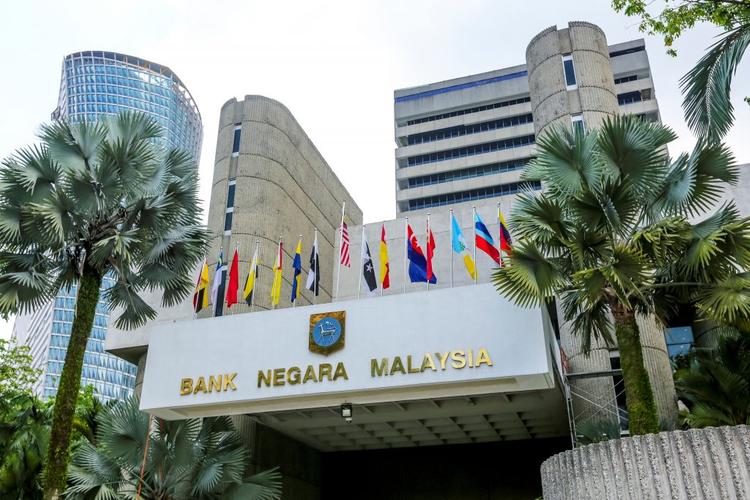
Kuala Lumpur, 10 July 2025 — Bank Negara Malaysia (BNM) has announced a reduction in the Overnight Policy Rate (OPR) by 25 basis points, bringing it down from 3.00% to 2.75%. This move comes amid ongoing efforts to support economic growth and ease financial conditions for households and businesses.
But what does this really mean for everyday Malaysians? And how does it affect your home loan or car loan?
Let’s break it down.
🔎 What Is the OPR?
The OPR is the interest rate at which banks lend money to one another overnight. When BNM adjusts the OPR, it influences Base Lending Rate (BLR) ,Base Rate (BR) and Standardise Base Rate (SBR) used by banks to determine the interest on loans and savings.
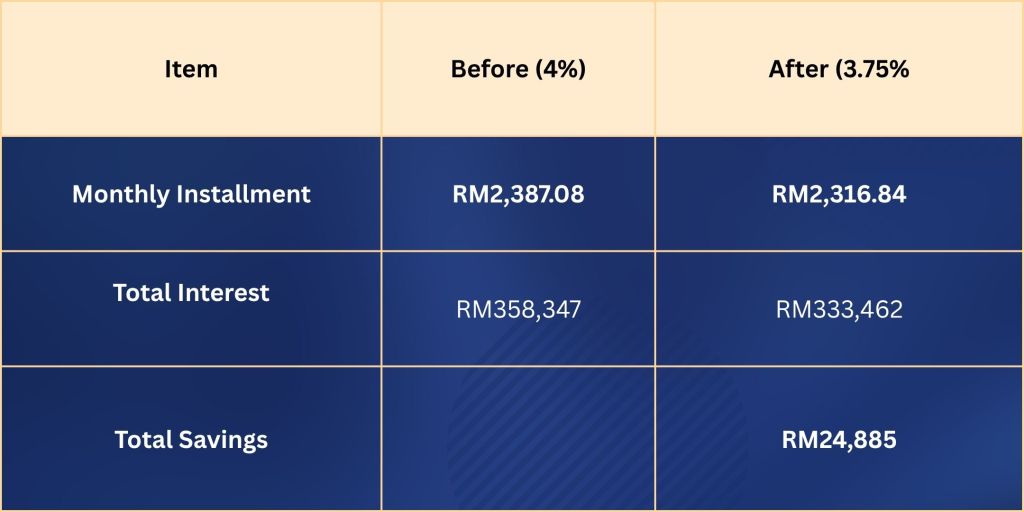
Let’s compare how the OPR cut affects a typical housing loan of RM500,000 over 30 years.
Assume a floating interest rate of:
Before: 4.00% (based on 3.00% OPR)
After: 3.75% (after 2.75% OPR cut)
🔹 Before OPR Cut (4.00%)
Loan amount: RM500,000
Tenure: 30 years
Interest rate: 4.00%
Monthly instalment: RM2,387.08
Total interest over 30 years: RM358,347
🔻 After OPR Cut (3.75%)
Loan amount: RM500,000
Tenure: 30 years
Interest rate: 3.75%
Monthly instalment: RM2,316.84
Total interest over 30 years: RM333,462
💡 You Save:
Monthly: RM70.24
Over 30 Years: RM24,885 in interest!
📌 Summary:
📉 Impact Beyond Housing Loans
The OPR cut doesn’t just affect home loans. It also impacts:
Car Loans – Lower monthly repayments
Personal Loans – Cheaper borrowing
Business Loans – Reduced financing costs
However, fixed-rate loans (such as some hire purchase loans) are generally not affected by OPR changes.
🏦 Why Did BNM Cut the OPR?
BNM’s Monetary Policy Committee cited the need to:
Support domestic economic activity
Manage downside risks from global uncertainties
Encourage spending and investment
With inflation under control and growth momentum slowing, the rate cut is intended to provide a cushion and maintain financial stability.
📊 Conclusion: A Relief for Borrowers
If you’re repaying a floating-rate loan, this OPR cut could offer welcome breathing space in your monthly budget. For potential homebuyers, it’s a good time to recalculate affordability and consider locking in better financing packages.
🔍 Tip: Contact your bank to check how the OPR cut affects your current loan rate. You may also explore refinancing options for better savings.
Five New Taxes Could Be Introduced in Malaysia’s Budget 2024 on 18th October: Key Highlights and Concerns
As Budget 2024 approaches, there are talks that the government may introduce five new taxes designed to address various social, environmental, and economic issues. If implemented, these taxes could bring significant changes to consumer behavior, corporate practices, and wealth distribution. Here are the five proposed taxes:
1. Unhealthy Food Tax
In a bid to tackle Malaysia’s rising obesity and health-related problems, the government plans to impose a tax on foods high in fat, sugar, and calories. This includes fast food, snacks, and baked goods—products often linked to unhealthy lifestyles.
According to the 2023 National Health and Morbidity Survey, 54.4% of Malaysians are considered overweight, raising alarms about the long-term burden on the healthcare system. The goal of this tax is to discourage the consumption of unhealthy foods and encourage better dietary choices. Funds collected could potentially be channeled into public health campaigns and nutritional education programs.
2. Carbon Pricing Tax
To align with Malaysia’s long-term environmental goals, including achieving net-zero carbon emissions by 2050, the government may introduce a carbon pricing tax. This tax would target industries and businesses that emit large quantities of greenhouse gases, encouraging them to reduce their carbon footprint.
The tax could be implemented through mechanisms like a carbon tax or an Emission Trading System (ETS). By placing a financial cost on carbon emissions, businesses would have incentives to adopt greener technologies and practices. This would help Malaysia transition toward a more sustainable and environmentally friendly economy.
3. Inheritance Tax
A proposed inheritance tax could be aimed at preventing the accumulation of unproductive wealth within a small segment of the population. This tax would target wealth passed down through generations without significantly contributing to the broader economy.
The objective is to promote wealth equality by taxing large inheritances. The revenue could be used to fund public services or social programs aimed at reducing the wealth gap. However, this tax could be controversial, especially among families who view property and assets as a legacy for future generations.
* Updated 14/10/2024
Anthony Loke States Inheritance Tax Won’t Be Included in Budget 2025. “Government policies only become official if they are presented in parliament, and so far, there has been no discussion regarding inheritance tax.”
4. High-Value Goods Tax (HVGT)
The High-Value Goods Tax is designed to target high-income earners by imposing taxes on luxury goods and services. Items such as high-end vehicles, expensive jewelry, designer products, and other luxury items would be subject to this tax.
The goal is to redistribute wealth by generating revenue from luxury consumption and using it to support social programs or economic development. This could also serve to narrow the wealth gap by ensuring that affluent individuals contribute more to public finances.
5. Artificial Intelligence (AI) Tax
In recognition of the growing role of technology and innovation in economic development, the government may introduce an AI tax. This tax would primarily target companies developing and deploying artificial intelligence technologies, aiming to ensure that the tech industry contributes to the country’s growth.
Revenue from the AI tax could support research and development in high-tech industries, positioning Malaysia as a leader in the global AI market. This tax could create a financial framework for innovation, fostering the next generation of technological advancements.
Property Sector Concerns: The Inheritance Tax
While the above taxes aim to address a wide range of issues, the proposed inheritance tax raises specific concerns, particularly in the property market. Many property buyers and investors see real estate as a legacy—something to pass on to their children and future generations. If an inheritance tax is imposed, beneficiaries would be subject to taxation when they inherit property. This could complicate the process of transferring wealth and assets across generations, especially if the property needs to be sold to pay off the tax.
Is It Fair to Property Buyers?
From a property investor’s point of view, this tax could be perceived as unfair. Many people buy real estate not only as an investment but as a way to secure their family’s financial future. They plan to pass down property to their heirs, building a generational legacy. If this tax is implemented, beneficiaries might face an additional financial burden when inheriting property, potentially reducing the long-term value of real estate investments.
Moreover, some might argue that such a tax could discourage property investment altogether, as the future tax implications would make it less appealing to hold on to real estate for the long term.
Will It Affect Future Generations?
Yes, an inheritance tax would undeniably affect future generations. It could reduce the wealth that families can pass down, especially if property values increase significantly. Heirs may have to sell the property to cover the tax liability, which could diminish the intention of leaving behind a lasting legacy. This could be especially difficult for middle-income families who have worked hard to acquire property as a form of security for their descendants.
A Personal Perspective
This is just my point of view, and I understand that others may not agree. In my opinion, an inheritance tax could have unintended consequences, particularly for those in the property market who want to ensure their investments benefit future generations. While wealth equality is important, there needs to be a balance, so the tax does not disproportionately impact those who have saved or invested in property with long-term goals in mind.
What are your thoughts on this? Do you believe such a tax is necessary, or would it be too burdensome on property buyers and their families?
Check out the latest article on how Budget 2025 impacts the property sector
After all the searching, surveying and checking, you have finally found your perfect home. Now comes the hardest part. The property is not yours to call home yet. Unless you buy it in cash, like most homebuyers, you would need to rely on a bank loan to turn your dream into reality.
Applying for a home loan can be quite nerve-wracking especially for first-time home buyer. What’s more, it can be very frustrating if the application is unsuccessful. If your loan is rejected, it’s not the end of the world, but it is human nature to put the blame on someone else. In a way, pointing the finger may also help you understand why your application was rejected, and what you can do differently in your next attempt. We have made a list of the top 3 contenders for the blame game:
Plenty of people blame Bank Negara Malaysia (BNM) for the many loan rejections in Malaysia. Are they the culprit, though? Well, BNM is the one making all the loan policies in Malaysia and most people may feel that the ever-tightening policies are making it more difficult to borrow from banks.
However, we need to look at this from another point perspective. If BNM did not have all these policies in place, we will most likely face a subprime mortgage crisis, as what occurred in the USA in 2008. How did this crisis come about? This happens when banks get greedy and start lending to anyone, even to borrowers who have a history of low credit scores and problems with debt. In time, these high-risk borrowers will default on their loan repayment and this will have a ripple effect and evolve into a national issue.
The Solution: Keep tabs on Bank Negara Malaysia’s latest borrowing regulations
With the country’s current slow but fluctuating economic growth, it’s beneficial to keep yourself updated with the latest Bank Negara Malaysia (BNM) borrowing regulations and not depend on word of mouth from friends or relatives.
Prior to that, homeowners were allowed to get their homes refinanced for up to 90% of their value with a maximum repayment tenure of 35 years and were able to use the cashed-out portion for investments. But in the 2014 revision, BNM capped the tenure of personal loans at 10 years.
So why does this matter? Well, take this example: your existing home loan with Bank A is RM400,000 and perhaps because of lower interest rates, you want to refinance your home for RM550,000 at Bank B. The additional RM150,000 would be classified as a personal loan and the 10-year repayment tenure would kick in.
This means that the DSR of the cashed-out portion would be calculated using the 10-year tenure, resulting in a much higher DSR and thereby affecting your overall credit score and potentially leading to your loan application getting rejected.
Besides that, BNM recently shared that many banks were using unfair T&Cs in housing loan contracts. BNM has assured that it will be releasing a set of standard T&Cs soon to keep Financial Service Providers in check – where they must act in good faith by ensuring the fairness of contract terms, provide clear and concise product information as well as offer appropriate advice/recommendation based on the needs and financial circumstances of loan applicants.
As a savvy consumer, you would want to equip yourself with these standards once it is out and study your rights as a financial consumer before approaching a bank for a home loan.
Therefore, we must remember that under BNM, we have a prudent and balanced lending policy. We need it to protect our country. Best to think again before pushing the blame onto BNM.
If we do not blame BNM, can we blame the banks instead? After all, they are the ones who approve or reject the loans. Let’s try this – put yourself in the bank’s shoes. Say you are the lender, and your friend the borrower, wants to borrow RM50,000 from you. You know that your friend earns RM5,000 a month. Each month, most of his money goes into paying off his debts. The big question here is, will you lend the money to him? The risk of not getting your money back is very high. Logically, most people would think twice or not even consider lending their friend that sum of money. A bank thinks the same way – they are not a charity, but a profit-driven organization who are accountable to their shareholders.
Some banks have their own internal policies in lending on top of the existing BNM policies – such as having their own scoring system. As different banks have different lending policies you need to know which bank is the most suitable one for you by conducting your own research and comparison. But do keep in mind that even before they look at your documents, they will first check your credit rating. If your rating is low, it’s not hard to see why your application may be rejected immediately. Do you still think we should be blaming the banks?
But do keep in mind that even before they look at your documents, they will first check your credit rating. If your rating is low, it’s not hard to see why your application may be rejected immediately.
The Solution: Determine the best bank DSR (which will match your DSR)
To reduce the chances of getting your home loan application rejected, you should first calculate your Debt to Service ratio (DSR), which is the calculation of your debt against your monthly income.
DSR = (Total commitment ÷ Nett Income) x 100
One of the most common reasons why banks would reject a home loan application is if the applicant’s DSR is above the bank’s maximum allowable DSR. This can get tricky as every bank will have its own respective guidelines for the maximum allowable DSR that they are willing to accept.
It could be affected by various factors such as income, age, qualifications and even your net worth. The most ideal DSR range would be between 50%-60% as it would hit below the maximum allowable DSR of many banks and thus the likelihood of loan approval would increase.
If your DSR is the reason why your loan application was rejected, don’t worry! You can start improving your DSR by either reducing your current debts or by consolidating your unsecured loans and credit card bills. Check out LoanCare, which calculates and uses your DSR to help you compare home loan products across at least 10 banks in Malaysia.
3. The borrowers
How about if we blame ourselves, the borrowers? Plenty of people are laden with debts from credit cards, personal loans, luxury cars and such. Would it be fair to ask the banks to lend them more money? The risk of non-repayment is very high.
The Solution: Determine your CCRIS report pitfalls
If your home loan is denied, the first thing you want to do is to check your CCRIS report. However, these days it’s rare to find anyone who isn’t aware that they must first check their credit score via The Central Credit Reference Information System (CCRIS). This system reflects your past 12 months of credit activities and shows the bank whether you are a good or bad paymaster.
However, the buck does not stop at having a great credit score. There are other factors which might skew your report. For instance, there is always the question, “If my loan is declined, when can I apply again?”
Did you know that all of your loan rejections are also reflected in your CCRIS? This can prove to be fatal for those that cast a wide net by submitting loan applications to multiple banks. Banks would usually be aware of any prior rejections via their CCRIS record, and thus, applicants would have to wait between 3-6 months before attempting to apply for another loan.
As such, it’s wise to improve your credit score before your next attempt. If you have multiple credit cards and loans attached to your name, making timely payments could help show that you are able to manage your commitments and are a good paymaster.
Besides that, zero obligations are not necessarily a good thing either. Keep in mind that banks would also be reluctant to approve your loan application if your CCRIS report is blank or ‘clean’ – where there are no credit cards/loan/overdraft facilities under your name. Better to have at least one active credit facility with timely payments to prove to the bank that you are able to take on and handle debt obligations responsibly.
The Next Step: Prepare at least 6 months of documentation
After fixing your credit score, the next thing you want to do to prove to the bank that you will be a good paymaster is to prepare at least 6 months’ worth of documentation. Regardless of whether you are a salaried employee or a freelancer, keeping meticulous records of all your financial documents is especially beneficial as the bank requires proof of financial capability.
In order to make your life much easier when it is time to submit your loan application, it’s advisable to keep on hand a record of the latest 6 months’ documentation of the following:
(a) EA Form/Form BE/Form B: Always file and pay your income taxes within the prescribed dateline.
(b) Salary slip/proof of income: Banks will require a continuous monthly record of your proof of income whether it’s salary slips or business banking statements. As such, make sure that your records are well organised with every month accounted for.
(c) EPF statements: This will not be a problem if you are a salaried employee as both you and your employer are required by law to make monthly contributions to your EPF. However, if you are a freelancer, consider making voluntary monthly contributions as a way to boost your credit portfolio.
(d) Bank account statements: Having either a current account or a separate saving account with a steady and consistent balance is another method that can help bolster your image as a responsible and credible borrower.
Financial planning is the cornerstone of a secure and prosperous future. It involves setting realistic goals, creating a roadmap to achieve them, and making informed decisions about your money. Whether you’re just starting your career or nearing retirement, having a solid financial plan in place is essential for building wealth, managing risks, and achieving financial independence. In this article, we’ll explore the key components of financial planning and provide actionable tips to help you navigate your financial journey with confidence.
1. Assess Your Current Financial Situation: The first step in financial planning is to assess your current financial situation. Take stock of your income, expenses, assets, and liabilities. Create a detailed budget to track your spending habits and identify areas where you can save money. Calculate your net worth by subtracting your liabilities from your assets. This snapshot of your finances will help you understand where you stand and identify areas for improvement.
2.Set SMART Financial Goals: Once you have a clear understanding of your financial situation, it’s time to set SMART (Specific, Measurable, Achievable, Relevant, Time-bound) financial goals. Whether it’s buying a home, saving for your children’s education, or planning for retirement, clearly define your goals and prioritize them based on their importance and urgency. Break down each goal into smaller, manageable milestones to track your progress along the way.
3.Create a Budget and Stick to It: A budget is a powerful tool that helps you allocate your income towards your financial goals while ensuring that you live within your means. Start by listing your fixed expenses such as rent/mortgage, utilities, and loan payments, then allocate a portion of your income towards savings and investments. Be mindful of discretionary spending and look for opportunities to cut unnecessary expenses. Regularly review and adjust your budget as your financial situation changes.
4. Build an Emergency Fund: Life is unpredictable, and unexpected expenses can derail your financial plans if you’re not prepared. That’s why it’s crucial to build an emergency fund to cover unforeseen expenses such as medical emergencies, car repairs, or job loss. Aim to save at least three to six months’ worth of living expenses in a liquid, accessible account like a savings account or money market fund. Having an emergency fund provides peace of mind and financial security during challenging times.
5. Manage Debt Wisely: Debt can be a significant obstacle to achieving your financial goals if not managed wisely. Prioritize paying off high-interest debt such as credit cards and personal loans to minimize interest payments and improve your financial health. Consider consolidating debt or negotiating lower interest rates to accelerate your debt repayment journey. Avoid taking on new debt unless absolutely necessary and use credit responsibly to build a positive credit history.
6. Invest for the Future: Investing is a powerful wealth-building tool that allows your money to grow over time through the power of compounding. Determine your risk tolerance and investment objectives, then develop a diversified investment portfolio tailored to your goals and timeline. Consider investing in a mix of stocks, bonds, mutual funds, and other asset classes to spread risk and maximize returns. Regularly review and rebalance your portfolio to ensure it remains aligned with your objectives.
7. Plan for Retirement: Retirement may seem far off, but it’s never too early to start planning for your golden years. Take advantage of employer-sponsored retirement plans such as 401(k)s or IRAs to save for retirement tax-efficiently. Contribute enough to qualify for employer matching contributions and increase your contributions over time as your income grows. Consider working with a financial advisor to develop a personalized retirement plan and explore options such as annuities or pension plans to supplement your retirement income.
8. Protect Yourself and Your Loved Ones: Insurance is an essential component of financial planning that provides protection against unforeseen events such as illness, disability, or death. Review your insurance coverage regularly to ensure it adequately protects you and your loved ones. Consider policies such as health insurance, life insurance, disability insurance, and long-term care insurance based on your needs and circumstances. Don’t overlook estate planning, including drafting a will and establishing powers of attorney to protect your assets and ensure your wishes are carried out.
Financial planning is a lifelong journey that requires diligence, discipline, and adaptability. By following these key principles and incorporating them into your financial strategy, you can take control of your finances, build wealth, and achieve your long-term goals. Remember that financial planning is not a one-time event but a continuous process that evolves with your life circumstances. Stay proactive, stay informed, and stay committed to securing your financial future.