Tag: Mortgage

  • Property Refinancing in Malaysia

    Property Refinancing in Malaysia

    New Rules, Regulations & When Refinancing Actually Makes Sense

    Over the years, refinancing has been one of the most powerful financial tools for Malaysian homeowners and property investors. Used correctly, it can improve cash flow, reduce interest costs, or unlock equity for smarter investments.

    However, recent regulatory changes by Bank Negara Malaysia (BNM) mean refinancing is no longer as straightforward as before — especially when it involves cash-out.

    If you’re considering refinancing your property in 2025 or beyond, here’s what you must understand before making a move.


    What Is Property Refinancing?

    Property refinancing simply means replacing your existing home loan with a new loan, usually with another bank, based on your property’s current market value.

    Homeowners typically refinance to:

    • Get a lower interest rate
    • Reduce monthly instalments
    • Adjust loan tenure
    • Access cash from accumulated property equity
    • Consolidate high-interest debts

    The strategy itself hasn’t changed — the rules have.


    What’s New? Key Refinancing Rules You Must Know

    1. Cash-Out Refinancing Is Now More Restrictive

    One of the biggest changes affects cash-out refinancing.

    If you refinance and take extra cash for personal use (such as lifestyle spending, personal debts, or non-income-generating purposes), that portion may now be treated as personal financing, not a housing loan.

    👉 Key impact:

    • The cash-out portion may be capped at a maximum repayment tenure of 10 years
    • Monthly instalments will be significantly higher compared to spreading it over 30–35 years

    This is a major shift. In the past, many borrowers stretched cash-out amounts across the full home loan tenure, keeping instalments low but debt long.


    2. Stronger Affordability & DSR Checks

    Banks are now applying stricter Debt Service Ratio (DSR) assessments, especially for:

    • Multiple property owners
    • Refinancing with cash-out
    • Borrowers with existing personal loans or credit card balances

    Even if your property value has increased, approval is no longer guaranteed if your cash flow doesn’t support the new repayment structure.


    3. More Transparency on Loan Costs

    BNM has reinforced rules to ensure:

    • Clear disclosure of effective interest rates
    • Transparent breakdown of total repayment costs
    • Fair interest calculations based on reducing balance, not outdated methods

    This protects borrowers — but it also means banks are less flexible with “creative structuring”.


    Why Did Bank Negara Tighten Refinancing Rules?

    The objective is simple: reduce unhealthy household debt behaviour.

    Over the years, many Malaysians:

    • Used refinancing repeatedly for lifestyle spending
    • Rolled short-term debts into long-term housing loans
    • Focused on “low monthly instalment” instead of total debt impact

    The new rules encourage:

    • Responsible borrowing
    • Better financial planning
    • Using refinancing for productive purposes, not emotional decisions

    So… Why Should You Refinance a Property?

    Refinancing still makes sense — if done for the right reasons.

    1. To Lower Your Interest Rate

    If your current loan is:

    • On an old package
    • Above current market rates

    Refinancing can reduce:

    • Monthly instalments
    • Total interest paid over the loan tenure

    This is the cleanest and safest reason to refinance.


    2. To Improve Monthly Cash Flow

    Some homeowners refinance to:

    • Extend tenure
    • Reduce instalments
    • Create breathing space for cash flow

    This can be helpful during:

    • Business expansion
    • Income transition
    • Temporary financial tightening

    However, it must be done strategically, not emotionally.


    3. To Access Equity for Income-Producing Purposes

    This is where refinancing still shines — when the cash is used productively, such as:

    • Renovating a rental property
    • Funding another investment
    • Business expansion with clear returns

    Banks are generally more supportive when refinancing is tied to income generation, not consumption.


    4. Debt Consolidation (With Caution)

    Refinancing to clear:

    • Credit cards
    • Personal loans

    can reduce interest costs if discipline improves after refinancing.

    If spending habits remain unchanged, refinancing only delays the problem.


    5. To Restructure Your Property Portfolio

    For investors, refinancing can be used to:

    • Optimise loan structure across multiple properties
    • Release equity to rebalance portfolio risk
    • Improve overall holding power

    This requires proper planning — not just chasing approval.


    What You Should Consider Before Refinancing

    Before signing anything, ask yourself:

    ✔ Does refinancing truly save money after legal & valuation costs?
    ✔ Can I comfortably afford repayments if cash-out tenure is shorter?
    ✔ Am I refinancing for strategy — or short-term relief?
    ✔ Does this move strengthen my financial position 5–10 years from now?

    Refinancing is a tool. Used correctly, it builds wealth. Used wrongly, it creates silent financial stress.


    Final Thoughts from Miichael

    In today’s environment, refinancing is no longer about “how much cash can I take out”.

    The real question is:

    Does this refinancing decision improve my financial position — or just make today easier at tomorrow’s expense?

    With tighter rules in place, planning matters more than approval.

    If you’re unsure whether refinancing makes sense for your situation, get proper advice before committing. The cost of a wrong decision today can take years to undo.

  • What you should do before applying a loan?

    What you should do before applying a loan?

    Securing a mortgage nowadays presents more challenges compared to two decades ago. During my tenure in the banking industry, a loan could easily be approved with just a photocopy of an identity card and salary vouchers. However, in today’s landscape, a more comprehensive set of documents and detailed borrower reports are required. We must acknowledge that we now live in a world of enhanced technology.

    Twenty years ago, when borrowers approached us for loans, we primarily checked their CTOS records for bankruptcy. If they passed this check, I would submit the loan for approval. However, today, the CTOS system has evolved, incorporating many other borrower details. It’s astonishing that, in most cases, the system possesses more information about individuals than they do themselves.

    Today, I’ll discuss the CTOS report. Another platform providing similar reports is called CCRIS, which we’ll cover in upcoming articles.

    What is CTOS?

    https://ctoscredit.com.my/credit-score-report/

    In simple terms, your CTOS report serves as your financial health assessment, aiding loan providers in evaluating your eligibility for borrowing.

    Whether you like it or not, when you apply for a loan, banks will scrutinize your financial health. Instead of leaving this research solely to the banks, why not check your CTOS report yourself beforehand? This way, you’ll be better prepared when submitting a loan application and won’t be caught off guard.

    There are two types of CTOS reports: a free version and a paid one.

    The free report offers basic information, while the paid report, costing RM27.00, provides more comprehensive and useful details for borrowers. For our discussion, we’ll focus on the full report.

    What’s included in the report?

    1. Personal Information
    2. Directorship & Business Interest
    3. Litigation & Bankruptcy
    4. Trade References
    5. CTOS Score
    6. CCRIS Record
    7. Dishonoured Cheques

    For today’s discussion, we’ll delve into sections 2, 3, 5, and 6.

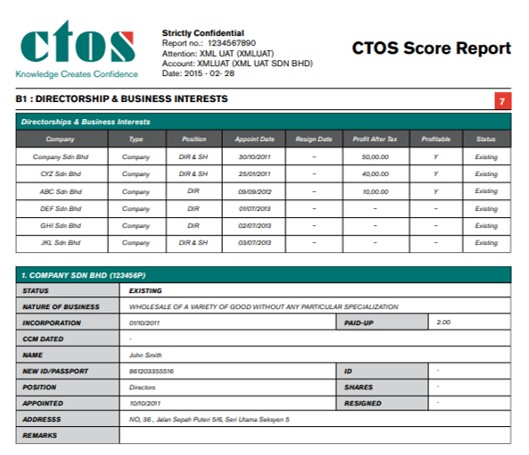
    Directorship & Business Interest

    This section lists any companies associated with the individual. Banks use this information to determine the number of companies an individual is involved with. Sometimes, individuals may disclose only one company, but upon checking, banks may find out about several undisclosed companies. If banks require unbiased information on these companies, they can conduct a CTOS search on them. As mentioned earlier, banks often know more about individuals than individuals do about themselves.

    CTOS Score

    What is it, and how does it work? These are common questions you may have.

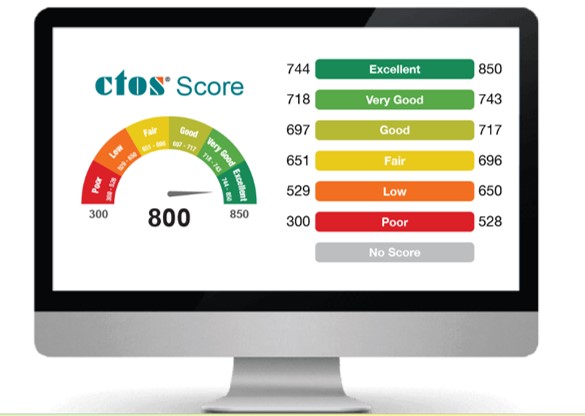
    The CTOS score determines your creditworthiness for the loan you’re applying for, indicating the likelihood of defaulting on repayments. Scores range from 300 to 850. If a borrower falls below the “fair” range, loan approval becomes more challenging. Banks become concerned about the higher risk associated with granting such loans. If borrowers discover that their score is below “fair,” it’s prudent to reassess their financial situation.

    You might wonder what factors influence the score. They include:

    a) Payment History (45%)

    b) Amount Owed (20%)

    c) Length of Credit History (7%)

    d) Credit Mix (14%)

    e) New Credit (14%)

    CCRIS Record

    The Central Credit Reference Information System (CCRIS) is established by Bank Negara Malaysia’s Credit Bureau, offering standardized credit reports on prospective borrowers.

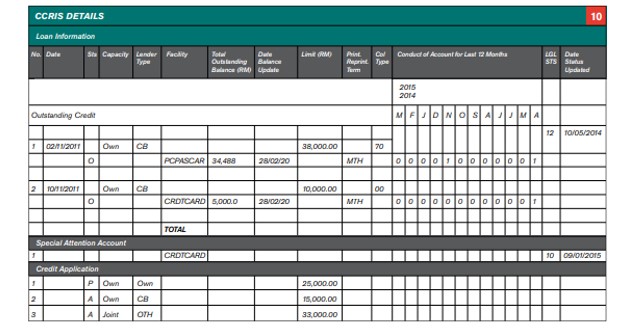
    CCRIS acts as a centralized database, providing insights into your financial status. Monthly updates from relevant institutions furnish essential data such as banks, insurance providers, and government agencies. This process enables financial institutions to evaluate borrowers’ creditworthiness effectively by referencing their financial history records.

    This section offers a detailed breakdown of each facility, including:

    • Status of the facility
    • Capacity
    • Lender Type
    • Facility Type
    • Total Outstanding Balance
    • Limit/Monthly Repayment
    • Repayment Term
    • Collateral Type
    • Conduct of Account
    • Legal Status
    • Special Attention Account
    • Credit Application Details

    If the conduct of the account consistently shows a number higher than zero, say 3, it indicates the borrower is in a three-month default. Banks use this information to assess the likelihood of future defaults.

    That’s a detailed overview of CTOS. I hope you find it helpful. Stay tuned for my next write-up, and don’t forget to subscribe.

    From the desk of Michael Yeoh

  • 10 Commandments of Mortgage Approval

    10 Commandments of Mortgage Approval

    Prior to diving into the mortgage application process, it’s essential to heed this advice, which could potentially spare you valuable time and considerable financial resources. Delve into these 10 commandments before embarking on your property journey to equip yourself with the knowledge necessary for a successful and cost-effective experience.

    1. Thou Shall not cheat the bank

    If you are thinking of buying many properties with just 1 income and well above your eligible limits, please think again. Now the banks do check the CCRIS again before releasing the loan. The have the right to reduce the loan limit as stated in the letter of offer you signed.

    2. Thou Shall not fake documents

    Some people have difficulties getting their loan approval. Thus, they resorted to doing fake documents. There are even companies specialized in this area to do it on behalf of the borrower. Let me tell you, banks are not stupid. They always double check before approving any loans. Currently, the check are getting tighter. Once caught,  it will be a police case.

    3. Thou Shall not be greedy

    The word GREED seems very familiar to everyone. Now instead of buying 1 property within your capacity, you instead buy 5. You have been thought how to achieve a lifetime goal of financial freedom at a very short time. If you are lucky you can be an instant millionaire but if you are not, you end to be an instant millionhair.

    4. Thou Shall not be guarantor

    Do you know that been a guarantor for someone else loan can be lead to loan rejection. Many years back, I have this case where a couple were planning to buy a house because they are getting married 6 months later.  They told me that all installments are promptly paid and they do not have any problem with the banks. Their loan was actually rejected by the bank because the lady stand as a guarantor for the brother’s loan. The brother’s car was repossessed by the bank. Her property loan is affected also.

    5. Thou Shall not incur debts

    The more debt you have the more difficult to get loan approval. Debts such as personal loans, car loans and etc are calculated in Debt Service Ratio (DSR) and will be part of approval. High personal DSR can either cost you your loan rejection or a very low margin of finance approval. The smart way is to minimize your debts or to repay all debts.

    6. Thou Shall not use credit card

    Do you know that credit card is the main culprit for loan rejection? Out of 10 loan rejected 65% are from credit card usage. Credit card function like a free money. Use now pay later. As in the term and conditions,

     your only required to pay 5% of the usage every month. Many people also resort to buying things in credit via credit card. All these will be calculated as your debts. The banks will take 5% of the outstanding amount as calculation. If the credit card usage is more than 70% of the approve limit, you are deemed as a high risk person even though you paid the minimum 5% monthly. Your loan approval will be affected.

    7. Thou Shall pay all your loan promptly

    As a bank, they will reject a loan if they were to find out that you have not paid your existing loan promptly. They can see from your CCRIS record. The bank will be worried as they are going to lend you some more but you have already showed to them you are not a good paymaster. They will assume that in future they will have the same problem. They rather not lend to you.

    8. Thou Shall only buy what you can afford

    Many people especially youngsters because of peer pressure buy property that they cannot afford to pay. The person can only afford RM300,000 property but end up buying RM600,000. The installment will be double. As the bank have their strict calculations on approval, the loans might be rejected or the margin slash. We cannot blame the bank for this as they are not charity organization.

    9. Thou Shall not change job

    You might think that what changing job have to do with loan approval. Please do not take this lightly. To the bank you are new to the company although you’re already working for years in your previous company. As you are new, your job is not secured and you might be terminated in 3 or 6 months period. So, the right way to do it is to apply the loan while you are at the existing company. After approval you move on to another company will not affect your loan.

    10. Thou Shall do at least one facility

    Why you may asked? Isn’t no debts at all easier to get approval? You are wrong. To the banks, if you do not have any facility at all you are too cleaned. They do not know who you are. Your CCRIS is too clean. Yeah, I agree getting a loan nowadays are very troublesome.  Well very simple to overcome this. Apply for a credit card, make sure you use it (every month fully paid is ok) then the banks will grant you the loan.