Tag: investment

  • Inheritance Law and Joint Ownership Explained

    Inheritance Law and Joint Ownership Explained

    Written by Jocelline Chee from Rightwill | Edited by Miichael Yeoh

    When it comes to inheritance, things can get complicated—and emotional—especially when property is involved. In Malaysia, many people assume that putting property under joint names (like with a spouse or child) will make things smoother when someone passes away. Unfortunately, it’s not always that simple.

    If you’re planning to leave a property behind for your loved ones, it’s important to understand how inheritance laws work in Malaysia and the potential problems that can pop up with joint ownership.


    🏛️ How Inheritance Works in Malaysia

    Inheritance laws in Malaysia depend on your religion:

    • For Muslims, faraid (Islamic inheritance law) applies. It has fixed rules on how the estate is divided among family members.
    • For non-Muslims, the Distribution Act 1958 (amended in 1997) applies. This Act lays out who gets what—based on whether the deceased leaves behind a spouse, children, or parents.

    If someone dies without a will, the law decides how the assets are shared. That’s why it’s so important to have a valid will—it ensures your wishes are followed.

    Example under the Distribution Act:

    If the deceased leaves behind…Parent(s) getSpouse getsChildren get
    Parents, spouse & children1/41/41/2

    🏠 Joint Name Properties – Not As Simple As You Think

    Many Malaysians put properties under joint names thinking it will automatically go to the other person when they pass away. But that’s not always true.

    There are two main types of joint ownership in property law:

    1. Joint Tenancy
      • Comes with the right of survivorship.
      • If one owner dies, the property automatically goes to the surviving owner.
      • This is common among married couples.
    2. Tenancy in Common
      • Each person owns a specific share.
      • When one dies, their share becomes part of their estate and is distributed according to their will or the law.
      • This is more common in Malaysia, even when it’s between family members.

    Here’s the catch: Most joint name properties in Malaysia are actually treated as tenancy in common, unless stated otherwise. That means—even if your name is on the title—the other person’s share doesn’t automatically go to you. It becomes part of their estate and is shared out according to their will or inheritance laws.


    ⚠️ Common Pitfalls to Watch Out For

    1. Unclear Ownership Type
      If it’s not clearly stated whether it’s joint tenancy or tenancy in common, it can lead to confusion—and disputes.
    2. Unequal Contributions
      One person may have paid more, but the property is split 50-50 on paper. This often leads to disagreements among family members.
    3. Family Conflicts
      Things can get messy with children from previous marriages, siblings, or estranged family members. Without clear planning, emotions can take over.
    4. Outdated or No Will
      A will that hasn’t been updated—or worse, no will at all—can cause contradictions and legal battles during probate.

    ✅ What You Should Do

    To protect your assets and your loved ones from future disputes:

    • ✅ Talk to a professional estate planner or lawyer
    • ✅ Make sure your will is valid, updated, and matches your current ownership structure
    • ✅ Clearly state the type of joint ownership on your property documents
    • ✅ Keep your family informed, so there are no surprises later

    Joint ownership may seem like the easy way, but without proper planning, it can create unnecessary complications. A little preparation now can give your family peace of mind in the future.

    From the desk Of

    Miichael Yeoh

    Property Strategist

    Thank you for subscribing!

    Please check your email to confirming your subscription.

  • Should You Buy Property in Malaysia Now? Insights 2025

    Should You Buy Property in Malaysia Now? Insights 2025

    Published: July 17, 2025
    By: Miichael Yeoh


    After a strong run in 2023 and 2024, Malaysia’s residential property market is finally taking a breather. While some see this as a red flag, the data paints a more balanced picture—one of resilience and recalibration, not recession.

    So, what exactly is happening in 2025? And should you be worried or ready to buy?

    Let’s break it down.


    📉 Q1 2025: Slower But Still Solid

    Malaysia’s residential property transactions dropped 6.2% in Q1 2025 compared to Q4 2024. That’s the first notable slowdown after nearly two years of consistent growth.


    But here’s the catch: activity levels are still higher than in 2022, which means we’re not seeing a crash—just a cooling-off.

    “The slowdown is expected. It’s the market stabilizing after a hot streak,” said a property analyst from KL.


    📈 Prices Are Still Moving Up

    The national average house price reached RM483,879 in Q1, reflecting a +1.4% year-on-year increase. Areas like Klang Valley, Penang Island, and Johor Bahru continue to dominate in both value and volume.

    Here’s a quick snapshot:

    AreaAvg. Price (Q1 2025)YoY Price Growth
    Klang ValleyRM 550,000+2.1%
    Penang IslandRM 620,000+1.8%
    Johor BahruRM 460,000+1.2%

    🏗️ Developers Stay Selective with New Launches

    With rising construction costs and cautious sentiment, developers are choosing quality over quantity. Most new launches are in well-connected, lifestyle-oriented locations—think smart townships, mixed developments, and green-certified homes.

    Hot-selling projects like Elmina Ridge 2 and Avalon Cybersouth saw near 90% take-up rates, showing buyers are still ready to act—when the product is right.


    🔍 What’s Supporting the Market?

    Despite the slowdown in transactions, several key factors are helping the market stay afloat:

    • Stable interest rates (BNM kept the OPR steady).
    • Low unemployment rate (around 3.3%).
    • Young home-buying population (millennials & Gen Z entering the market).
    • MM2H visa tweaks requiring foreigners to purchase property.

    These are long-term positives that signal stability in the residential segment.


    ⚠️ What Buyers & Investors Should Watch

    While the fundamentals are strong, here are a few caution signs to keep in mind:

    1. Affordability gaps in cities like KL and Penang may limit demand in certain price segments.
    2. Oversupply risks in high-rise areas still exist, especially where demand isn’t organic.
    3. Policy changes—any adjustments to RPGT, stamp duties, or loan rules could shift the playing field fast.

    💡 Final Thoughts

    If you’re a buyer or investor waiting for a market crash—you might be waiting for a while. What we’re seeing now is not the end of growth, but a healthier, more stable market emerging after years of turbulence.

    This could actually be the perfect window to enter—especially if you’re eyeing the right locations, products, and long-term value.

    🗣 “The best time to buy property is when others hesitate—because real opportunity hides in uncertainty.”


    Need help identifying the right property in 2025?
    Join the Property EDU Club — get expert guidance, real-life case studies, and insider access to property deals most investors never see.

    👉 Click here to learn more and join now

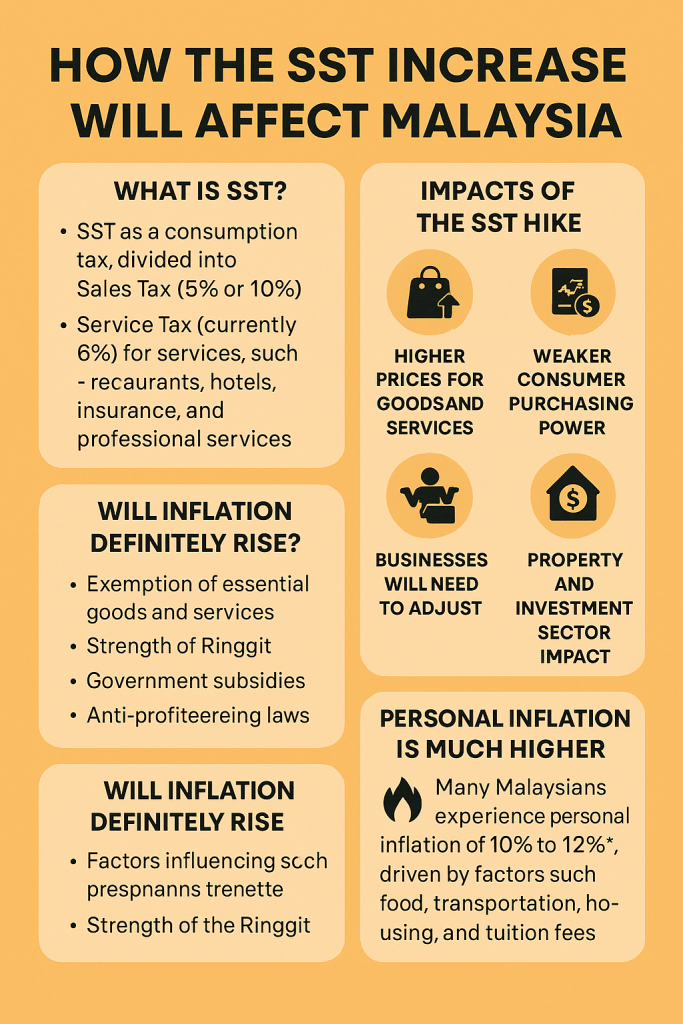
  • SST Increase from 6% to 8%: How It Will Impact Malaysia’s Property Industry

    SST Increase from 6% to 8%: How It Will Impact Malaysia’s Property Industry


    Introduction

    Starting July 1, 2025, the Malaysian government officially raised the Sales and Services Tax (SST) from 6% to 8%, aiming to increase national revenue and reduce fiscal deficits. While basic necessities and certain essential services remain exempt, many sectors — including construction, legal, professional, and property-related services — are now affected. This tax adjustment is expected to have ripple effects across various industries, especially the property market, which is already facing affordability challenges.

    This article examines how the SST hike impacts the property industry, giving practical examples and offering insights into how buyers, developers, and investors might respond.


    1. Scope of SST Increase in the Property Sector

    The SST increase does not apply directly to the sale of residential properties, which are exempt from SST. However, indirect costs will go up due to increased service charges in the construction, legal, and property management sectors. These cost increments will eventually be transferred to end buyers and tenants, especially in commercial and high-rise residential developments.


    2. Areas Affected in Property Development

    Here’s a breakdown of how the 2% SST increase affects the property ecosystem:

    Service TypeBaseOld SST (6%)New SST (8%)
    Architect/Engineer FeesRM100,000RM106,000RM108,000
    Legal/Stamping ServicesRM20,000RM21,200RM21,600
    Renovation/Interior Fit-OutRM150,000RM159,000RM162,000
    Property Management ServicesRM50,000RM53,000RM54,000
    Advertising & MarketingRM30,000RM31,800RM32,400

    Example:
    A developer constructing a new serviced apartment project incurs around RM5 million in professional and management fees. Under the previous 6% SST, the tax was RM300,000. Now, it’s RM400,000 — a 33% increase in SST cost, which could result in higher launch prices to maintain developer margins.


    3. Impact on Property Developers

    • Higher Development Cost: Most developers will face a 5–8% increase in overall project costs when combined with inflation and compliance costs.
    • Price Adjustment Pressure: Developers may either absorb the cost (lowering margins) or pass it to consumers — likely raising launch prices, especially in urban areas.
    • Delay in New Launches: Some developers may delay project launches until market conditions stabilize.

    4. Impact on Homebuyers

    Although SST is not directly charged on residential property purchases, buyers may feel the pinch in several ways:

    • Higher Property Prices: Due to rising development and marketing costs.
    • Increased Renovation Expenses: Renovation and interior design are service-based industries and are now charged 8% SST.
    • Increased Maintenance Fees: Management services in condos or commercial buildings may increase, translating to higher monthly maintenance charges for owners and tenants.

    5. Impact on Real Estate Investors

    Investors will also be affected indirectly:

    • Lower Rental Yield: If property prices go up but rental rates remain stagnant, net returns will shrink.
    • Higher Operational Costs: Especially for those managing short-term rentals or Airbnb units (cleaning, advertising, renovation services all now taxed at 8%).
    • Buyer Caution: Investors may delay purchases or switch to lower-risk assets like REITs or landed residential properties outside city centers.

    6. Outlook and Strategies

    Despite the challenges, the SST increase may drive some positive changes:

    • Developers may adopt cost-efficiency technologies to maintain affordability.
    • Buyers may turn to subsale markets, which are less affected by SST-related costs.
    • Investors may focus on cash-flow-positive properties, especially those with low operating costs.

    Conclusion

    The SST increase from 6% to 8% might seem modest on paper, but its cascading effect across the property value chain is real. While residential property sales remain tax-exempt, associated services — from construction to maintenance — will become costlier. As developers adjust pricing and investors reassess risk, Malaysia’s property market may experience a short-term slowdown but could stabilize as the market adapts.


    Final Thought
    For both buyers and investors, 2024–2025 will require careful financial planning and a close eye on property pricing trends. Understanding the real costs behind the price tag is more important than ever.

    From The Desk of Miichael Yeoh

  • Unlock Real Estate Success with Property Study Tours

    Unlock Real Estate Success with Property Study Tours

    As a property investment coach and mentor, I’ve seen firsthand how powerful a property study trip can be for investors at all levels. Whether you’re a seasoned investor or just starting out, nothing beats the experience of visiting properties in person, analyzing market trends, and networking with experts. That’s why I organize property study trips—to give you a competitive edge in the real estate market. Here’s why you should join me on this journey.

    1. Firsthand Property Inspection

    Browsing online listings and reading brochures only tell part of the story. When you join my property study tour, you’ll get to walk through the properties, examine the surroundings, and see if they align with your investment goals. I’ll guide you in assessing crucial aspects like location, infrastructure, and future development plans so you can make a well-informed decision. Plus, I’ll share my insights on what to look for in a profitable property, helping you avoid costly mistakes.

    2. Understand Market Trends and Insights

    Every property market operates differently, and the key to successful investing is understanding these nuances. On my study tours, I provide in-depth briefings on market trends, pricing structures, and upcoming investment hotspots. You’ll also hear from local experts who can offer data-driven insights into property price movements and rental yields. I’ve spent years studying the market, and I’ll help you cut through the noise to identify real opportunities.

    3. Network with Like-Minded Investors

    One of the biggest advantages of joining my study trips is the opportunity to meet and network with like-minded investors. Many of my past participants have formed business partnerships, co-invested in properties, or simply found a supportive community to grow with. Learning from the experiences of others can be incredibly valuable, and I make sure to create an environment where everyone can share and learn together.

    4. Exclusive Access to Off-Market Deals

    Through my network and relationships with developers, I often get access to exclusive deals that aren’t available to the general public. This means you’ll have the chance to secure high-potential properties before they hit the open market. Developers also offer special discounts, incentives, and flexible payment plans to my study trip attendees—something you wouldn’t get if you were searching on your own.

    5. Expert Guidance and Analysis

    Investing in property isn’t just about buying a house or unit—it’s about making the right investment decisions. I provide expert guidance throughout the trip, helping you analyze risks, assess potential returns, and navigate financing options. You’ll also gain insights into legal requirements, taxation, and property management. With my years of experience in property investment and financial consulting, I’ll make sure you’re equipped with the knowledge you need to succeed.

    6. Experience the Local Lifestyle and Environment

    A great investment isn’t just about the property itself—it’s also about the surrounding lifestyle, infrastructure, and amenities. By visiting the location in person, you’ll get a feel for the area, check out nearby facilities, and determine whether it aligns with your personal or investment objectives. I’ll also share my insights on which neighborhoods have the most growth potential and what to watch out for when assessing an area’s long-term viability.

    7. Gain Confidence in Your Investment Decisions

    One of the biggest challenges new investors face is hesitation and uncertainty. I believe that seeing is believing, and by joining my study trip, you’ll gain the confidence to make informed investment decisions. I’ll help you weigh the pros and cons of different properties so you can make a calculated decision rather than relying on guesswork.

    8. Exposure to Different Property Investment Strategies

    Not all property investments are the same. During the tour, I’ll introduce you to different strategies such as buying for rental yield, flipping properties, or capital appreciation. You’ll also learn about new trends like co-living spaces and serviced apartments that can diversify your portfolio. By understanding these strategies, you’ll be able to choose an approach that aligns with your financial goals.

    9. Learn from Real-Life Case Studies

    I always include real-life case studies in my study trips, sharing stories of successful property investors who have built wealth through smart real estate decisions. These case studies provide valuable lessons, helping you understand what works and what doesn’t in property investment. You’ll hear from actual investors who share their journeys, challenges, and strategies.

    10. Potential for Immediate Action

    Unlike attending a seminar or watching an online course, a property study tour allows you to take action immediately. If you find a property that meets your criteria, you can reserve it on the spot—often with exclusive perks and discounts. Many of my past participants have successfully secured properties during the trip, giving them a head start in their investment journey.

    Conclusion

    I’ve designed my property study tours to be an immersive, hands-on learning experience that equips you with the knowledge, connections, and confidence to invest successfully. Whether you’re looking for your first property or expanding your portfolio, this tour will give you a significant advantage. Don’t miss out on this opportunity—join me on the next study trip and take your property investment journey to the next level!

    Most importantly, my property study tours are not just about learning and investing—they’re also about having fun! You’ll get to travel, explore new locations, and enjoy meaningful conversations with fellow property enthusiasts. It’s a great way to bond with like-minded individuals, share experiences, and build lasting relationships in a relaxed and enjoyable setting. See you on the next trip!

  • Avoid Costly Mistakes: 8 Reasons to Learn Before Investing in Real Estate

    Avoid Costly Mistakes: 8 Reasons to Learn Before Investing in Real Estate

    Purchasing or investing in property is one of the most significant financial decisions a person can make. While the prospect of owning a piece of real estate can be exciting, it’s also fraught with risks and complexities. Here are eight compelling reasons why educating yourself before taking the plunge is crucial:

    1. Understanding the Market

    The property market is dynamic, influenced by factors such as economic conditions, interest rates, and government policies. Without proper knowledge, you might buy at the wrong time or in the wrong location, potentially leading to financial losses. Education helps you grasp market cycles and trends, enabling informed decisions.

    2. Avoiding Costly Mistakes

    From overpaying for a property to falling victim to scams, the risks of making costly mistakes are high for uninformed buyers. Learning about property valuation, legal processes, and common pitfalls can save you from financial heartache.

    3. Maximizing Investment Returns

    Investing in property isn’t just about buying a house or apartment; it’s about choosing assets that will appreciate in value or generate steady rental income. Understanding key metrics such as ROI (Return on Investment) and cash flow can help you identify profitable opportunities.

    4. Navigating Legal and Financial Complexities

    Property transactions involve a maze of legal and financial considerations. From understanding loan agreements to navigating tax implications and zoning laws, there’s a lot to learn. A lack of knowledge could lead to delays or even legal troubles.

    5. Building Confidence

    The more you know, the more confident you’ll feel about your decisions. Knowledge reduces fear and uncertainty, empowering you to negotiate effectively, choose wisely, and stick to your long-term goals.

    6. Identifying Red Flags

    Not all properties are created equal. Structural issues, poor location, and hidden costs can turn a dream investment into a nightmare. Learning to conduct due diligence and property inspections ensures you spot potential problems early.

    7. Accessing Better Financing Options

    Understanding how mortgages and loans work can save you thousands of dollars over the life of your investment. Learning about different financing options and how to improve your creditworthiness can lead to better interest rates and loan terms.

    8. Planning for the Future

    Property investment is a long-term commitment. Learning helps you align your investment choices with your financial goals, whether it’s building wealth, securing passive income, or preparing for retirement. Knowledge enables strategic planning that benefits you in the long run.

    Conclusion

    Investing time and effort into learning before buying or investing in property is an investment in itself. It equips you with the tools and insights needed to make smart, informed decisions that align with your financial aspirations. Remember, in the world of property, knowledge isn’t just power; it’s profit.

  • Mike Tyson’s Resilience: Investment Lessons for Every Age

    Mike Tyson’s Resilience: Investment Lessons for Every Age

    Mike Tyson, the legendary former heavyweight boxing champion, shocked the world when he continues to maintain his fighting spirit at 58. His return wasn’t just about showcasing his physical prowess; it symbolized the unyielding human spirit and a refusal to let age define capabilities. Tyson’s story offers an invaluable lesson: it’s never too late to keep striving for your dreams, even after traditional retirement age.

    For property investors, Tyson’s journey serves as a powerful reminder that success often comes to those who refuse to give up, regardless of age or setbacks.

    Age is Just a Number in Life and Property Investment

    Many believe that real estate is a young person’s game. However, the truth is that property investment, much like Tyson’s boxing career, rewards perseverance, learning, and action—qualities that grow stronger with age and experience. Whether you’re in your 30s or your 60s, there’s always an opportunity to start or scale your property portfolio.

    The Beauty of Late Blooming

    Tyson isn’t alone in proving that success can come at any age. Many individuals have achieved extraordinary milestones well past the age society deems “prime.” These stories also align closely with property investment principles.

    1. Donald Trump

    Donald Trump built a significant part of his wealth through real estate. Even at 70, when he became the oldest first-term President of the United States in 2016, he demonstrated that reinvention is possible at any age. His story reminds property investors that it’s never too late to think big and make bold moves.

    2. Colonel Harland Sanders

    The founder of Kentucky Fried Chicken (KFC) started his fried chicken empire at 62 after facing multiple failures. Sanders’s persistence mirrors the journey of seasoned investors who’ve faced setbacks but ultimately built lasting wealth by taking calculated risks.

    3. Ray Kroc

    At 52, Ray Kroc transformed McDonald’s into a global powerhouse. Like in property investment, Kroc’s success required spotting a great opportunity and scaling it—a skill that improves with age and experience.

    4. Diana Nyad

    At 64, Diana Nyad became the first person to swim from Cuba to Florida without a shark cage. Her determination to push limits reflects the same mindset required in property investment: relentless focus and belief in achieving the impossible.

    Why Real Estate Works at Any Age

    1. Compounding Growth: Property investments tend to grow in value over time, making it ideal for those looking to build wealth regardless of when they start.
    2. Leverage Experience: With age comes wisdom—an invaluable asset in understanding market trends and avoiding costly mistakes.
    3. Passive Income: Rental properties offer a consistent income stream, making them perfect for retirement planning or financial independence at any stage of life.
    4. Opportunities for Reinvention: Like Tyson stepping back into the ring, seasoned individuals can pivot into property investment as a second career or passion project.

    Lessons from Tyson for Property Investors

    Tyson’s return to the ring, like the stories of Trump, Sanders, and others, underscores the importance of persistence and seizing opportunities. Property investment is no different. It requires:

    • Resilience: Markets fluctuate, but seasoned investors stay the course.
    • Action: It’s never too late to make that first purchase or expand your portfolio.
    • Vision: Investing in property, like boxing, requires foresight and planning to achieve long-term success.

    Making Your Comeback

    Whether you’re approaching retirement or already there, property investment offers one of the most reliable ways to achieve financial freedom. With proper guidance, anyone—regardless of age—can start building a portfolio that generates wealth for years to come.

    Just like Tyson’s return to the ring, starting or growing a property portfolio later in life is proof that you can achieve greatness in your “second act.” So, lace up your gloves, do your research, and take the first step—your property investment journey starts now!

  • Discover The Keys to Successful Property Investment (Live Webinar)

    Discover The Keys to Successful Property Investment (Live Webinar)

    Are these familiar struggles for you?

    🏠 Feeling lost in the world of property investment?

    💰 Watching your investments drain your finances?

    😱 Scared off by terrifying investment horror stories?

    💸 Struggling to secure funds for investment?

    🏦 Facing obstacles getting a loan from the bank?

    🔍 Bought a property but can’t find a tenant?

    You’re not alone. But here’s what awaits you on the other side:

    • Witnessing others prosper through property investment while you sit on the sidelines.
    • Regretting missed opportunities for passive income generation.
    • Reflecting on how better financial planning could have changed your life.

    What’s in store for you at my seminar?

    🔍 Insights to equip yourself for successful property investment.

    ⚠️ Awareness of common pitfalls to avoid in the property market.

    🏡 Understanding the crucial components of property investment.

    📊 Appreciation for the importance of property data analysis.

    🔍 Guidance on conducting thorough due diligence before buying.

    💼 Experience the transformative power of effective financial planning.

    Audiences and events I’ve spoken and organized for property buyers/investors, developers, conventions, and property study trips.

    Don’t let uncertainty or fear hold you back! Join me and unlock the doors to a brighter financial future!

    Register your FREE SEATS Now as seats are limited…..

    See you soon,

    Miichael Yeoh