Tag: investing

  • Should You Buy Property in Malaysia Now? Insights 2025

    Should You Buy Property in Malaysia Now? Insights 2025

    Published: July 17, 2025
    By: Miichael Yeoh


    After a strong run in 2023 and 2024, Malaysia’s residential property market is finally taking a breather. While some see this as a red flag, the data paints a more balanced picture—one of resilience and recalibration, not recession.

    So, what exactly is happening in 2025? And should you be worried or ready to buy?

    Let’s break it down.


    📉 Q1 2025: Slower But Still Solid

    Malaysia’s residential property transactions dropped 6.2% in Q1 2025 compared to Q4 2024. That’s the first notable slowdown after nearly two years of consistent growth.

    But here’s the catch: activity levels are still higher than in 2022, which means we’re not seeing a crash—just a cooling-off.

    “The slowdown is expected. It’s the market stabilizing after a hot streak,” said a property analyst from KL.


    📈 Prices Are Still Moving Up

    The national average house price reached RM483,879 in Q1, reflecting a +1.4% year-on-year increase. Areas like Klang Valley, Penang Island, and Johor Bahru continue to dominate in both value and volume.

    Here’s a quick snapshot:

    AreaAvg. Price (Q1 2025)YoY Price Growth
    Klang ValleyRM 550,000+2.1%
    Penang IslandRM 620,000+1.8%
    Johor BahruRM 460,000+1.2%

    🏗️ Developers Stay Selective with New Launches

    With rising construction costs and cautious sentiment, developers are choosing quality over quantity. Most new launches are in well-connected, lifestyle-oriented locations—think smart townships, mixed developments, and green-certified homes.

    Hot-selling projects like Elmina Ridge 2 and Avalon Cybersouth saw near 90% take-up rates, showing buyers are still ready to act—when the product is right.


    🔍 What’s Supporting the Market?

    Despite the slowdown in transactions, several key factors are helping the market stay afloat:

    • Stable interest rates (BNM kept the OPR steady).
    • Low unemployment rate (around 3.3%).
    • Young home-buying population (millennials & Gen Z entering the market).
    • MM2H visa tweaks requiring foreigners to purchase property.

    These are long-term positives that signal stability in the residential segment.


    ⚠️ What Buyers & Investors Should Watch

    While the fundamentals are strong, here are a few caution signs to keep in mind:

    1. Affordability gaps in cities like KL and Penang may limit demand in certain price segments.
    2. Oversupply risks in high-rise areas still exist, especially where demand isn’t organic.
    3. Policy changes—any adjustments to RPGT, stamp duties, or loan rules could shift the playing field fast.

    💡 Final Thoughts

    If you’re a buyer or investor waiting for a market crash—you might be waiting for a while. What we’re seeing now is not the end of growth, but a healthier, more stable market emerging after years of turbulence.

    This could actually be the perfect window to enter—especially if you’re eyeing the right locations, products, and long-term value.

    🗣 “The best time to buy property is when others hesitate—because real opportunity hides in uncertainty.”


    Need help identifying the right property in 2025?
    Join the Property EDU Club — get expert guidance, real-life case studies, and insider access to property deals most investors never see.

    👉 Click here to learn more and join now

  • 📰 BNM Cuts OPR to 2.75%: What It Means for You and Your Loans

    📰 BNM Cuts OPR to 2.75%: What It Means for You and Your Loans

    Kuala Lumpur, 10 July 2025 — Bank Negara Malaysia (BNM) has announced a reduction in the Overnight Policy Rate (OPR) by 25 basis points, bringing it down from 3.00% to 2.75%. This move comes amid ongoing efforts to support economic growth and ease financial conditions for households and businesses.

    But what does this really mean for everyday Malaysians? And how does it affect your home loan or car loan?

    Let’s break it down.


    🔎 What Is the OPR?

    The OPR is the interest rate at which banks lend money to one another overnight. When BNM adjusts the OPR, it influences Base Lending Rate (BLR) ,Base Rate (BR) and Standardise Base Rate (SBR) used by banks to determine the interest on loans and savings.

    A lower OPR typically leads to:

    ✅ Lower loan interest rates
    ✅ Cheaper monthly repayments
    ✅ Easier access to credit


    🏠 Before & After: Sample Loan Calculation

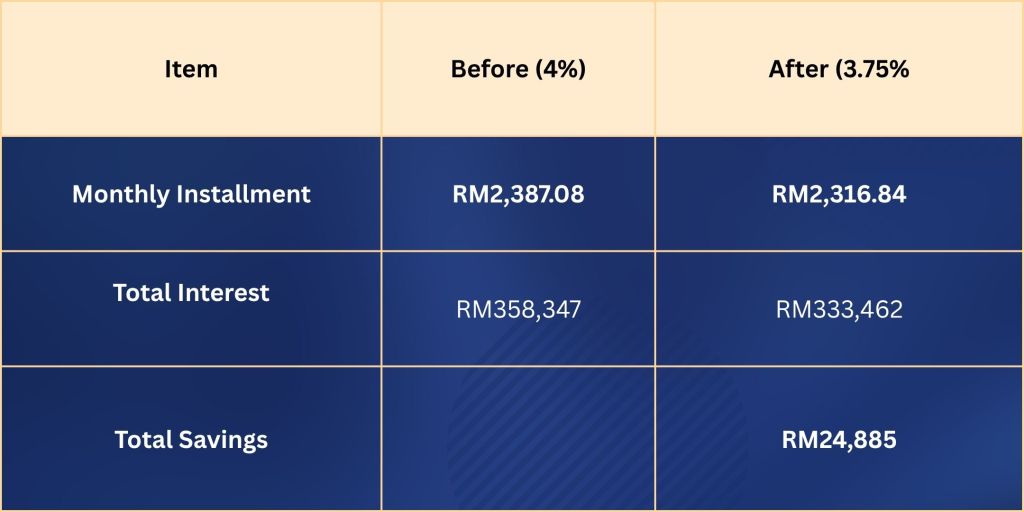
    Let’s compare how the OPR cut affects a typical housing loan of RM500,000 over 30 years.

    Assume a floating interest rate of:

    • Before: 4.00% (based on 3.00% OPR)
    • After: 3.75% (after 2.75% OPR cut)

    🔹 Before OPR Cut (4.00%)

    • Loan amount: RM500,000
    • Tenure: 30 years
    • Interest rate: 4.00%
    • Monthly instalment: RM2,387.08
    • Total interest over 30 years: RM358,347

    🔻 After OPR Cut (3.75%)

    • Loan amount: RM500,000
    • Tenure: 30 years
    • Interest rate: 3.75%
    • Monthly instalment: RM2,316.84
    • Total interest over 30 years: RM333,462

    💡 You Save:

    • Monthly: RM70.24
    • Over 30 Years: RM24,885 in interest!

    📌 Summary:


    📉 Impact Beyond Housing Loans

    The OPR cut doesn’t just affect home loans. It also impacts:

    • Car Loans – Lower monthly repayments
    • Personal Loans – Cheaper borrowing
    • Business Loans – Reduced financing costs

    However, fixed-rate loans (such as some hire purchase loans) are generally not affected by OPR changes.


    🏦 Why Did BNM Cut the OPR?

    BNM’s Monetary Policy Committee cited the need to:

    • Support domestic economic activity
    • Manage downside risks from global uncertainties
    • Encourage spending and investment

    With inflation under control and growth momentum slowing, the rate cut is intended to provide a cushion and maintain financial stability.


    📊 Conclusion: A Relief for Borrowers

    If you’re repaying a floating-rate loan, this OPR cut could offer welcome breathing space in your monthly budget. For potential homebuyers, it’s a good time to recalculate affordability and consider locking in better financing packages.

    🔍 Tip: Contact your bank to check how the OPR cut affects your current loan rate. You may also explore refinancing options for better savings.

    From The Desk of

    Miichael Yeoh

  • SST Increase from 6% to 8%: How It Will Impact Malaysia’s Property Industry

    SST Increase from 6% to 8%: How It Will Impact Malaysia’s Property Industry


    Introduction

    Starting July 1, 2025, the Malaysian government officially raised the Sales and Services Tax (SST) from 6% to 8%, aiming to increase national revenue and reduce fiscal deficits. While basic necessities and certain essential services remain exempt, many sectors — including construction, legal, professional, and property-related services — are now affected. This tax adjustment is expected to have ripple effects across various industries, especially the property market, which is already facing affordability challenges.

    This article examines how the SST hike impacts the property industry, giving practical examples and offering insights into how buyers, developers, and investors might respond.


    1. Scope of SST Increase in the Property Sector

    The SST increase does not apply directly to the sale of residential properties, which are exempt from SST. However, indirect costs will go up due to increased service charges in the construction, legal, and property management sectors. These cost increments will eventually be transferred to end buyers and tenants, especially in commercial and high-rise residential developments.


    2. Areas Affected in Property Development

    Here’s a breakdown of how the 2% SST increase affects the property ecosystem:

    Service TypeBaseOld SST (6%)New SST (8%)
    Architect/Engineer FeesRM100,000RM106,000RM108,000
    Legal/Stamping ServicesRM20,000RM21,200RM21,600
    Renovation/Interior Fit-OutRM150,000RM159,000RM162,000
    Property Management ServicesRM50,000RM53,000RM54,000
    Advertising & MarketingRM30,000RM31,800RM32,400

    Example:
    A developer constructing a new serviced apartment project incurs around RM5 million in professional and management fees. Under the previous 6% SST, the tax was RM300,000. Now, it’s RM400,000 — a 33% increase in SST cost, which could result in higher launch prices to maintain developer margins.


    3. Impact on Property Developers

    • Higher Development Cost: Most developers will face a 5–8% increase in overall project costs when combined with inflation and compliance costs.
    • Price Adjustment Pressure: Developers may either absorb the cost (lowering margins) or pass it to consumers — likely raising launch prices, especially in urban areas.
    • Delay in New Launches: Some developers may delay project launches until market conditions stabilize.

    4. Impact on Homebuyers

    Although SST is not directly charged on residential property purchases, buyers may feel the pinch in several ways:

    • Higher Property Prices: Due to rising development and marketing costs.
    • Increased Renovation Expenses: Renovation and interior design are service-based industries and are now charged 8% SST.
    • Increased Maintenance Fees: Management services in condos or commercial buildings may increase, translating to higher monthly maintenance charges for owners and tenants.

    5. Impact on Real Estate Investors

    Investors will also be affected indirectly:

    • Lower Rental Yield: If property prices go up but rental rates remain stagnant, net returns will shrink.
    • Higher Operational Costs: Especially for those managing short-term rentals or Airbnb units (cleaning, advertising, renovation services all now taxed at 8%).
    • Buyer Caution: Investors may delay purchases or switch to lower-risk assets like REITs or landed residential properties outside city centers.

    6. Outlook and Strategies

    Despite the challenges, the SST increase may drive some positive changes:

    • Developers may adopt cost-efficiency technologies to maintain affordability.
    • Buyers may turn to subsale markets, which are less affected by SST-related costs.
    • Investors may focus on cash-flow-positive properties, especially those with low operating costs.

    Conclusion

    The SST increase from 6% to 8% might seem modest on paper, but its cascading effect across the property value chain is real. While residential property sales remain tax-exempt, associated services — from construction to maintenance — will become costlier. As developers adjust pricing and investors reassess risk, Malaysia’s property market may experience a short-term slowdown but could stabilize as the market adapts.


    Final Thought
    For both buyers and investors, 2024–2025 will require careful financial planning and a close eye on property pricing trends. Understanding the real costs behind the price tag is more important than ever.

    From The Desk of Miichael Yeoh

  • Avoid Costly Mistakes: 8 Reasons to Learn Before Investing in Real Estate

    Avoid Costly Mistakes: 8 Reasons to Learn Before Investing in Real Estate

    Purchasing or investing in property is one of the most significant financial decisions a person can make. While the prospect of owning a piece of real estate can be exciting, it’s also fraught with risks and complexities. Here are eight compelling reasons why educating yourself before taking the plunge is crucial:

    1. Understanding the Market

    The property market is dynamic, influenced by factors such as economic conditions, interest rates, and government policies. Without proper knowledge, you might buy at the wrong time or in the wrong location, potentially leading to financial losses. Education helps you grasp market cycles and trends, enabling informed decisions.

    2. Avoiding Costly Mistakes

    From overpaying for a property to falling victim to scams, the risks of making costly mistakes are high for uninformed buyers. Learning about property valuation, legal processes, and common pitfalls can save you from financial heartache.

    3. Maximizing Investment Returns

    Investing in property isn’t just about buying a house or apartment; it’s about choosing assets that will appreciate in value or generate steady rental income. Understanding key metrics such as ROI (Return on Investment) and cash flow can help you identify profitable opportunities.

    4. Navigating Legal and Financial Complexities

    Property transactions involve a maze of legal and financial considerations. From understanding loan agreements to navigating tax implications and zoning laws, there’s a lot to learn. A lack of knowledge could lead to delays or even legal troubles.

    5. Building Confidence

    The more you know, the more confident you’ll feel about your decisions. Knowledge reduces fear and uncertainty, empowering you to negotiate effectively, choose wisely, and stick to your long-term goals.

    6. Identifying Red Flags

    Not all properties are created equal. Structural issues, poor location, and hidden costs can turn a dream investment into a nightmare. Learning to conduct due diligence and property inspections ensures you spot potential problems early.

    7. Accessing Better Financing Options

    Understanding how mortgages and loans work can save you thousands of dollars over the life of your investment. Learning about different financing options and how to improve your creditworthiness can lead to better interest rates and loan terms.

    8. Planning for the Future

    Property investment is a long-term commitment. Learning helps you align your investment choices with your financial goals, whether it’s building wealth, securing passive income, or preparing for retirement. Knowledge enables strategic planning that benefits you in the long run.

    Conclusion

    Investing time and effort into learning before buying or investing in property is an investment in itself. It equips you with the tools and insights needed to make smart, informed decisions that align with your financial aspirations. Remember, in the world of property, knowledge isn’t just power; it’s profit.

  • Mike Tyson’s Resilience: Investment Lessons for Every Age

    Mike Tyson’s Resilience: Investment Lessons for Every Age

    Mike Tyson, the legendary former heavyweight boxing champion, shocked the world when he continues to maintain his fighting spirit at 58. His return wasn’t just about showcasing his physical prowess; it symbolized the unyielding human spirit and a refusal to let age define capabilities. Tyson’s story offers an invaluable lesson: it’s never too late to keep striving for your dreams, even after traditional retirement age.

    For property investors, Tyson’s journey serves as a powerful reminder that success often comes to those who refuse to give up, regardless of age or setbacks.

    Age is Just a Number in Life and Property Investment

    Many believe that real estate is a young person’s game. However, the truth is that property investment, much like Tyson’s boxing career, rewards perseverance, learning, and action—qualities that grow stronger with age and experience. Whether you’re in your 30s or your 60s, there’s always an opportunity to start or scale your property portfolio.

    The Beauty of Late Blooming

    Tyson isn’t alone in proving that success can come at any age. Many individuals have achieved extraordinary milestones well past the age society deems “prime.” These stories also align closely with property investment principles.

    1. Donald Trump

    Donald Trump built a significant part of his wealth through real estate. Even at 70, when he became the oldest first-term President of the United States in 2016, he demonstrated that reinvention is possible at any age. His story reminds property investors that it’s never too late to think big and make bold moves.

    2. Colonel Harland Sanders

    The founder of Kentucky Fried Chicken (KFC) started his fried chicken empire at 62 after facing multiple failures. Sanders’s persistence mirrors the journey of seasoned investors who’ve faced setbacks but ultimately built lasting wealth by taking calculated risks.

    3. Ray Kroc

    At 52, Ray Kroc transformed McDonald’s into a global powerhouse. Like in property investment, Kroc’s success required spotting a great opportunity and scaling it—a skill that improves with age and experience.

    4. Diana Nyad

    At 64, Diana Nyad became the first person to swim from Cuba to Florida without a shark cage. Her determination to push limits reflects the same mindset required in property investment: relentless focus and belief in achieving the impossible.

    Why Real Estate Works at Any Age

    1. Compounding Growth: Property investments tend to grow in value over time, making it ideal for those looking to build wealth regardless of when they start.
    2. Leverage Experience: With age comes wisdom—an invaluable asset in understanding market trends and avoiding costly mistakes.
    3. Passive Income: Rental properties offer a consistent income stream, making them perfect for retirement planning or financial independence at any stage of life.
    4. Opportunities for Reinvention: Like Tyson stepping back into the ring, seasoned individuals can pivot into property investment as a second career or passion project.

    Lessons from Tyson for Property Investors

    Tyson’s return to the ring, like the stories of Trump, Sanders, and others, underscores the importance of persistence and seizing opportunities. Property investment is no different. It requires:

    • Resilience: Markets fluctuate, but seasoned investors stay the course.
    • Action: It’s never too late to make that first purchase or expand your portfolio.
    • Vision: Investing in property, like boxing, requires foresight and planning to achieve long-term success.

    Making Your Comeback

    Whether you’re approaching retirement or already there, property investment offers one of the most reliable ways to achieve financial freedom. With proper guidance, anyone—regardless of age—can start building a portfolio that generates wealth for years to come.

    Just like Tyson’s return to the ring, starting or growing a property portfolio later in life is proof that you can achieve greatness in your “second act.” So, lace up your gloves, do your research, and take the first step—your property investment journey starts now!

  • Proposed New Taxes in Malaysia’s 2024 Budget: What You Need to Know

    Proposed New Taxes in Malaysia’s 2024 Budget: What You Need to Know

    Five New Taxes Could Be Introduced in Malaysia’s Budget 2024 on 18th October: Key Highlights and Concerns

    As Budget 2024 approaches, there are talks that the government may introduce five new taxes designed to address various social, environmental, and economic issues. If implemented, these taxes could bring significant changes to consumer behavior, corporate practices, and wealth distribution. Here are the five proposed taxes:

    1. Unhealthy Food Tax

    In a bid to tackle Malaysia’s rising obesity and health-related problems, the government plans to impose a tax on foods high in fat, sugar, and calories. This includes fast food, snacks, and baked goods—products often linked to unhealthy lifestyles.

    According to the 2023 National Health and Morbidity Survey, 54.4% of Malaysians are considered overweight, raising alarms about the long-term burden on the healthcare system. The goal of this tax is to discourage the consumption of unhealthy foods and encourage better dietary choices. Funds collected could potentially be channeled into public health campaigns and nutritional education programs.

    2. Carbon Pricing Tax

    To align with Malaysia’s long-term environmental goals, including achieving net-zero carbon emissions by 2050, the government may introduce a carbon pricing tax. This tax would target industries and businesses that emit large quantities of greenhouse gases, encouraging them to reduce their carbon footprint.

    The tax could be implemented through mechanisms like a carbon tax or an Emission Trading System (ETS). By placing a financial cost on carbon emissions, businesses would have incentives to adopt greener technologies and practices. This would help Malaysia transition toward a more sustainable and environmentally friendly economy.

    3. Inheritance Tax

    A proposed inheritance tax could be aimed at preventing the accumulation of unproductive wealth within a small segment of the population. This tax would target wealth passed down through generations without significantly contributing to the broader economy.

    The objective is to promote wealth equality by taxing large inheritances. The revenue could be used to fund public services or social programs aimed at reducing the wealth gap. However, this tax could be controversial, especially among families who view property and assets as a legacy for future generations.

    * Updated 14/10/2024

    Anthony Loke States Inheritance Tax Won’t Be Included in Budget 2025. “Government policies only become official if they are presented in parliament, and so far, there has been no discussion regarding inheritance tax.”

    4. High-Value Goods Tax (HVGT)

    The High-Value Goods Tax is designed to target high-income earners by imposing taxes on luxury goods and services. Items such as high-end vehicles, expensive jewelry, designer products, and other luxury items would be subject to this tax.

    The goal is to redistribute wealth by generating revenue from luxury consumption and using it to support social programs or economic development. This could also serve to narrow the wealth gap by ensuring that affluent individuals contribute more to public finances.

    5. Artificial Intelligence (AI) Tax

    In recognition of the growing role of technology and innovation in economic development, the government may introduce an AI tax. This tax would primarily target companies developing and deploying artificial intelligence technologies, aiming to ensure that the tech industry contributes to the country’s growth.

    Revenue from the AI tax could support research and development in high-tech industries, positioning Malaysia as a leader in the global AI market. This tax could create a financial framework for innovation, fostering the next generation of technological advancements.


    Property Sector Concerns: The Inheritance Tax

    While the above taxes aim to address a wide range of issues, the proposed inheritance tax raises specific concerns, particularly in the property market. Many property buyers and investors see real estate as a legacy—something to pass on to their children and future generations. If an inheritance tax is imposed, beneficiaries would be subject to taxation when they inherit property. This could complicate the process of transferring wealth and assets across generations, especially if the property needs to be sold to pay off the tax.

    Is It Fair to Property Buyers?

    From a property investor’s point of view, this tax could be perceived as unfair. Many people buy real estate not only as an investment but as a way to secure their family’s financial future. They plan to pass down property to their heirs, building a generational legacy. If this tax is implemented, beneficiaries might face an additional financial burden when inheriting property, potentially reducing the long-term value of real estate investments.

    Moreover, some might argue that such a tax could discourage property investment altogether, as the future tax implications would make it less appealing to hold on to real estate for the long term.

    Will It Affect Future Generations?

    Yes, an inheritance tax would undeniably affect future generations. It could reduce the wealth that families can pass down, especially if property values increase significantly. Heirs may have to sell the property to cover the tax liability, which could diminish the intention of leaving behind a lasting legacy. This could be especially difficult for middle-income families who have worked hard to acquire property as a form of security for their descendants.

    A Personal Perspective

    This is just my point of view, and I understand that others may not agree. In my opinion, an inheritance tax could have unintended consequences, particularly for those in the property market who want to ensure their investments benefit future generations. While wealth equality is important, there needs to be a balance, so the tax does not disproportionately impact those who have saved or invested in property with long-term goals in mind.

    What are your thoughts on this? Do you believe such a tax is necessary, or would it be too burdensome on property buyers and their families?

    Check out the latest article on how Budget 2025 impacts the property sector

  • Discover The Keys to Successful Property Investment (Live Webinar)

    Discover The Keys to Successful Property Investment (Live Webinar)

    Are these familiar struggles for you?

    🏠 Feeling lost in the world of property investment?

    💰 Watching your investments drain your finances?

    😱 Scared off by terrifying investment horror stories?

    💸 Struggling to secure funds for investment?

    🏦 Facing obstacles getting a loan from the bank?

    🔍 Bought a property but can’t find a tenant?

    You’re not alone. But here’s what awaits you on the other side:

    • Witnessing others prosper through property investment while you sit on the sidelines.
    • Regretting missed opportunities for passive income generation.
    • Reflecting on how better financial planning could have changed your life.

    What’s in store for you at my seminar?

    🔍 Insights to equip yourself for successful property investment.

    ⚠️ Awareness of common pitfalls to avoid in the property market.

    🏡 Understanding the crucial components of property investment.

    📊 Appreciation for the importance of property data analysis.

    🔍 Guidance on conducting thorough due diligence before buying.

    💼 Experience the transformative power of effective financial planning.

    Audiences and events I’ve spoken and organized for property buyers/investors, developers, conventions, and property study trips.

    Don’t let uncertainty or fear hold you back! Join me and unlock the doors to a brighter financial future!

    Register your FREE SEATS Now as seats are limited…..

    See you soon,

    Miichael Yeoh