Tag: interest-rates

  • Bank Negara Reduces SRR from 2% to 1%: What Does It Mean and How Will It Affect Us?

    Bank Negara Reduces SRR from 2% to 1%: What Does It Mean and How Will It Affect Us?

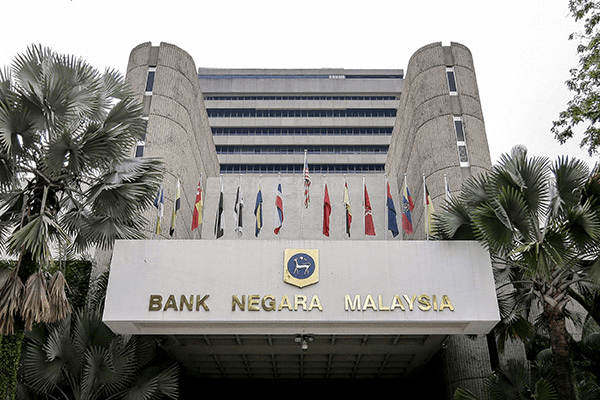
    Bank Negara Malaysia (BNM) has recently announced a reduction in the Statutory Reserve Requirement (SRR) ratio from 2% to 1%. This move is part of a broader strategy to ensure sufficient liquidity in the financial system, supporting economic growth amidst current economic challenges. But what exactly does this mean, and how will it impact individuals and businesses? Let’s break it down.

    Understanding SRR

    The Statutory Reserve Requirement (SRR) is the percentage of a bank’s total deposits that must be kept as reserves with Bank Negara Malaysia. Essentially, it is a tool used by the central bank to control the money supply in the economy. When the SRR is lowered, banks are required to hold less money in reserve, thereby freeing up more funds that can be lent out to businesses and individuals.

    Why Did BNM Reduce the SRR?

    The reduction in the SRR by 1% is expected to release approximately RM19 billion into the banking system, effective from 17 May 2025. This significant injection of liquidity aims to provide banks with more funds for lending and to stimulate economic activities during this period of economic uncertainty.

    The reduction in the SRR from 2% to 1% is aimed at increasing liquidity in the banking system. By allowing banks to keep less money in reserve, more funds become available for lending purposes. This is particularly crucial during periods of economic uncertainty when businesses and individuals may require more financial support. It also helps to reduce the cost of funds for banks, potentially leading to lower interest rates.

    How Does This Impact Us?

    1. More Accessible Loans: With more liquidity in the banking system, banks are more likely to offer loans to businesses and individuals. This can facilitate personal loans, home loans, and business financing, making it easier for borrowers to access funds.
    2. Lower Interest Rates: When banks have more funds to lend, competition among banks may increase, potentially leading to a reduction in lending rates. This is beneficial for borrowers seeking to refinance existing loans or take new loans.
    3. Impact on Savings and Fixed Deposits: On the flip side, while borrowers may benefit from lower interest rates, depositors may see a decrease in interest rates on their savings accounts and fixed deposits as banks adjust their rates to manage the increased liquidity.
    4. Business Expansion and Investment: With more funds available for lending, businesses may find it easier to obtain financing for expansion, investments, or operational costs. This can stimulate economic activity and potentially lead to job creation.

    Potential Risks and Considerations

    While the reduction in SRR can stimulate lending and economic growth, it is essential to consider potential risks. Increased lending could lead to higher household debt if borrowers overextend themselves. Additionally, excessive liquidity could contribute to asset bubbles if funds are channeled into speculative investments.

    Conclusion

    The reduction in SRR from 2% to 1% by Bank Negara Malaysia is a strategic move to increase liquidity and stimulate economic activity. While this creates more lending opportunities and potentially lower interest rates, it is crucial for borrowers to exercise caution and assess their financial capacity before taking on additional debt. Similarly, depositors should monitor interest rate trends to make informed decisions regarding their savings and investments.

    From The Desk of

    Miichael Yeoh

  • 8 Strategies for Paying Off Your Home Loan Faster

    8 Strategies for Paying Off Your Home Loan Faster

    Without a doubt, your mortgage represents one of the most significant financial commitments you’ll undertake. Over its lifespan, the interest paid to the bank alone can skyrocket into tens of thousands. Consider this: by adhering to a 30-year home loan term, you may ultimately shell out twice the original loan amount in total.

    Did you know that within the first five years of a 30-year loan, you’re likely to reduce only about 7% of the principal? Even by the 20th year, you might still be grappling with less than half. It’s high time to reclaim control over your loan and expedite its repayment to save substantial sums in interest.

    Gone are the days of rigid loan structures prevalent from the 1960s to the 1990s. Today, borrowers have access to a plethora of tools and flexible bank policies, enabling them to slash down loan tenures.

    The sooner you bid farewell to your home loan, the sooner you’ll inch closer to retirement and debt-free living. While myriad methods exist to accelerate repayment, not all may be a perfect fit for your situation. It’s imperative to conduct thorough research and select the strategies best aligned with your needs.

    Here are some actionable ways to expedite home loan repayment:

    1. Making Extra Payments: Witness the magic unfold by utilizing a mortgage calculator to see how even modest additional monthly payments can drastically reduce interest and hasten home loan repayment. Remember, every dollar directed towards the principal shrinks the interest burden and speeds up loan clearance
    2. Refinance: Take advantage of prevailing lower interest rates by refinancing your loan. Use a mortgage calculator to gauge potential interest savings, but don’t forget to factor in associated costs like penalties and legal fees.
    3. Negotiate Interest Rate Adjustments: Keep a keen eye on interest rate fluctuations and consider negotiating with your bank for a reduction. Maintaining current installment amounts despite rate reductions can substantially reduce repayment years
    4. Utilize Flexi Mortgages: Explore flexible mortgage options like the Flexi Mortgage or Money Merge Account, where daily interest calculations and account consolidation accelerate principal reduction, thus shortening loan tenure.
    5. Interest Rate Adjustments: Strategize responses to fluctuating interest rates by either increasing monthly installments to maintain repayment duration or maintaining installments to reduce repayment years.
    6. EPF Withdrawals: Tap into your EPF Account II to swiftly reduce principal and expedite loan repayment. This can even be arranged on a monthly basis for added convenience. In Malaysia it is called EPF or Employee Provident Fund. Its a retirement saving account.
    7. Continuous Monitoring and Adjustment: Regularly monitor your loan progress and financial situation, adjusting strategies as needed to optimize repayment efficiency.
    8. Bi-Weekly Payments: Divide your monthly installment into bi-weekly payments, effectively making 13 monthly payments annually. This simple adjustment can shave off at least four years from a typical 30-year loan term, although availability may vary by region. Please take note that not every country has this package.

    By diligently implementing these strategies, you can significantly alleviate the burden of your home loan and pave the way towards financial freedom.

    From the desk of Miichael Yeoh

  • What you should do before applying a loan?

    What you should do before applying a loan?

    Securing a mortgage nowadays presents more challenges compared to two decades ago. During my tenure in the banking industry, a loan could easily be approved with just a photocopy of an identity card and salary vouchers. However, in today’s landscape, a more comprehensive set of documents and detailed borrower reports are required. We must acknowledge that we now live in a world of enhanced technology.

    Twenty years ago, when borrowers approached us for loans, we primarily checked their CTOS records for bankruptcy. If they passed this check, I would submit the loan for approval. However, today, the CTOS system has evolved, incorporating many other borrower details. It’s astonishing that, in most cases, the system possesses more information about individuals than they do themselves.

    Today, I’ll discuss the CTOS report. Another platform providing similar reports is called CCRIS, which we’ll cover in upcoming articles.

    What is CTOS?

    https://ctoscredit.com.my/credit-score-report/

    In simple terms, your CTOS report serves as your financial health assessment, aiding loan providers in evaluating your eligibility for borrowing.

    Whether you like it or not, when you apply for a loan, banks will scrutinize your financial health. Instead of leaving this research solely to the banks, why not check your CTOS report yourself beforehand? This way, you’ll be better prepared when submitting a loan application and won’t be caught off guard.

    There are two types of CTOS reports: a free version and a paid one.

    The free report offers basic information, while the paid report, costing RM27.00, provides more comprehensive and useful details for borrowers. For our discussion, we’ll focus on the full report.

    What’s included in the report?

    1. Personal Information
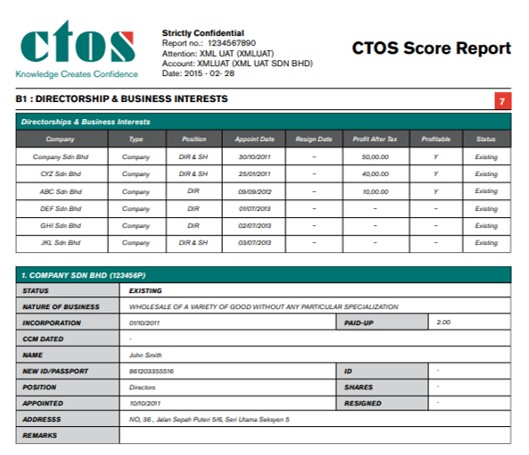
    2. Directorship & Business Interest
    3. Litigation & Bankruptcy
    4. Trade References
    5. CTOS Score
    6. CCRIS Record
    7. Dishonoured Cheques

    For today’s discussion, we’ll delve into sections 2, 3, 5, and 6.

    Directorship & Business Interest

    This section lists any companies associated with the individual. Banks use this information to determine the number of companies an individual is involved with. Sometimes, individuals may disclose only one company, but upon checking, banks may find out about several undisclosed companies. If banks require unbiased information on these companies, they can conduct a CTOS search on them. As mentioned earlier, banks often know more about individuals than individuals do about themselves.

    CTOS Score

    What is it, and how does it work? These are common questions you may have.

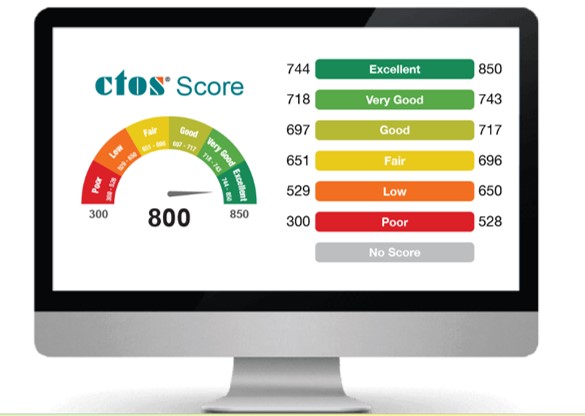
    The CTOS score determines your creditworthiness for the loan you’re applying for, indicating the likelihood of defaulting on repayments. Scores range from 300 to 850. If a borrower falls below the “fair” range, loan approval becomes more challenging. Banks become concerned about the higher risk associated with granting such loans. If borrowers discover that their score is below “fair,” it’s prudent to reassess their financial situation.

    You might wonder what factors influence the score. They include:

    a) Payment History (45%)

    b) Amount Owed (20%)

    c) Length of Credit History (7%)

    d) Credit Mix (14%)

    e) New Credit (14%)

    CCRIS Record

    The Central Credit Reference Information System (CCRIS) is established by Bank Negara Malaysia’s Credit Bureau, offering standardized credit reports on prospective borrowers.

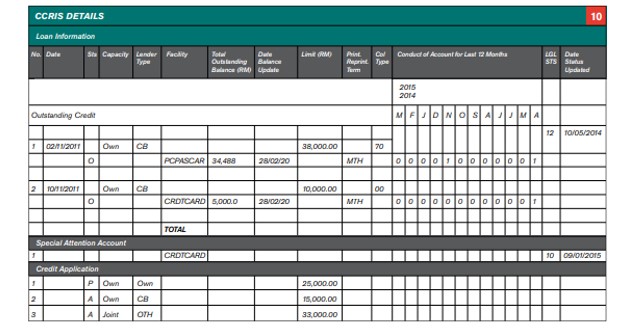
    CCRIS acts as a centralized database, providing insights into your financial status. Monthly updates from relevant institutions furnish essential data such as banks, insurance providers, and government agencies. This process enables financial institutions to evaluate borrowers’ creditworthiness effectively by referencing their financial history records.

    This section offers a detailed breakdown of each facility, including:

    • Status of the facility
    • Capacity
    • Lender Type
    • Facility Type
    • Total Outstanding Balance
    • Limit/Monthly Repayment
    • Repayment Term
    • Collateral Type
    • Conduct of Account
    • Legal Status
    • Special Attention Account
    • Credit Application Details

    If the conduct of the account consistently shows a number higher than zero, say 3, it indicates the borrower is in a three-month default. Banks use this information to assess the likelihood of future defaults.

    That’s a detailed overview of CTOS. I hope you find it helpful. Stay tuned for my next write-up, and don’t forget to subscribe.

    From the desk of Michael Yeoh