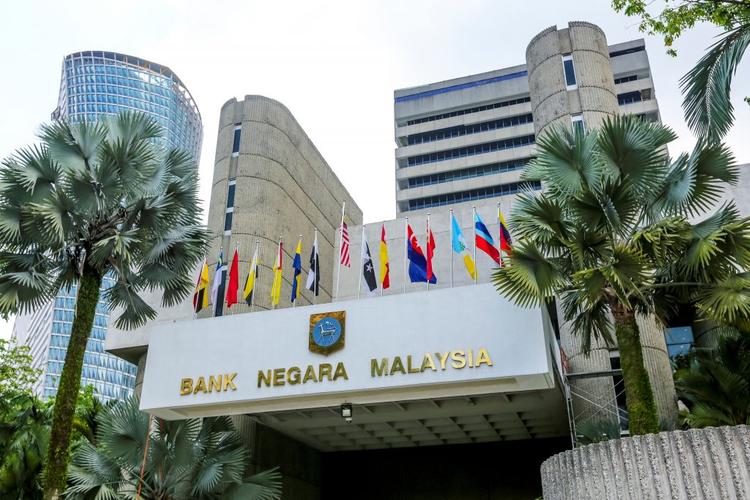
Kuala Lumpur, 10 July 2025 — Bank Negara Malaysia (BNM) has announced a reduction in the Overnight Policy Rate (OPR) by 25 basis points, bringing it down from 3.00% to 2.75%. This move comes amid ongoing efforts to support economic growth and ease financial conditions for households and businesses.
But what does this really mean for everyday Malaysians? And how does it affect your home loan or car loan?
Let’s break it down.
🔎 What Is the OPR?
The OPR is the interest rate at which banks lend money to one another overnight. When BNM adjusts the OPR, it influences Base Lending Rate (BLR) ,Base Rate (BR) and Standardise Base Rate (SBR) used by banks to determine the interest on loans and savings.
Let’s compare how the OPR cut affects a typical housing loan of RM500,000 over 30 years.
Assume a floating interest rate of:
Before: 4.00% (based on 3.00% OPR)
After: 3.75% (after 2.75% OPR cut)
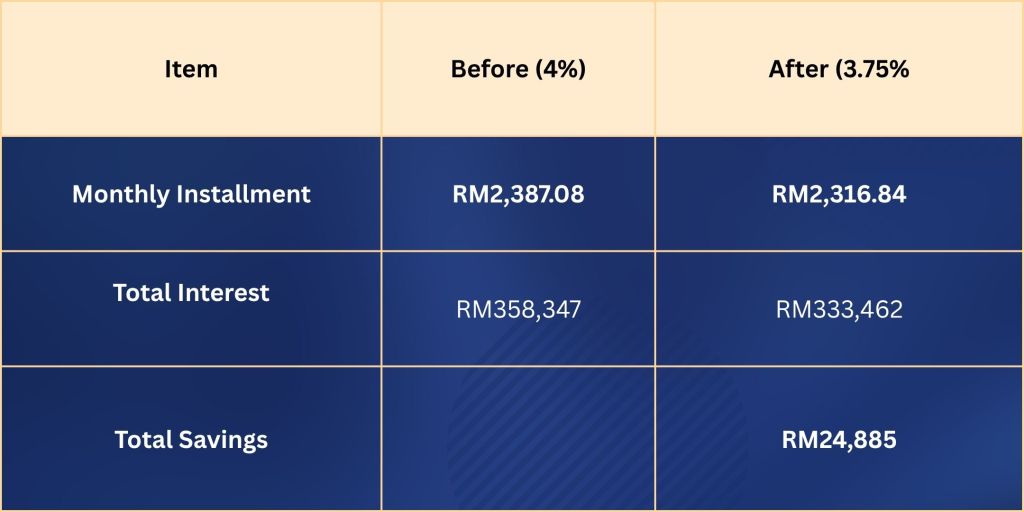
🔹 Before OPR Cut (4.00%)
Loan amount: RM500,000
Tenure: 30 years
Interest rate: 4.00%
Monthly instalment: RM2,387.08
Total interest over 30 years: RM358,347
🔻 After OPR Cut (3.75%)
Loan amount: RM500,000
Tenure: 30 years
Interest rate: 3.75%
Monthly instalment: RM2,316.84
Total interest over 30 years: RM333,462
💡 You Save:
Monthly: RM70.24
Over 30 Years: RM24,885 in interest!
📌 Summary:
📉 Impact Beyond Housing Loans
The OPR cut doesn’t just affect home loans. It also impacts:
Car Loans – Lower monthly repayments
Personal Loans – Cheaper borrowing
Business Loans – Reduced financing costs
However, fixed-rate loans (such as some hire purchase loans) are generally not affected by OPR changes.
🏦 Why Did BNM Cut the OPR?
BNM’s Monetary Policy Committee cited the need to:
Support domestic economic activity
Manage downside risks from global uncertainties
Encourage spending and investment
With inflation under control and growth momentum slowing, the rate cut is intended to provide a cushion and maintain financial stability.
📊 Conclusion: A Relief for Borrowers
If you’re repaying a floating-rate loan, this OPR cut could offer welcome breathing space in your monthly budget. For potential homebuyers, it’s a good time to recalculate affordability and consider locking in better financing packages.
🔍 Tip: Contact your bank to check how the OPR cut affects your current loan rate. You may also explore refinancing options for better savings.
A major financial scandal in Malaysia has exposed a corrupt syndicate involving consultancy firms and bank officials, who siphoned 35% of approved loans from borrowers, primarily civil servants. The Malaysian Anti-Corruption Commission (MACC) revealed that these firms manipulated loan processes, securing multiple overlapping loans for victims, leaving them with crippling debts. Over RM700 million in loans were processed, but borrowers received only a fraction after exorbitant fees. The MACC’s ongoing crackdown has arrested 27 individuals and frozen RM22 million in assets, but the financial and emotional toll on victims remains severe.
Click for more Information or Sign Up
This issue has persisted for years, with many property buyers enticed to purchase multiple properties beyond their means. For instance, individuals with a RM5,000 salary were lured into buying 10 properties with high cashback offers, only to face financial ruin. In one case, a couple after attending my seminar shared how they were encouraged by a “Property Guru” to buy five properties at once, exploiting bank loopholes. They later discovered the properties were overpriced and unrentable, leaving them bankrupt with RM16,000 monthly installments and two young children to support. This highlights the dangers of reckless investment decisions. Always verify sources, avoid intermediaries charging excessive fees, and ensure investments align with your financial capacity.
A financial scandal of massive proportions has rocked Malaysia’s banking sector, exposing a corrupt syndicate that preyed on borrowers, especially civil servants, by siphoning off exorbitant fees from approved bank loans.
The Malaysian Anti-Corruption Commission (MACC) recently uncovered that financial consultancy firms, operating under the guise of loan facilitators, were pocketing at least 35% of the approved loan amounts, leaving victims with far less than what they had borrowed.
A Web of Deceit: How Borrowers Were Trapped
The scheme involved consultancy firms manipulating the loan approval process in collusion with corrupt bank officials. According to MACC Chief Commissioner Tan Sri Azam Baki, the syndicate exploited desperate borrowers by securing multiple loans from various financial institutions simultaneously, orchestrating a complex scam that resulted in borrowers being burdened with insurmountable debts.
“These firms orchestrated ‘multiple loans’ by manipulating bank systems and turn-around times, making it seem as if previous loans had been settled when, in reality, they had not. This deception ensured that borrowers would receive overlapping loans, only to have substantial portions deducted as ‘fees,’” said Azam.
Many victims, entangled in financial distress and seeking funds to settle previous debts, unknowingly agreed to the terms set by these firms. In addition to the 35% consultancy fee, borrowers were also subjected to loan settlement charges of up to 40%, further exacerbating their financial woes.
RM700 Million in Loans: But Victims Still Drowning in Debt
The investigation, codenamed Ops Sky, revealed that the syndicate managed to secure approximately RM700 million in loans for borrowers. However, instead of receiving their full loan amounts, victims were left with only a fraction of what they applied for, leading to a debt crisis far beyond their means to repay.
Despite the dismantling of the syndicate, the damage has already been done. Many victims now owe three times more than their financial capabilities allow, making repayment virtually impossible. “Even though the syndicate has been dismantled, borrowers remain indebted to the banks and must continue servicing their loans,” Azam stated.
Massive Crackdown: Bank Officers and Syndicate Members Arrested
In a coordinated crackdown, MACC and Bank Negara Malaysia raided 24 locations across the Klang Valley, including residences and offices linked to the syndicate. The operation led to the arrest of 12 key individuals, including bank officials and employees of the financial consultancy firms involved.
Further investigations revealed that 98 company and personal bank accounts worth over RM22 million had been frozen, and nearly 4,000 documents seized as part of the evidence collection.
A total of 27 individuals, including 18 bank officers, eight financial consultancy employees, and one member of the public, were detained before being released on bail.
Social Media and Celebrities Used to Lure Victims
Adding another layer to the scandal, the syndicate aggressively marketed its services using social media influencers, celebrities, and public figures to gain credibility.
Advertisements flooded Facebook, TikTok, and Instagram, targeting schoolteachers, nurses, and government employees.
The firms even conducted surveys, roadshows, and CSR programs at schools and hospitals, falsely promoting their services as legitimate financial solutions.
What’s Next? Ongoing Investigations and a Warning to the Public
The MACC has vowed to continue its investigations under Ops Sky, with more witnesses expected to be summoned. The public is urged to be cautious when dealing with financial consultancy firms that promise easy loans, especially those charging high service fees upfront. “This case serves as a stark warning and always verify loan processes directly with the bank and avoid intermediaries who demand excessive fees,” Azam cautioned.
As investigations continue, Malaysians are left questioning how such large-scale corruption involving multiple financial institutions could have persisted unchecked for so long. The financial burden on victims remains heavy, and the battle for justice is far from over.
What can I say? Malaysians are incredibly innovative. We always find all sorts of ways to make money. Recently, I stumbled upon an intriguing article online about a new scheme: borrowing against your EPF. Yes, you heard me right. If you have money in your EPF and you are between the ages of 48 to 55, you are supposedly eligible to borrow. But is this scheme legal? The answer is a resounding “NO.” There is no such scheme approved by KWSP. This is the creation by syndicates.
I discovered that many people are promoting this scheme. Approval is alarmingly easy; all you need is a copy of your MyKad and your latest EPF statement. As long as there is money in your account, consider your loan approved. Of course, the interest rate is sky-high, but the borrower doesn’t need to repay until EPF withdrawal.
Picture Credit: Focus Malaysia
These types of loans pose a significant risk to the financial security of retirees. With the promise of immediate cash, many are tempted to apply, potentially jeopardizing their retirement. EPF contributors are strongly advised to seek advice before considering such schemes.
Bank Negara Malaysia (BNM) has announced today (9th May 2024) that the Overnight Policy Rate (OPR) will remain steady at 3%. This rate has remained unchanged since May 2023, marking a year of consistent monetary policy.
The monetary policy meets six times annually to deliberate on the OPR.
Source: BNM
Looking ahead , there is uncertainty surrounding whether the OPR will stay at 3% or increase further. Historically, the highest OPR since April 2015 was 3.50%, and the lowest was 1.75% in July 2020 during the COVID-19 pandemic. Typically, changes in the OPR are made in increments of 25 basis points (0.25%).
As for the likelihood of an OPR increase this year, it appears unlikely that there will be a reduction in the near future. Instead, the OPR will either hold steady or increase depending on several factors:
EPF Withdrawals: Starting May 11, 2024, contributors to the Employees Provident Fund (EPF) can withdraw from Account 3 at any time, potentially leading to RM25 billion (around 1.3% of GDP) in withdrawals. This could result in increased demand-driven inflation.
Civil Service Salary Hike: There may be a raise in civil service salaries by over 13% beginning in December, which could also contribute to inflationary pressures.
Fuel Subsidy Rationalization: Implementation of fuel subsidy rationalization could occur in 2025 or earlier, which may further increase inflation risk.
Given these factors, my prediction is that the OPR is likely to remain unchanged at 3% this year, but it could increase in 2025 due to inflationary pressures. This would allow BNM to maintain stability in the economy while also addressing any potential inflation concerns.
After all the searching, surveying and checking, you have finally found your perfect home. Now comes the hardest part. The property is not yours to call home yet. Unless you buy it in cash, like most homebuyers, you would need to rely on a bank loan to turn your dream into reality.
Applying for a home loan can be quite nerve-wracking especially for first-time home buyer. What’s more, it can be very frustrating if the application is unsuccessful. If your loan is rejected, it’s not the end of the world, but it is human nature to put the blame on someone else. In a way, pointing the finger may also help you understand why your application was rejected, and what you can do differently in your next attempt. We have made a list of the top 3 contenders for the blame game:
Plenty of people blame Bank Negara Malaysia (BNM) for the many loan rejections in Malaysia. Are they the culprit, though? Well, BNM is the one making all the loan policies in Malaysia and most people may feel that the ever-tightening policies are making it more difficult to borrow from banks.
However, we need to look at this from another point perspective. If BNM did not have all these policies in place, we will most likely face a subprime mortgage crisis, as what occurred in the USA in 2008. How did this crisis come about? This happens when banks get greedy and start lending to anyone, even to borrowers who have a history of low credit scores and problems with debt. In time, these high-risk borrowers will default on their loan repayment and this will have a ripple effect and evolve into a national issue.
The Solution: Keep tabs on Bank Negara Malaysia’s latest borrowing regulations
With the country’s current slow but fluctuating economic growth, it’s beneficial to keep yourself updated with the latest Bank Negara Malaysia (BNM) borrowing regulations and not depend on word of mouth from friends or relatives.
Prior to that, homeowners were allowed to get their homes refinanced for up to 90% of their value with a maximum repayment tenure of 35 years and were able to use the cashed-out portion for investments. But in the 2014 revision, BNM capped the tenure of personal loans at 10 years.
So why does this matter? Well, take this example: your existing home loan with Bank A is RM400,000 and perhaps because of lower interest rates, you want to refinance your home for RM550,000 at Bank B. The additional RM150,000 would be classified as a personal loan and the 10-year repayment tenure would kick in.
This means that the DSR of the cashed-out portion would be calculated using the 10-year tenure, resulting in a much higher DSR and thereby affecting your overall credit score and potentially leading to your loan application getting rejected.
Besides that, BNM recently shared that many banks were using unfair T&Cs in housing loan contracts. BNM has assured that it will be releasing a set of standard T&Cs soon to keep Financial Service Providers in check – where they must act in good faith by ensuring the fairness of contract terms, provide clear and concise product information as well as offer appropriate advice/recommendation based on the needs and financial circumstances of loan applicants.
As a savvy consumer, you would want to equip yourself with these standards once it is out and study your rights as a financial consumer before approaching a bank for a home loan.
Therefore, we must remember that under BNM, we have a prudent and balanced lending policy. We need it to protect our country. Best to think again before pushing the blame onto BNM.
If we do not blame BNM, can we blame the banks instead? After all, they are the ones who approve or reject the loans. Let’s try this – put yourself in the bank’s shoes. Say you are the lender, and your friend the borrower, wants to borrow RM50,000 from you. You know that your friend earns RM5,000 a month. Each month, most of his money goes into paying off his debts. The big question here is, will you lend the money to him? The risk of not getting your money back is very high. Logically, most people would think twice or not even consider lending their friend that sum of money. A bank thinks the same way – they are not a charity, but a profit-driven organization who are accountable to their shareholders.
Some banks have their own internal policies in lending on top of the existing BNM policies – such as having their own scoring system. As different banks have different lending policies you need to know which bank is the most suitable one for you by conducting your own research and comparison. But do keep in mind that even before they look at your documents, they will first check your credit rating. If your rating is low, it’s not hard to see why your application may be rejected immediately. Do you still think we should be blaming the banks?
But do keep in mind that even before they look at your documents, they will first check your credit rating. If your rating is low, it’s not hard to see why your application may be rejected immediately.
The Solution: Determine the best bank DSR (which will match your DSR)
To reduce the chances of getting your home loan application rejected, you should first calculate your Debt to Service ratio (DSR), which is the calculation of your debt against your monthly income.
DSR = (Total commitment ÷ Nett Income) x 100
One of the most common reasons why banks would reject a home loan application is if the applicant’s DSR is above the bank’s maximum allowable DSR. This can get tricky as every bank will have its own respective guidelines for the maximum allowable DSR that they are willing to accept.
It could be affected by various factors such as income, age, qualifications and even your net worth. The most ideal DSR range would be between 50%-60% as it would hit below the maximum allowable DSR of many banks and thus the likelihood of loan approval would increase.
If your DSR is the reason why your loan application was rejected, don’t worry! You can start improving your DSR by either reducing your current debts or by consolidating your unsecured loans and credit card bills. Check out LoanCare, which calculates and uses your DSR to help you compare home loan products across at least 10 banks in Malaysia.
3. The borrowers
How about if we blame ourselves, the borrowers? Plenty of people are laden with debts from credit cards, personal loans, luxury cars and such. Would it be fair to ask the banks to lend them more money? The risk of non-repayment is very high.
The Solution: Determine your CCRIS report pitfalls
If your home loan is denied, the first thing you want to do is to check your CCRIS report. However, these days it’s rare to find anyone who isn’t aware that they must first check their credit score via The Central Credit Reference Information System (CCRIS). This system reflects your past 12 months of credit activities and shows the bank whether you are a good or bad paymaster.
However, the buck does not stop at having a great credit score. There are other factors which might skew your report. For instance, there is always the question, “If my loan is declined, when can I apply again?”
Did you know that all of your loan rejections are also reflected in your CCRIS? This can prove to be fatal for those that cast a wide net by submitting loan applications to multiple banks. Banks would usually be aware of any prior rejections via their CCRIS record, and thus, applicants would have to wait between 3-6 months before attempting to apply for another loan.
As such, it’s wise to improve your credit score before your next attempt. If you have multiple credit cards and loans attached to your name, making timely payments could help show that you are able to manage your commitments and are a good paymaster.
Besides that, zero obligations are not necessarily a good thing either. Keep in mind that banks would also be reluctant to approve your loan application if your CCRIS report is blank or ‘clean’ – where there are no credit cards/loan/overdraft facilities under your name. Better to have at least one active credit facility with timely payments to prove to the bank that you are able to take on and handle debt obligations responsibly.
The Next Step: Prepare at least 6 months of documentation
After fixing your credit score, the next thing you want to do to prove to the bank that you will be a good paymaster is to prepare at least 6 months’ worth of documentation. Regardless of whether you are a salaried employee or a freelancer, keeping meticulous records of all your financial documents is especially beneficial as the bank requires proof of financial capability.
In order to make your life much easier when it is time to submit your loan application, it’s advisable to keep on hand a record of the latest 6 months’ documentation of the following:
(a) EA Form/Form BE/Form B: Always file and pay your income taxes within the prescribed dateline.
(b) Salary slip/proof of income: Banks will require a continuous monthly record of your proof of income whether it’s salary slips or business banking statements. As such, make sure that your records are well organised with every month accounted for.
(c) EPF statements: This will not be a problem if you are a salaried employee as both you and your employer are required by law to make monthly contributions to your EPF. However, if you are a freelancer, consider making voluntary monthly contributions as a way to boost your credit portfolio.
(d) Bank account statements: Having either a current account or a separate saving account with a steady and consistent balance is another method that can help bolster your image as a responsible and credible borrower.