Tag: Bank Negara

  • What Is OPR in Malaysia and How Does It Affect Housing Loan Interest Rates?

    What Is OPR in Malaysia and How Does It Affect Housing Loan Interest Rates?

    By Miichael Yeoh

    As someone who has spent nearly three decades in banking, mortgage advisory and property strategy, one question I get repeatedly from investors and homebuyers is:

    “Why did my bank increase (or educe) my interest rate when I didn’t change anything?”

    The answer almost always traces back to one key number — the Overnight Policy Rate (OPR).

    Let’s break down how OPR is derived, who decides it, and how it directly affects your housing loan, business financing, and even fixed deposits.


    What Is OPR?

    Bank Negara Malaysia (BNM) uses the Overnight Policy Rate (OPR) as its main monetary policy tool.

    The OPR is the interest rate at which banks lend money to one another overnight. It serves as the benchmark rate that influences all other interest rates in the country.

    Think of it as the “master switch” of Malaysia’s financial system.


    How Is OPR Derived?

    OPR is not randomly adjusted. It is decided by BNM’s Monetary Policy Committee (MPC) based on several key economic indicators:

    1️⃣ Inflation (Price Stability)

    If inflation is rising too quickly, BNM may increase OPR to slow down spending and borrowing.
    If inflation is low or the economy is weak, BNM may reduce OPR to stimulate growth.

    2️⃣ Economic Growth (GDP)

    Strong economic growth may lead to higher OPR to prevent overheating.
    Weak GDP growth may lead to lower OPR to encourage borrowing and investment.

    3️⃣ Employment & Consumer Spending

    High unemployment? Lower OPR to boost activity.
    Strong consumer demand? Possibly tighten policy.

    4️⃣ Global Economic Conditions

    US Federal Reserve rates, global trade trends, currency strength, and geopolitical risks all influence Malaysia’s monetary decisions.

    5️⃣ Financial System Stability

    BNM ensures banks remain liquid and stable. OPR adjustments help manage systemic risk.

    In simple terms:

    OPR balances growth and inflation.


    How OPR Affects Banks’ Interest Rates

    When OPR changes, banks adjust their benchmark rates such as:

    • BR (Base Rate)
    • SBR (Standardised Base Rate)

    Most housing loans today are priced as:

    SBR + Spread (e.g., SBR + 1.5%)

    When OPR increases:

    • SBR increases
    • Monthly instalments increase
    • Loan affordability reduces

    When OPR decreases:

    • SBR decreases
    • Monthly instalments reduce
    • Borrowing becomes cheaper

    Example: How It Impacts a Housing Loan

    Let’s say:

    • Loan: RM500,000
    • Tenure: 35 years
    • Rate: SBR 3.00% + 1.50% = 4.50%

    If OPR increases by 0.25%:

    • SBR may rise to 3.25%
    • New rate becomes 4.75%
    • Monthly instalment increases

    Even a 0.25% increase can mean thousands of ringgit extra over the loan tenure.

    This is why property investors must monitor OPR closely.


    Impact on Different Groups

    🏠 Homeowners

    Higher OPR = higher instalments (if on floating rate).

    🏢 Property Investors

    Rental yield may be squeezed if instalments rise but rental cannot increase proportionally.

    💼 Businesses

    Cost of financing increases, affecting expansion decisions.

    💰 Savers

    Good news — Fixed deposit rates usually improve when OPR rises.


    Why OPR Matters in Property Strategy

    As a developer consultant and property strategist, I always advise clients:

    Don’t only calculate today’s instalment. Stress-test at +1% or +2%.

    Markets move in cycles. OPR will not stay low forever.

    Smart investors:

    • Lock in good spreads during low-rate environments
    • Structure debt efficiently
    • Maintain cash flow buffers

    Final Thoughts

    OPR is not just a technical banking term.

    It is the heartbeat of the financial system, influencing property prices, loan affordability, rental yields, and overall market sentiment.

    Understanding how it works allows you to:

    • Make better borrowing decisions
    • Time property acquisitions strategically
    • Structure financing intelligently

    If you are planning your next property move, always ask:

    “What is the interest rate cycle telling me?”

    Because in property investing,
    Timing and financing strategy often matter more than price.

  • Before You Buy Any Property, Run It Through This Simple Checklist

    Before You Buy Any Property, Run It Through This Simple Checklist

    Most property mistakes don’t happen after you buy.
    They happen before you sign.

    Over the years — working in banks, speaking on stages, and educating buyers and investors — I’ve noticed one consistent pattern:

    People buy property based on emotion, marketing, or price,
    instead of structure, numbers, and risk.

    Good property decisions are rarely accidental.
    They are the result of asking the right questions early.

    Let me show you the checklist I personally use — and teach — before anyone commits to a property purchase.


    1. Start With the Right Question (Not “Can I Buy?”)

    The wrong question is:

    “Can I get a loan?”

    The better question is:

    “Is this property right for me?”

    Before you look at projects, promotions, or discounts, be clear on your purpose:

    • Are you buying for own stay, rental income, or long-term growth?
    • Do you want monthly stability, future upside, or both?
    • How long are you prepared to hold this property?

    A good property for someone else can be a bad property for you.

    Clarity always comes before commitment.


    2. Understand Your Financial Comfort Zone

    Many buyers confuse approval with affordability.

    Just because you can commit, doesn’t mean you should.

    Before buying, be honest about:

    • Your monthly commitments after purchase
    • Your buffer if interest rates rise or income changes
    • Whether the property adds pressure or flexibility to your life

    A simple rule I often share:

    If a property causes stress from Day One, it’s already a bad decision.

    Property should support your long-term plan — not trap you in it.


    3. Protect Yourself Before You Celebrate

    Buying property is not just about price and location.
    It’s about rights, responsibilities, and clarity.

    Before you sign anything, make sure you understand:

    • What you truly own
    • Any conditions or restrictions attached to the property
    • Your obligations now and in the future
    • What happens if things don’t go according to plan

    Many buyers only realise what they signed after problems arise.
    By then, it’s often too late.

    Confidence comes from understanding — not assumptions.


    4. Look at the Real Cost, Not Just the Purchase Price

    The purchase price is only the beginning.

    You need to consider:

    • All upfront costs
    • Ongoing holding expenses
    • The impact of rental income on your overall finances
    • What you walk away with — not just what comes in

    A property that looks attractive on paper can disappoint once all costs are considered.

    Smart buyers focus on net outcome, not headline numbers.


    5. Evaluate the Property Like an Investor, Even If You’re Not One

    Even if you’re buying for own stay, think ahead.

    Ask yourself:

    • Who else would want this property in the future?
    • Is supply increasing in this area?
    • Are rental expectations realistic?
    • If you needed to sell, who would be your buyer?

    Hope is not a strategy.
    Every property should have a clear future story.


    6. A Simple Yes / No Filter I Personally Use

    Before I say yes to any property, I run through this:

    • ✅ Does this make sense financially over time?
    • ✅ Do I fully understand what I’m committing to?
    • ✅ Am I comfortable holding this through different market cycles?
    • ✅ Does this fit my life plan — not just today, but later?
    • ✅ Do I have flexibility if things change?

    If any answer is No, I pause.

    Property rewards patience far more than pressure.


    Final Thought: Learn First, Buy Second

    Property is not about buying fast or buying early.
    It’s about buying wisely.

    Too many people buy first — and learn later.
    The cost of that mistake can last decades.

    That’s why I believe education must always come before action.

    When you understand the decision fully, confidence follows naturally.

    And confident buyers make better property decisions — every time.

    From the desk of

    Miichael Yeoh

  • Property Refinancing in Malaysia

    Property Refinancing in Malaysia

    New Rules, Regulations & When Refinancing Actually Makes Sense

    Over the years, refinancing has been one of the most powerful financial tools for Malaysian homeowners and property investors. Used correctly, it can improve cash flow, reduce interest costs, or unlock equity for smarter investments.

    However, recent regulatory changes by Bank Negara Malaysia (BNM) mean refinancing is no longer as straightforward as before — especially when it involves cash-out.

    If you’re considering refinancing your property in 2025 or beyond, here’s what you must understand before making a move.


    What Is Property Refinancing?

    Property refinancing simply means replacing your existing home loan with a new loan, usually with another bank, based on your property’s current market value.

    Homeowners typically refinance to:

    • Get a lower interest rate
    • Reduce monthly instalments
    • Adjust loan tenure
    • Access cash from accumulated property equity
    • Consolidate high-interest debts

    The strategy itself hasn’t changed — the rules have.


    What’s New? Key Refinancing Rules You Must Know

    1. Cash-Out Refinancing Is Now More Restrictive

    One of the biggest changes affects cash-out refinancing.

    If you refinance and take extra cash for personal use (such as lifestyle spending, personal debts, or non-income-generating purposes), that portion may now be treated as personal financing, not a housing loan.

    👉 Key impact:

    • The cash-out portion may be capped at a maximum repayment tenure of 10 years
    • Monthly instalments will be significantly higher compared to spreading it over 30–35 years

    This is a major shift. In the past, many borrowers stretched cash-out amounts across the full home loan tenure, keeping instalments low but debt long.


    2. Stronger Affordability & DSR Checks

    Banks are now applying stricter Debt Service Ratio (DSR) assessments, especially for:

    • Multiple property owners
    • Refinancing with cash-out
    • Borrowers with existing personal loans or credit card balances

    Even if your property value has increased, approval is no longer guaranteed if your cash flow doesn’t support the new repayment structure.


    3. More Transparency on Loan Costs

    BNM has reinforced rules to ensure:

    • Clear disclosure of effective interest rates
    • Transparent breakdown of total repayment costs
    • Fair interest calculations based on reducing balance, not outdated methods

    This protects borrowers — but it also means banks are less flexible with “creative structuring”.


    Why Did Bank Negara Tighten Refinancing Rules?

    The objective is simple: reduce unhealthy household debt behaviour.

    Over the years, many Malaysians:

    • Used refinancing repeatedly for lifestyle spending
    • Rolled short-term debts into long-term housing loans
    • Focused on “low monthly instalment” instead of total debt impact

    The new rules encourage:

    • Responsible borrowing
    • Better financial planning
    • Using refinancing for productive purposes, not emotional decisions

    So… Why Should You Refinance a Property?

    Refinancing still makes sense — if done for the right reasons.

    1. To Lower Your Interest Rate

    If your current loan is:

    • On an old package
    • Above current market rates

    Refinancing can reduce:

    • Monthly instalments
    • Total interest paid over the loan tenure

    This is the cleanest and safest reason to refinance.


    2. To Improve Monthly Cash Flow

    Some homeowners refinance to:

    • Extend tenure
    • Reduce instalments
    • Create breathing space for cash flow

    This can be helpful during:

    • Business expansion
    • Income transition
    • Temporary financial tightening

    However, it must be done strategically, not emotionally.


    3. To Access Equity for Income-Producing Purposes

    This is where refinancing still shines — when the cash is used productively, such as:

    • Renovating a rental property
    • Funding another investment
    • Business expansion with clear returns

    Banks are generally more supportive when refinancing is tied to income generation, not consumption.


    4. Debt Consolidation (With Caution)

    Refinancing to clear:

    • Credit cards
    • Personal loans

    can reduce interest costs if discipline improves after refinancing.

    If spending habits remain unchanged, refinancing only delays the problem.


    5. To Restructure Your Property Portfolio

    For investors, refinancing can be used to:

    • Optimise loan structure across multiple properties
    • Release equity to rebalance portfolio risk
    • Improve overall holding power

    This requires proper planning — not just chasing approval.


    What You Should Consider Before Refinancing

    Before signing anything, ask yourself:

    ✔ Does refinancing truly save money after legal & valuation costs?
    ✔ Can I comfortably afford repayments if cash-out tenure is shorter?
    ✔ Am I refinancing for strategy — or short-term relief?
    ✔ Does this move strengthen my financial position 5–10 years from now?

    Refinancing is a tool. Used correctly, it builds wealth. Used wrongly, it creates silent financial stress.


    Final Thoughts from Miichael

    In today’s environment, refinancing is no longer about “how much cash can I take out”.

    The real question is:

    Does this refinancing decision improve my financial position — or just make today easier at tomorrow’s expense?

    With tighter rules in place, planning matters more than approval.

    If you’re unsure whether refinancing makes sense for your situation, get proper advice before committing. The cost of a wrong decision today can take years to undo.

  • Residential Property & Mortgage Trends in Malaysia (2026 and beyond)

    Residential Property & Mortgage Trends in Malaysia (2026 and beyond)

    By Miichael Yeoh

    The Malaysian property market has been through a lot in the last few years — pandemic, inflation, rising construction costs, slow wage growth, and changing buyer behaviour. But as we step into 2025, one thing is clear:

    Property is still moving… but the market is no longer the same.
    Buyers are more cautious, banks are more selective, and affordability remains a major issue.

    Here’s my take on what’s really happening in the residential property and mortgage landscape, and what you should pay attention to — especially if you’re planning to buy, invest, or restructure your loans.


    📈 Long-Term Price Trend: Property Still Moves Up

    Whether the market is “good” or “bad”, one fact remains consistent:

    Property prices in Malaysia have been rising steadily for the last 20+ years.

    Urban areas like Klang Valley, Penang and Johor consistently show appreciation because of:

    • population growth
    • job concentration
    • infrastructure development
    • scarcity of prime land

    But here’s the catch:
    House prices have risen much faster than income, making affordability the No.1 challenge for Malaysians today.

    This explains why many young buyers are stuck deciding between renting longer… or compromising on location and size.


    🏘️ What’s Happening in the Market Now?

    1. Transaction volume is rising — but buyers are choosy

    2024 recorded strong growth in overall property transactions, and 2025 is projected to see single-digit positive growth.
    People are buying — but not blindly.

    Buyers today compare:

    • price per sq ft
    • rental potential
    • exit value
    • access to MRT / LRT
    • developer reputation

    Gone are the days when anything “new launch” can sell out.
    Today, value matters more than hype.


    💰 Mortgage & Financing Trend: Here’s the Real Story

    The biggest shift recently is OPR dropping to 2.75%, making borrowing cheaper.

    This directly means:

    • Lower monthly instalments
    • Higher loan eligibility
    • Better cashflow for investors

    But with great news comes reality…
    Banks are approving loans more carefully than ever.

    Your CCRIS, CTOS, commitments and even gig-income consistency matter.
    If your financial health is not clean, even a low OPR won’t help you.

    For many Malaysians, the challenge isn’t interest rate — it’s getting the loan approved.


    🧱 Supply vs Demand: The Affordable Gap

    You’re hearing this everywhere:

    “So many houses unsold!”
    —but at the same time—
    “I can’t find any home I can afford!”

    Why?
    Because the overhang is mainly:

    • too expensive for the mass market
    • too big (1,000 sq ft and above)
    • wrong location

    This mismatch will continue unless developers pivot more aggressively into the mid-market segment.


    🧭 What Buyers & Investors Should Look At Now

    ✔️ If you’re a first-time buyer

    This is a golden window.
    Low OPR + many choices + developers offering incentives = value for money.

    Look for:

    • good location > big size
    • future MRT/LRT corridors
    • reputable developers
    • high rental demand areas

    ✔️ If you’re an investor

    Capital gain will still happen — but don’t expect overnight appreciation.
    Focus on:

    • rental yield
    • undervalued areas
    • distress or motivated sellers
    • T.O.P. projects with ready tenants

    The smart investors in 2025 are not speculating.
    They’re buying below market value, or in growth corridors, or early in new infrastructure zones.

    ✔️ If you own multiple properties with loans

    This is the best time to:

    • refinance
    • consolidate debts
    • reset your cashflow
    • restructure your portfolio

    A small adjustment in interest rate can save thousands per year.


    🧩 Conclusion: The Market Isn’t Booming, But It’s Moving

    Malaysia’s residential market today is stable, resilient, and buyer-driven.
    We’re not in a bubble.
    We’re not in a crash.

    We’re in a value-driven market, where the winners are:
    ✔️ informed buyers
    ✔️ strategic investors
    ✔️ those who manage their loans wisely

    If you understand the trends — and you know how to analyse value correctly — 2025-2026 can be a very profitable year for you.

  • 📰 BNM Cuts OPR to 2.75%: What It Means for You and Your Loans

    📰 BNM Cuts OPR to 2.75%: What It Means for You and Your Loans

    Kuala Lumpur, 10 July 2025 — Bank Negara Malaysia (BNM) has announced a reduction in the Overnight Policy Rate (OPR) by 25 basis points, bringing it down from 3.00% to 2.75%. This move comes amid ongoing efforts to support economic growth and ease financial conditions for households and businesses.

    But what does this really mean for everyday Malaysians? And how does it affect your home loan or car loan?

    Let’s break it down.


    🔎 What Is the OPR?

    The OPR is the interest rate at which banks lend money to one another overnight. When BNM adjusts the OPR, it influences Base Lending Rate (BLR) ,Base Rate (BR) and Standardise Base Rate (SBR) used by banks to determine the interest on loans and savings.

    A lower OPR typically leads to:

    ✅ Lower loan interest rates
    ✅ Cheaper monthly repayments
    ✅ Easier access to credit


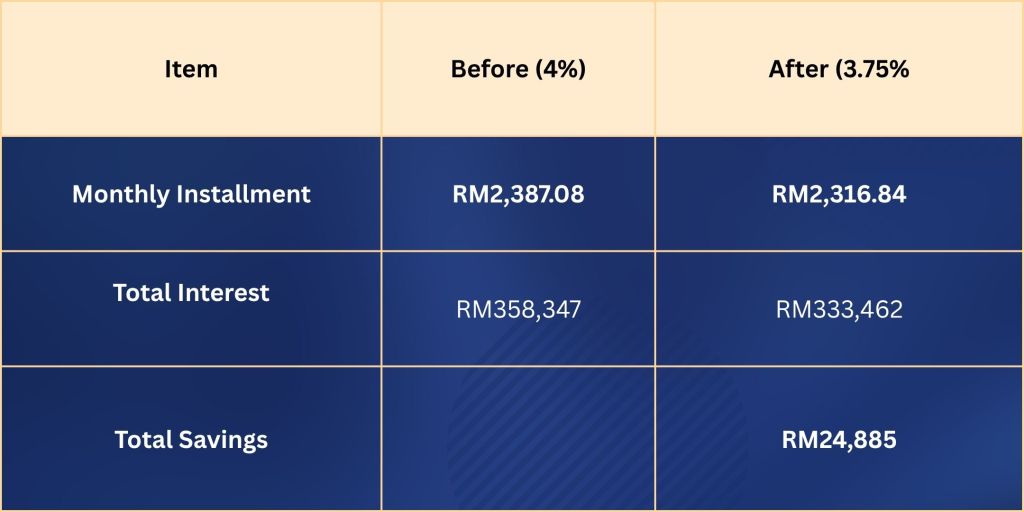
    🏠 Before & After: Sample Loan Calculation

    Let’s compare how the OPR cut affects a typical housing loan of RM500,000 over 30 years.

    Assume a floating interest rate of:

    • Before: 4.00% (based on 3.00% OPR)
    • After: 3.75% (after 2.75% OPR cut)

    🔹 Before OPR Cut (4.00%)

    • Loan amount: RM500,000
    • Tenure: 30 years
    • Interest rate: 4.00%
    • Monthly instalment: RM2,387.08
    • Total interest over 30 years: RM358,347

    🔻 After OPR Cut (3.75%)

    • Loan amount: RM500,000
    • Tenure: 30 years
    • Interest rate: 3.75%
    • Monthly instalment: RM2,316.84
    • Total interest over 30 years: RM333,462

    💡 You Save:

    • Monthly: RM70.24
    • Over 30 Years: RM24,885 in interest!

    📌 Summary:


    📉 Impact Beyond Housing Loans

    The OPR cut doesn’t just affect home loans. It also impacts:

    • Car Loans – Lower monthly repayments
    • Personal Loans – Cheaper borrowing
    • Business Loans – Reduced financing costs

    However, fixed-rate loans (such as some hire purchase loans) are generally not affected by OPR changes.


    🏦 Why Did BNM Cut the OPR?

    BNM’s Monetary Policy Committee cited the need to:

    • Support domestic economic activity
    • Manage downside risks from global uncertainties
    • Encourage spending and investment

    With inflation under control and growth momentum slowing, the rate cut is intended to provide a cushion and maintain financial stability.


    📊 Conclusion: A Relief for Borrowers

    If you’re repaying a floating-rate loan, this OPR cut could offer welcome breathing space in your monthly budget. For potential homebuyers, it’s a good time to recalculate affordability and consider locking in better financing packages.

    🔍 Tip: Contact your bank to check how the OPR cut affects your current loan rate. You may also explore refinancing options for better savings.

    From The Desk of

    Miichael Yeoh

  • Effects of OPR Changes on Borrowing and Savings

    Effects of OPR Changes on Borrowing and Savings

    As of January 2025, Bank Negara Malaysia (BNM) has maintained the Overnight Policy Rate (OPR) at 3.00%, a position held since May 2023.

    Understanding the Overnight Policy Rate (OPR)

    The OPR is the benchmark interest rate at which banks lend to one another overnight. Set by BNM, it serves as a primary monetary policy tool to regulate liquidity, control inflation, and sustain economic growth.

    Implications of an OPR Increase

    When BNM raises the OPR, it signals an intent to tighten monetary policy. The effects of such an increase include:

    Higher Borrowing Costs: Banks typically respond to an OPR hike by raising their base rates, leading to increased interest rates on loans and mortgages. This results in higher monthly repayments for borrowers.

    Enhanced Savings Returns: Conversely, depositors may benefit from higher interest earnings on savings and fixed deposits, encouraging increased savings.

    Controlled Inflation: Elevated borrowing costs can dampen consumer spending and business investments, helping to moderate demand-pull inflation.

    Currency Appreciation: Higher interest rates can attract foreign investment, potentially strengthening the Malaysian ringgit.

    Impact on Property Market: Increased interest rates may lead to higher mortgage costs, potentially cooling property demand and affecting market dynamics.

    Recent Economic Context

    In the third quarter of 2024, Malaysia’s economic growth slowed to 5.3% from 5.9% in the previous quarter, influenced by reduced oil and gas production. Despite this, robust household spending and increased investments provided support.

    BNM’s Monetary Policy Stance

    BNM has maintained the OPR at 3.00% since May 2023, citing positive economic growth and steady inflation. Economists anticipate that the central bank will keep the OPR unchanged until at least 2026, aligning with current economic assessments.

    Interest Rate Impact Example

    Let’s look at an example of how interest rates affect property loans. Assume you’re borrowing RM500,000 for 30 years:

    • Current Interest Rate (4.5%): Monthly repayment is approximately RM2,533.43.
    • If OPR Increases by 25 Basis Points (4.75%): Monthly repayment rises to around RM2,608.82.
    • Impact: This increase of RM75.39 per month adds up to RM27,140.40 over the loan’s term.

    This illustrates why understanding interest rates and their potential changes is crucial for planning your finances.

    Conclusion

    An increase in Malaysia’s OPR has multifaceted effects, influencing borrowing costs, savings returns, inflation, currency value, and the property market. Understanding these dynamics is crucial for individuals and businesses to make informed financial decisions in response to monetary policy changes.

    From the Desk of

    Miichael Yeoh

  • Unlock Rental Property Success with a Strong DSCR

    Unlock Rental Property Success with a Strong DSCR

    Ever come across the term Debt Service Coverage Ratio (DSCR)? If not, don’t worry—I’m here to simplify it for you. While it might seem complex, DSCR is actually a straightforward concept that plays a crucial role in real estate investing.

    What is Debt Service Coverage Ratio (DSCR)?

    The Debt Service Coverage Ratio (DSCR) is a key metric that assesses whether a property’s income is sufficient to cover its debt obligations. Think of it as a financial report card for real estate investors, showing if a property is financially sustainable. Let’s break it down for easier understanding:

    The DSCR Formula

    DSCR = Net Operating Income (NOI) / Total Debt Service (TDS)

    • Net Operating Income (NOI): The income generated by the property, including rent and other sources, after deducting expenses like maintenance, property management fees, and taxes.
    • Total Debt Service (TDS): The total annual payments required to service the loan, covering both principal and interest.

    How to Interpret DSCR

    • DSCR > 1: The property generates more income than needed to cover its debt—this is a positive sign!
    • DSCR < 1: The property’s income is insufficient to cover the debt—this signals potential risk.

    A higher DSCR indicates a lower risk of default, making the property more attractive to lenders.

    How DSCR Works in Practice

    Let’s see DSCR in action with a practical example:

    1. Net Operating Income (NOI):
      • Peter’s rental property generates RM50,000 annually.
      • Annual expenses total RM20,000.
      • NOI = RM50,000 – RM20,000 = RM30,000.
    1. Total Debt Service (TDS):
      • Peter’s annual mortgage payment is RM24,000.
      • Total Debt Service (TDS) = RM24,000.
    1. DSCR Calculation:
      • DSCR = RM30,000 (NOI) / RM24,000 (TDS) = 1.25.

    With a DSCR of 1.25, Peter’s property generates more income than needed to cover the debt, indicating financial stability and a comfortable margin for loan payments.

    Why DSCR Matters?

    The Debt Service Coverage Ratio (DSCR) is a critical indicator in real estate investing, helping you assess whether a property’s income can cover its debt obligations. Whether you’re looking to own rental properties or simply exploring the real estate market, understanding DSCR is essential for your success. By maintaining a healthy DSCR, you can build a solid foundation for your investments and ensure long-term profitability.

    From The Desk of Miichael Yeoh

    Check out the latest article on how Budget 2025 impacts the property sector

  • Secondary Property Purchase Fees for Foreigners in Penang, Malaysia: Complete Guide 2024

    Secondary Property Purchase Fees for Foreigners in Penang, Malaysia: Complete Guide 2024

    In every country, additional fees are typically involved when purchasing property as a foreigner. Malaysia is no exception, and these fees vary from state to state. Let’s focus on Penang.

    The fees involved depend on whether you’re purchasing secondary property on the island or the mainland. Here’s a breakdown of the fees applicable:

    Property Type

    LocationStrata (Min)Landed (Min)
    IslandRM 1,000,000RM 3,000,000
    MainlandRM 500.000RM 1,000,000

    State Consent

    State Consent
    (Individual)
    RM 10,000
    (Residential)
    RM 20,000
    (Commercial)
    State Consent
    (Company)
    RM 20,000
    (Residential)
    RM40,000
    (Commercial)

    State Levy

    RM 1 mil to RM1.5 mil1.5% of purchase price
    RM 1.5 mil above3.0% of purchase price

    Please be aware that the figures provided are accurate as of the time of writing and may be subject to change in the future.

    From the Desk Of Miichael Yeoh

  • Malaysia Property Report 2023

    Malaysia Property Report 2023

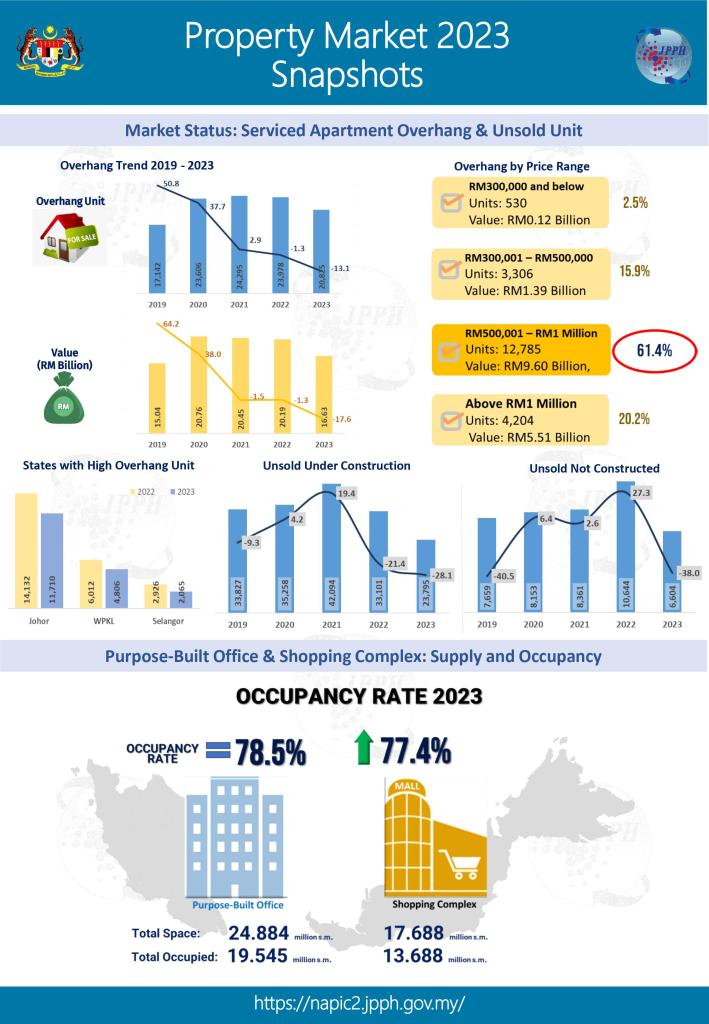
    In 2023, Malaysia’s property market surged, boasting more than 399,000 transactions totaling nearly RM200 billion, marking a notable 2.5% uptick in transactions and a substantial 9.9% increase in overall value compared to the previous year.

    Good news, there is a promising decline in unsold residential properties, dropping to 26,000 units valued at RM17.7 billion from 28,000 units worth RM18.41 billion in 2022.

    Further buoying this optimism, the Valuation and Property Management Department (JPPH) reported a palpable uptrend in property transactions across various subsectors. Residential transactions saw a notable 7.1% increase, while commercial, industrial, agricultural, and development land and other subsectors experienced growth rates of 17.5%, 13.1%, 4.6%, and 13.8%, respectively, compared to 2022.

    Moreover, JPPH noted a significant uptick in new residential launches, up by 4.4% to 56,526 units in 2023 compared to 54,118 units in 2022. Impressively, these launches exhibited improved sales performance, with a surge to 40.4% from 36% in the previous year.

    Meanwhile, the Malaysia House Price Index (MHPI) registered at 216.5 points (equating to RM467,144 per unit) in 2023, indicating moderate annual growth of 3.2%. This stable growth trajectory underscores the resilience and attractiveness of Malaysia’s property market amidst evolving economic dynamics.

    Here are the Property Market 2023 snapshot by JPPH

    From the desk of Miichael Yeoh

  • Praying For Luck in Mortgage Approval

    Praying For Luck in Mortgage Approval

    In the picture, what do you think I am doing? Praying for the money to drop

    I do not really depend on these. I don’t think money will suddenly drop from the sky or hoping for a miracle to happen. If a car were to break down, you will need a mechanic to fix the problem. He will have to follow a series of steps in doing repair and to make sure your car is running again.

    Likewise, in mortgage approval you cannot wait for miracle things to happen. To me, luck have nothing to do on mortgage approval. Many borrowers and agents, prefer to photocopy many stacks of financial documents and give to every bank they know off or can find and submit to them for approval. Is this the right way?

    Do you know that every time your documents are submitted, the banks will record and send to Bank Negara which in turn will update the Central Credit Information System (CCRIS) every month? No matter whether your loan is approved or rejected it will be updated on the last page of your record. Let’s say Bank A rejects your loan, Bank B,C and D also rejects but Bank E actually can approve your loan but seeing so many banks rejected your loan the chances are they will also reject your loan.

    Never expose yourself. Every bank have different approval criteria. Some banks might not like you but some does. I have a case once, his Debt Service Ratio is very high at 150% in which is higher than the normal 70-85%. Either the banks rejects or do not want to waste time processing his case. I reviewed his documents and to cut things short, I managed to get 70% loan approval. This case is a fine example where the borrower will have to do the following:

    • Do a Know yourself (KYS) test.
    • Check your credit status
    • Check which bank is suitable for you.

    You will have to do more work on the last step. You will need to find out each bank approval criteria and also the different types of documents for approval. You are not buying a RM1,000 property but hundreds or even millions worth of property. It is good to do a research first. It is hard to go back when your loan had been rejected. It is easier to diagnose a problem first.

    Related article https://miichaelyeoh.com/2024/04/07/what-you-should-do-before-applying-a-loan/

    From the desk of Miichael Yeoh

  • BNM Maintain OPR at 3% – Updated 9th May

    BNM Maintain OPR at 3% – Updated 9th May

    Bank Negara Malaysia (BNM) has announced today (9th May 2024) that the Overnight Policy Rate (OPR) will remain steady at 3%. This rate has remained unchanged since May 2023, marking a year of consistent monetary policy.

    The monetary policy meets six times annually to deliberate on the OPR.

    Source: BNM

    Looking ahead , there is uncertainty surrounding whether the OPR will stay at 3% or increase further. Historically, the highest OPR since April 2015 was 3.50%, and the lowest was 1.75% in July 2020 during the COVID-19 pandemic. Typically, changes in the OPR are made in increments of 25 basis points (0.25%).

    As for the likelihood of an OPR increase this year, it appears unlikely that there will be a reduction in the near future. Instead, the OPR will either hold steady or increase depending on several factors:

    1. EPF Withdrawals: Starting May 11, 2024, contributors to the Employees Provident Fund (EPF) can withdraw from Account 3 at any time, potentially leading to RM25 billion (around 1.3% of GDP) in withdrawals. This could result in increased demand-driven inflation.
    2. Civil Service Salary Hike: There may be a raise in civil service salaries by over 13% beginning in December, which could also contribute to inflationary pressures.
    3. Fuel Subsidy Rationalization: Implementation of fuel subsidy rationalization could occur in 2025 or earlier, which may further increase inflation risk.

    Get ready to seize this incredible opportunity and make your purchase! Get your copy NOW…

    Given these factors, my prediction is that the OPR is likely to remain unchanged at 3% this year, but it could increase in 2025 due to inflationary pressures. This would allow BNM to maintain stability in the economy while also addressing any potential inflation concerns.

    From the Desk of Miichael Yeoh