Category: Uncategorized

  • What the New EPF Policy Changes Mean for Your Retirement โ€” and Your Financial Freedom in 2026

    What the New EPF Policy Changes Mean for Your Retirement โ€” and Your Financial Freedom in 2026

    Happy New Year, friends! Starting today, a suite of important changes to the Employees Provident Fund (EPF) takes effect โ€” and if youโ€™re serious about building financial security and retirement freedom, youโ€™ll want to know what these mean for you.

    As someone who talks to regular Malaysians about money, property and long-term planning every week, my goal is simple: help you turn policies into practical moves you can use to grow your wealth.

    Letโ€™s break this down in a way thatโ€™s clear and actionable.


    ๐Ÿ”น 1. Expanded Retirement Planning Tools (RIA Framework)

    EPF has introduced a Retirement Income Adequacy (RIA) Framework that gives benchmarks for how much you should aim to save by retirement:

    • Basic Savings: RM390,000
    • Adequate Savings: RM650,000
    • Enhanced Savings: RM1.3 million
      These are guidelines, not limits โ€” but they are extremely useful targets to align your financial plan with real aspirations and lifestyle goals in retirement.

    ๐Ÿ”น 2. More Flexibility for High-Savings Members

    If youโ€™ve been disciplined and grown your EPF to more than RM1 million, the new rules give you more control over that excess:

    • From 2026, the threshold before you can withdraw excess savings will increase gradually โ€” starting at RM1.1M this year, then RM1.2M and RM1.3M in future years.

    Why is this smart? Because the policy encourages strong retirement savings first before letting you unlock surplus funds โ€” great if you are thinking about investment or business opportunities after securing your basics.


    ๐Ÿ”น 3. New Opportunities for Gig and Informal Workers

    This is a huge deal for drivers, riders and the self-employed:
    EPF is launching i-Saraan Plus, an enhanced contribution scheme just for gig workers โ€” with government matching of up to RM600 per year (capped at RM6,000 lifetime).

    This means youโ€™re effectively getting a subsidy from the government just for saving โ€” and that boosts your retirement-nest egg without extra burden.


    ๐Ÿ”น 4. i-Suri Extended to Age 60

    For homemakers and spouses who contribute voluntarily under i-Suri, the eligibility age has been raised from 55 to 60.
    Plus, the 50% government matching incentive continues โ€” meaning more government help to grow your savings pot.

    For many families, this is a practical way to build savings even without a traditional salary.


    ๐Ÿ”น 5. Haj Withdrawal Limit Increased

    Good news if performing Hajj is in your 2026 plans:
    You can now withdraw up to RM10,000 from your EPF Hajj savings, up from RM3,000 previously โ€” and with a simpler process.

    This change shows that EPF understands real life goals โ€” not just retirement โ€” and is adapting to help you plan important life milestones.


    ๐Ÿ”น 6. Helpful Changes to Investment Eligibility

    The Members Investment Scheme (MIS) โ€” which lets EPF contributors invest part of their savings โ€” will now align with the basic RIA savings level.
    This means the minimum savings balance required for MIS participation increases gradually, ensuring that investment decisions donโ€™t compromise your core retirement needs.


    What This Means for Your Money Strategy

    Hereโ€™s how you can think about these changes in your financial plan:

    โœ… Make EPF savings your foundation โ€” the new RIA Framework gives goals to aim for.
    โœ… If youโ€™re a gig worker or informal worker, take advantage of voluntary schemes like i-Saraan Plus โ€” free government matching is like extra income.
    โœ… Plan ahead for retirement AND life goals โ€” from Hajj to home deposits to future business capital.
    โœ… Keep investing mindfully โ€” the MIS changes protect retirement security first, while letting disciplined savers grow their wealth.


    My Take: Retirement Isnโ€™t Just an Age โ€” Itโ€™s a Strategy

    Too many Malaysians think of EPF as just something you touch at 55. But with these changes, EPF is becoming a more powerful engine for lifelong financial planning โ€” from your 20s all the way to retirement and beyond.

    If youโ€™re building property portfolios, planning business income, or aiming for financial freedom, understanding how to use EPF strategically makes all the difference.

    Stay savvy, stay disciplined โ€” and letโ€™s make 2026 the year your financial future gets real traction.

    ๐Ÿ’ฌ Got questions about how to align these EPF changes with your property or investment goals? Ask me below!

    From the Desk of

    Miichael Yeoh

  • ๐Ÿ“ฐ BNM Cuts OPR to 2.75%: What It Means for You and Your Loans

    ๐Ÿ“ฐ BNM Cuts OPR to 2.75%: What It Means for You and Your Loans

    Kuala Lumpur, 10 July 2025 โ€” Bank Negara Malaysia (BNM) has announced a reduction in the Overnight Policy Rate (OPR) by 25 basis points, bringing it down from 3.00% to 2.75%. This move comes amid ongoing efforts to support economic growth and ease financial conditions for households and businesses.

    But what does this really mean for everyday Malaysians? And how does it affect your home loan or car loan?

    Letโ€™s break it down.


    ๐Ÿ”Ž What Is the OPR?

    The OPR is the interest rate at which banks lend money to one another overnight. When BNM adjusts the OPR, it influences Base Lending Rate (BLR) ,Base Rate (BR) and Standardise Base Rate (SBR) used by banks to determine the interest on loans and savings.

    A lower OPR typically leads to:

    โœ… Lower loan interest rates
    โœ… Cheaper monthly repayments
    โœ… Easier access to credit


    ๐Ÿ  Before & After: Sample Loan Calculation

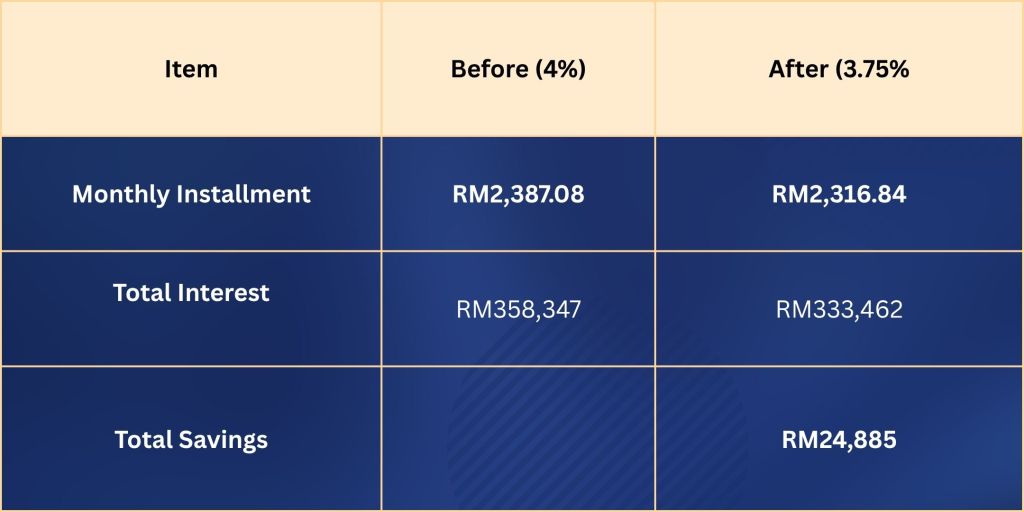
    Let’s compare how the OPR cut affects a typical housing loan of RM500,000 over 30 years.

    Assume a floating interest rate of:

    • Before: 4.00% (based on 3.00% OPR)
    • After: 3.75% (after 2.75% OPR cut)

    ๐Ÿ”น Before OPR Cut (4.00%)

    • Loan amount: RM500,000
    • Tenure: 30 years
    • Interest rate: 4.00%
    • Monthly instalment: RM2,387.08
    • Total interest over 30 years: RM358,347

    ๐Ÿ”ป After OPR Cut (3.75%)

    • Loan amount: RM500,000
    • Tenure: 30 years
    • Interest rate: 3.75%
    • Monthly instalment: RM2,316.84
    • Total interest over 30 years: RM333,462

    ๐Ÿ’ก You Save:

    • Monthly: RM70.24
    • Over 30 Years: RM24,885 in interest!

    ๐Ÿ“Œ Summary:


    ๐Ÿ“‰ Impact Beyond Housing Loans

    The OPR cut doesnโ€™t just affect home loans. It also impacts:

    • Car Loans โ€“ Lower monthly repayments
    • Personal Loans โ€“ Cheaper borrowing
    • Business Loans โ€“ Reduced financing costs

    However, fixed-rate loans (such as some hire purchase loans) are generally not affected by OPR changes.


    ๐Ÿฆ Why Did BNM Cut the OPR?

    BNMโ€™s Monetary Policy Committee cited the need to:

    • Support domestic economic activity
    • Manage downside risks from global uncertainties
    • Encourage spending and investment

    With inflation under control and growth momentum slowing, the rate cut is intended to provide a cushion and maintain financial stability.


    ๐Ÿ“Š Conclusion: A Relief for Borrowers

    If you’re repaying a floating-rate loan, this OPR cut could offer welcome breathing space in your monthly budget. For potential homebuyers, itโ€™s a good time to recalculate affordability and consider locking in better financing packages.

    ๐Ÿ” Tip: Contact your bank to check how the OPR cut affects your current loan rate. You may also explore refinancing options for better savings.

    From The Desk of

    Miichael Yeoh

  • SST Increase from 6% to 8%: How It Will Impact Malaysiaโ€™s Property Industry

    SST Increase from 6% to 8%: How It Will Impact Malaysiaโ€™s Property Industry


    Introduction

    Starting July 1, 2025, the Malaysian government officially raised the Sales and Services Tax (SST) from 6% to 8%, aiming to increase national revenue and reduce fiscal deficits. While basic necessities and certain essential services remain exempt, many sectors โ€” including construction, legal, professional, and property-related services โ€” are now affected. This tax adjustment is expected to have ripple effects across various industries, especially the property market, which is already facing affordability challenges.

    This article examines how the SST hike impacts the property industry, giving practical examples and offering insights into how buyers, developers, and investors might respond.


    1. Scope of SST Increase in the Property Sector

    The SST increase does not apply directly to the sale of residential properties, which are exempt from SST. However, indirect costs will go up due to increased service charges in the construction, legal, and property management sectors. These cost increments will eventually be transferred to end buyers and tenants, especially in commercial and high-rise residential developments.


    2. Areas Affected in Property Development

    Hereโ€™s a breakdown of how the 2% SST increase affects the property ecosystem:

    Service TypeBaseOld SST (6%)New SST (8%)
    Architect/Engineer FeesRM100,000RM106,000RM108,000
    Legal/Stamping ServicesRM20,000RM21,200RM21,600
    Renovation/Interior Fit-OutRM150,000RM159,000RM162,000
    Property Management ServicesRM50,000RM53,000RM54,000
    Advertising & MarketingRM30,000RM31,800RM32,400

    Example:
    A developer constructing a new serviced apartment project incurs around RM5 million in professional and management fees. Under the previous 6% SST, the tax was RM300,000. Now, itโ€™s RM400,000 โ€” a 33% increase in SST cost, which could result in higher launch prices to maintain developer margins.


    3. Impact on Property Developers

    • Higher Development Cost: Most developers will face a 5โ€“8% increase in overall project costs when combined with inflation and compliance costs.
    • Price Adjustment Pressure: Developers may either absorb the cost (lowering margins) or pass it to consumers โ€” likely raising launch prices, especially in urban areas.
    • Delay in New Launches: Some developers may delay project launches until market conditions stabilize.

    4. Impact on Homebuyers

    Although SST is not directly charged on residential property purchases, buyers may feel the pinch in several ways:

    • Higher Property Prices: Due to rising development and marketing costs.
    • Increased Renovation Expenses: Renovation and interior design are service-based industries and are now charged 8% SST.
    • Increased Maintenance Fees: Management services in condos or commercial buildings may increase, translating to higher monthly maintenance charges for owners and tenants.

    5. Impact on Real Estate Investors

    Investors will also be affected indirectly:

    • Lower Rental Yield: If property prices go up but rental rates remain stagnant, net returns will shrink.
    • Higher Operational Costs: Especially for those managing short-term rentals or Airbnb units (cleaning, advertising, renovation services all now taxed at 8%).
    • Buyer Caution: Investors may delay purchases or switch to lower-risk assets like REITs or landed residential properties outside city centers.

    6. Outlook and Strategies

    Despite the challenges, the SST increase may drive some positive changes:

    • Developers may adopt cost-efficiency technologies to maintain affordability.
    • Buyers may turn to subsale markets, which are less affected by SST-related costs.
    • Investors may focus on cash-flow-positive properties, especially those with low operating costs.

    Conclusion

    The SST increase from 6% to 8% might seem modest on paper, but its cascading effect across the property value chain is real. While residential property sales remain tax-exempt, associated services โ€” from construction to maintenance โ€” will become costlier. As developers adjust pricing and investors reassess risk, Malaysia’s property market may experience a short-term slowdown but could stabilize as the market adapts.


    Final Thought
    For both buyers and investors, 2024โ€“2025 will require careful financial planning and a close eye on property pricing trends. Understanding the real costs behind the price tag is more important than ever.

    From The Desk of Miichael Yeoh

  • Discover Malaysia’s RM13.3 Billion in Unclaimed Money

    Discover Malaysia’s RM13.3 Billion in Unclaimed Money

    As of April 2025, the Accountant Generalโ€™s Department of Malaysia (JANM) has recorded a staggering RM13.3 billion in Unclaimed Money (Wang Tak Dituntut – WTD). However, despite decades of awareness campaigns, only about RM4 billion has been successfully claimed since the initiative began in 1977.

    According to Accountant General Nor Yati Ahmad, many Malaysians are still unaware that they might be entitled to unclaimed funds โ€” or have never checked.

    To improve public awareness, JANM is actively reaching out through community programs and mobile campaigns, especially in rural areas. But the process remains simple for anyone, anywhere, with internet access.


    ๐Ÿ’ก What Is Unclaimed Money (WTD)?

    Unclaimed Money refers to funds that legally belong to an individual but remain unpaid for over one year. These include:

    • Dormant bank account balances
    • Unclaimed insurance benefits
    • Refunds or overpayments
    • Dividends from investments
    • Uncollected salaries or bonuses

    โœ… How to Check If You Have Unclaimed Money

    Option 1: Online via eGUMIS

    1. Visit https://egumis.anm.gov.my
    2. Register with your NRIC, email, and a password
    3. Log in and enter your IC number to search
    4. If money is found under your name:
      • Upload necessary documents
      • Submit your claim and wait for verification

    Option 2: Visit a JANM Office

    1. Bring required documents (see below)
    2. Complete the WTD Claim Form
    3. Submit in person at any JANM branch

    ๐Ÿ“„ Documents Required for Claims

    For Personal Claims:

    • Copy of NRIC (front & back)
    • Bank account details (if requesting transfer)
    • Completed claim form (manual method)

    For Claims on Behalf of a Deceased Family Member:

    • Death certificate
    • Proof of relationship (e.g., birth/marriage certificate)
    • Letter of Administration or Grant of Probate
    • Copy of claimant’s NRIC

    Important:
    โœ”๏ธ Claims are free of charge
    โœ”๏ธ There is no time limit to submit your claim


    ๐Ÿ“ข Donโ€™t Let Your Money Go Unclaimed

    If you’ve ever opened a bank account, had an insurance policy, received dividends, or worked in Malaysia, thereโ€™s a chance you may have unclaimed money waiting. Take just 5 minutes to check โ€” and share this with your family and friends. It could make a real difference!

    From the desk of

    Miichael Yeoh

    WEEKLY PROPERTY ROUNDUP

    The week of September 5-11, 2026, highlighted Malaysia’s thriving property market, ongoing demand for sustainable buildings, and the importance of financial stability amid global interest rate fluctuations for buyers and investors.

    WEEKLY PROPERTY ROUNDUP

    This week highlighted how property value is increasingly influenced by infrastructure, digital investments, and surrounding ecosystems, shifting focus from mere location to overall community benefits.

  • 109 Developers Blacklisted: Safeguards for Malaysian Homebuyers

    109 Developers Blacklisted: Safeguards for Malaysian Homebuyers

    The recent announcement by Housing and Local Government Minister Nga Kor Ming regarding the blacklisting of 109 housing developers is a significant step toward enhancing transparency and protecting homebuyers in Malaysia. By making this list publicly accessible on the ministry’s website, potential buyers can now verify the credibility of developers before making purchasing decisions.

    This initiative is part of broader efforts to address issues related to abandoned projects and fraudulent practices in the housing sector. The proposed amendments to the Housing Development (Control and Licensing) Act 1966 aim to impose stricter penalties on errant developers, including potential travel bans and substantial fines. โ€‹

    While these measures demonstrate the government’s commitment to safeguarding homebuyers, it’s crucial for individuals to conduct thorough due diligence. Beyond consulting the blacklist, prospective buyers should assess developers’ track records, financial stability, and past project completions. Engaging with real estate professionals and seeking legal advice can further ensure informed decisions.โ€‹

    In summary, the public disclosure of blacklisted developers is a commendable move toward greater accountability in Malaysia’s housing industry. However, a collaborative approach involving stringent enforcement, legislative reforms, and proactive consumer awareness is essential to foster a trustworthy and resilient housing market.

    Read related article by The Star

    Homebuyers beware: 109 housing developers blacklisted, says Nga | The Star

    From the Desk of

    Miichael Yeoh

  • Discover The Keys to Successful Property Investment (Live Webinar)

    Discover The Keys to Successful Property Investment (Live Webinar)

    Are these familiar struggles for you?

    ๐Ÿ  Feeling lost in the world of property investment?

    ๐Ÿ’ฐ Watching your investments drain your finances?

    ๐Ÿ˜ฑ Scared off by terrifying investment horror stories?

    ๐Ÿ’ธ Struggling to secure funds for investment?

    ๐Ÿฆ Facing obstacles getting a loan from the bank?

    ๐Ÿ” Bought a property but can’t find a tenant?

    You’re not alone. But here’s what awaits you on the other side:

    • Witnessing others prosper through property investment while you sit on the sidelines.
    • Regretting missed opportunities for passive income generation.
    • Reflecting on how better financial planning could have changed your life.

    What’s in store for you at my seminar?

    ๐Ÿ” Insights to equip yourself for successful property investment.

    โš ๏ธ Awareness of common pitfalls to avoid in the property market.

    ๐Ÿก Understanding the crucial components of property investment.

    ๐Ÿ“Š Appreciation for the importance of property data analysis.

    ๐Ÿ” Guidance on conducting thorough due diligence before buying.

    ๐Ÿ’ผ Experience the transformative power of effective financial planning.

    Audiences and events I’ve spoken and organized for property buyers/investors, developers, conventions, and property study trips.

    Don’t let uncertainty or fear hold you back! Join me and unlock the doors to a brighter financial future!

    Register your FREE SEATS Now as seats are limited…..

    See you soon,

    Miichael Yeoh

  • Secondary Property Purchase Fees for Foreigners in Penang, Malaysia: Complete Guide 2024

    Secondary Property Purchase Fees for Foreigners in Penang, Malaysia: Complete Guide 2024

    In every country, additional fees are typically involved when purchasing property as a foreigner. Malaysia is no exception, and these fees vary from state to state. Let’s focus on Penang.

    The fees involved depend on whether you’re purchasing secondary property on the island or the mainland. Here’s a breakdown of the fees applicable:

    Property Type

    LocationStrata (Min)Landed (Min)
    IslandRM 1,000,000RM 3,000,000
    MainlandRM 500.000RM 1,000,000

    State Consent

    State Consent
    (Individual)
    RM 10,000
    (Residential)
    RM 20,000
    (Commercial)
    State Consent
    (Company)
    RM 20,000
    (Residential)
    RM40,000
    (Commercial)

    State Levy

    RM 1 mil to RM1.5 mil1.5% of purchase price
    RM 1.5 mil above3.0% of purchase price

    Please be aware that the figures provided are accurate as of the time of writing and may be subject to change in the future.

    From the Desk Of Miichael Yeoh