Malaysia’s property market faces an interesting contradiction. Many people are struggling to find homes they can afford, yet thousands of completed properties remain unsold. Perhaps the problem is not simply a lack of buyers — but a mismatch between what the market needs and what the industry is building.
Malaysia’s property market has a question worth examining.
On one hand, homeownership remains an important aspiration for many Malaysians. Young professionals are looking for their first homes. Growing families need more space. Some households are searching for affordable housing closer to their workplaces.
On the other hand, completed residential properties remain unsold across the country.
How can both situations exist at the same time?
If people need homes, why are developers struggling to sell them?
The answer may be more complicated than simply saying property prices are too high or buyers cannot afford to purchase.
It may point to a deeper issue: the property market is not always building what the market actually needs.
1. A property overhang is more than a supply problem
When we hear about unsold properties, the immediate assumption is that Malaysia has too much housing supply.
But this explanation does not tell the whole story.
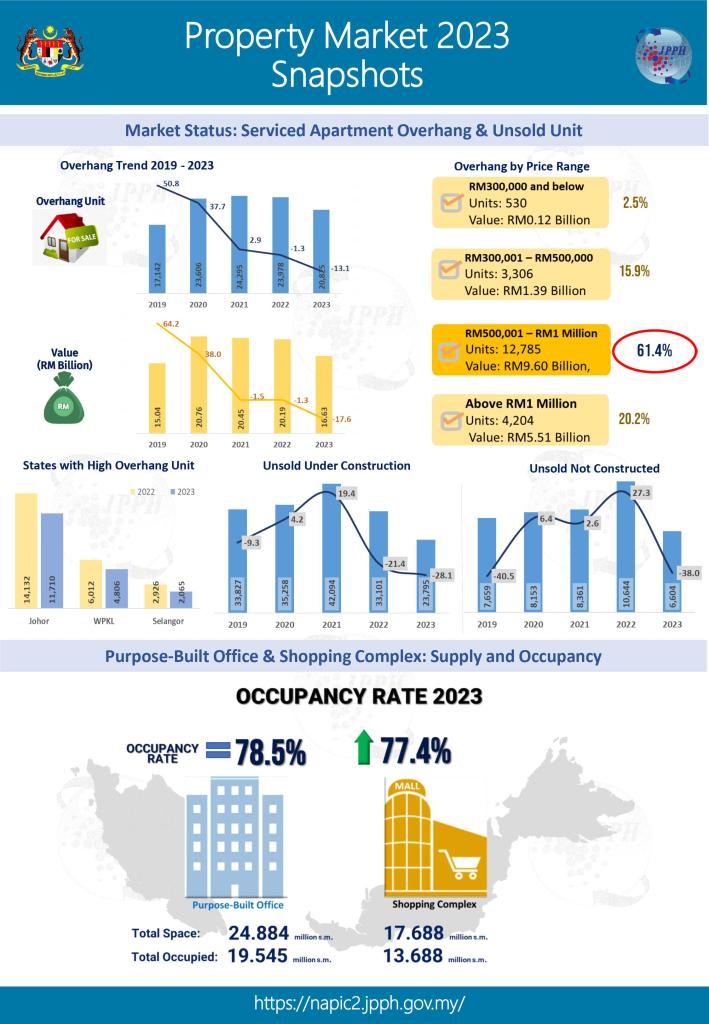
According to reported NAPIC figures, Malaysia recorded 33,094 completed unsold residential units in the first half of 2026, with a combined value of approximately RM17.78 billion.
These are properties that have already been completed but remain unsold.
The numbers deserve attention, but we should look beyond the national total.
A property in Kuala Lumpur is not necessarily competing for the same buyer as one in Penang, Johor Bahru or a smaller township.
A condominium priced at RM800,000 may appeal to a very different market from an affordable apartment priced at RM300,000.
Even within the same location, a studio apartment, a two-bedroom unit and a family-sized home serve different needs.
Therefore, the real question should not simply be:
“How many properties are unsold?”
It should be:
“Which properties are unsold, where are they located, who were they designed for, and why are buyers not purchasing them?”
That is a much more useful starting point.
2. Are developers building for demand or for market assumptions?
Property development involves considerable planning, investment and risk.
Developers need to assess land costs, construction costs, financing, target selling prices, competition and expected market demand.
However, there is a difference between identifying a market opportunity and understanding actual buyer demand.
For example, a location may have strong economic activity, new infrastructure and an expanding population.
On paper, it may look attractive for residential development.
But does that automatically mean buyers will purchase every type of property launched there?
Not necessarily.
A young working professional may need a reasonably priced one-bedroom or two-bedroom apartment near employment opportunities.
A family may prioritise space, schools, accessibility and daily convenience.
An investor may be attracted by rental potential, but an owner-occupier may be more concerned about affordability and long-term liveability.
These are different buyer profiles with different expectations.
A development can be located in a promising area and still struggle if its product, pricing or unit configuration does not match the people most likely to purchase it.
A good location does not automatically make every property in that location a good product.
3. The affordability gap is becoming harder to ignore
One of the biggest challenges facing property buyers is affordability.
A property may be attractively designed and offer excellent facilities, but the asking price still needs to make sense for its intended market.
Consider a simple example.
A first-time buyer earning RM5,000 a month may be interested in purchasing a home near the workplace.
However, once the buyer considers the monthly mortgage instalment, maintenance charges, insurance, utilities, transport and daily living expenses, the financial commitment may become too demanding.
The buyer may like the property but decide not to proceed.
This is an important distinction.
Interest in a property does not necessarily translate into purchasing ability.
There are also buyers who receive loan approval but decide that taking on the commitment would leave them financially stretched.
Others may fail to secure financing because their income documentation, existing commitments or credit profile do not meet the bank’s requirements.
For developers, this means the potential buyer pool may be smaller than expected.
For buyers, it means that a property’s selling price should never be assessed independently of their actual financial capacity.
A property is only affordable when the buyer can comfortably sustain the ownership commitment — not merely when the bank is willing to provide financing.
4. The serviced apartment question: Who is the intended occupier?
Another issue worth examining is the number of completed unsold serviced apartments.
Recent market reporting has highlighted the concentration of completed unsold serviced apartments in Kuala Lumpur and Johor. It has also raised an important question: do some smaller units, originally designed with investment or short-term accommodation in mind, adequately meet the needs of people looking for permanent homes?
This deserves closer attention.
A compact studio may be suitable for a single professional, a certain rental market or a specific investment strategy.
But it may not be suitable for a young family looking for a long-term home.
Similarly, a development marketed around lifestyle facilities and investment potential may attract attention during its launch, but its long-term performance will depend on whether there is genuine demand from occupiers and tenants.
The important lesson is that we should not confuse a property’s marketing appeal with its actual market suitability.
Before developing or purchasing a property, we need to understand who will occupy it, why they would choose it and whether the surrounding location supports their daily needs.

5. Developers need to think beyond the launch
A successful property launch does not necessarily mean a successful development.
Strong marketing, attractive showrooms, promotional packages and early-bird incentives can generate initial interest.
However, the real test comes when the development is completed and buyers begin evaluating the actual product.
Can the property attract genuine owner-occupiers?
Is there sufficient rental demand?
Does the selling price remain competitive against completed and secondary-market properties?
Are the facilities, layout and unit sizes appropriate for the target market?
Can buyers obtain financing?
These questions should be considered well before a project reaches its launch stage.
Developers need to recognise that buyers today have more information and more choices. They can compare prices, examine competing developments and assess whether a property offers genuine value.
The development process should therefore begin with a clear understanding of the market — not simply with a decision to build because the location appears promising.
6. What does this mean for property investors?
For investors, an unsold property market should be a reminder that buying is only one part of an investment decision.
A property may look attractive at launch, but investors should also consider what happens after completion.
Will there be sufficient rental demand?
Who are the likely tenants?
How many competing units will be available?
Will the property appeal to future buyers when the investor eventually decides to sell?
A development with a large number of similar units may face considerable competition, particularly if many owners intend to rent out their properties at the same time.
This can place pressure on rental rates and make it more difficult to secure tenants.
The resale market may face a similar challenge if too many comparable properties are competing for a limited number of buyers.
Investors should therefore look beyond the promised rental yield and projected capital appreciation.
They need to understand the actual demand supporting those expectations.
A property investment is not successful simply because the purchase price looks attractive. It must also have a realistic market to support its future rental and resale value.
7. The property industry needs better market discovery
Perhaps the biggest lesson from Malaysia’s property overhang is that the industry needs to improve how it understands demand.
For buyers, this means evaluating properties based on personal needs, financial capacity and long-term suitability rather than being influenced solely by promotional campaigns.
For investors, it means studying the actual rental and resale market before committing capital.
For developers, it means investing more effort in understanding the people who will eventually occupy or purchase their products.
Market research should go beyond population growth, infrastructure announcements and general economic indicators.
It should examine the intended buyer profile, household income, affordability, competing supply, unit configuration, employment opportunities and actual purchasing behaviour.
This is where a more structured property discovery process becomes important.
At PDS — Property Discovery System™, we believe that better property decisions begin with better questions.
Before asking whether a property is attractive, we should ask whether it is suitable.
Before asking whether the location has growth potential, we should understand who will drive that growth.
And before asking whether a development offers good investment returns, we should establish whether there is genuine demand to support those returns.
The bigger question: Are we building enough homes, or the right homes?
Malaysia does not simply need more property development.
It needs developments that respond to real market requirements.
The property overhang should not be viewed only as a developer’s sales challenge or a buyer’s affordability problem. It is also an opportunity for the entire industry to examine how properties are planned, priced, positioned and delivered.
A home is not just a collection of concrete, facilities and attractive marketing materials.
It is a product that must serve the needs of the people who will eventually live in it.
And an investment property must have a realistic market that can support its rental and resale potential.
Perhaps the property industry’s next competitive advantage will not come from building bigger projects or offering more facilities.
It will come from understanding the market better.
Because the real question is not whether Malaysians need homes. It is whether we are building the homes that Malaysians can afford, want and genuinely need.
Discover Better. Decide Smarter.
Miichael yeoh
Property Strategist
Disclaimer: This article is intended for general educational and property market discussion purposes only. Market conditions, property prices, financing requirements and investment outcomes may vary by location and individual circumstances. Readers should conduct their own due diligence and seek appropriate professional advice before making property-related decisions.