Tag: real estate malaysia

  • The Malaysian Property Market Has Changed — Are Buyers Buying the Right Way?

    The Malaysian Property Market Has Changed — Are Buyers Buying the Right Way?

    The Malaysian Property Market Has Changed — Are Buyers Buying the Right Way?

    For many years, property investing in Malaysia followed a familiar formula.

    Buy a new launch, wait a few years, and hope the price goes up.

    This strategy worked reasonably well during earlier property cycles when prices were rising quickly, financing was easier, and supply was more limited. Many investors entered the market believing that capital appreciation alone would justify the purchase.

    But today, the Malaysian property market has entered a different phase.

    The question buyers should now ask is no longer “Will the price go up?”
    The more important question is “Can this property sustain itself financially?”


    The Shift From Speculation to Sustainability

    Over the past decade, the mindset of property buyers has gradually evolved.

    Today’s buyers are more cautious, more analytical, and more focused on cash flow and long-term holding power.

    Instead of relying purely on future price appreciation, investors are increasingly asking questions such as:

    • What is the rental demand in this area?
    • Can the rental cover most of the loan instalment?
    • What happens if interest rates increase?
    • Who is the actual tenant profile for this property?

    These questions reflect a more mature approach to property investing.

    The reality is simple: not every property will appreciate significantly in the short term. When appreciation slows, the ability of the property to generate rental income becomes far more important.


    Financing Strategy Now Matters More Than Ever

    Another major shift in the market is the growing importance of financing structure.

    Many buyers focus heavily on the purchase price but pay little attention to how the property is financed. Yet the financing strategy can determine whether an investment becomes manageable or financially stressful.

    Buyers today need to consider:

    • Loan margin and interest rates
    • Monthly instalment affordability
    • Holding power during market slowdowns
    • Overall debt exposure

    A well-structured loan can give investors time and flexibility, while poor financial planning can force them to sell prematurely.

    Thinking about financing before buying is no longer optional — it is essential.


    Rental Demand Is Becoming a Key Decision Factor

    One of the biggest mistakes many investors made in the past was buying properties without considering who would actually rent the unit.

    Today, buyers are beginning to look more closely at demand drivers such as:

    • Proximity to employment hubs
    • Accessibility and transportation infrastructure
    • Nearby universities or hospitals
    • Tourism demand and short-term rental potential

    In markets like Penang, Kuala Lumpur, and Johor Bahru, rental demand is increasingly shaping investment decisions.

    For example, areas with strong tourism activity or major infrastructure developments may offer better rental prospects compared to purely speculative locations.

    The key question investors should ask is:

    “Who is my tenant?”

    If there is no clear answer, the investment may not perform as expected.


    The Role of Infrastructure and Economic Drivers

    Another important factor influencing property performance today is real economic activity.

    Infrastructure projects, transportation connectivity, employment centres, and tourism growth can significantly impact both rental demand and long-term property value.

    For instance, upcoming transportation developments and urban revitalisation projects in cities such as Georgetown could change demand patterns in the coming years.

    However, infrastructure alone does not guarantee success. The surrounding ecosystem — population growth, business activity, and lifestyle demand — must also support the property market.


    Buying Property Today Requires a Different Mindset

    The Malaysian property market has not disappeared. But the way buyers approach property must evolve.

    Successful investors today tend to follow a more balanced approach:

    • Evaluate rental yield and cash flow
    • Structure financing carefully
    • Understand real demand drivers
    • Focus on long-term sustainability

    In other words, the focus has shifted from short-term speculation to long-term investment discipline.


    A Final Thought

    Property has always been a long-term asset class.

    But in today’s market environment, buying property requires more than just optimism about future price growth.

    It requires careful thinking, realistic financial planning, and a clear understanding of market demand.

    The Malaysian property market has changed.

    The real question is — have buyers changed with it?


    Miichael Yeoh
    Property Strategist | Developer Consultant | HRD Corp Trainer

    Miichael Yeoh has more than 28 years of experience spanning banking, mortgage advisory, property investment, and developer consultancy. He is also the author of Think Like a Banker, Act Like a Player, Property Investment BLT, and Buying Property Like A Pro.

  • Property Investment: Success or Bankrupt?

    Property Investment: Success or Bankrupt?

    Many people are enthusiastic about making money from property investment. After all, who wouldn’t want a reliable safety net for the future? Property can indeed offer financial security, but this is only true if you plan properly and do your due diligence before buying. While it may sound lucrative, without the correct approach, it can quickly turn into a financial disaster.

    I recall an incident that starkly highlights this point. After one of my seminars organized by a property developer, a couple in their 30s approached me. They shared a heartbreaking story: they had declared bankruptcy and had a 6-year-old child to care for. Their downfall began when they followed advice from a so-called property expert and started purchasing properties beyond their financial means. The rental income from these properties was either too low or non-existent, and they couldn’t find tenants. To make matters worse, the so-called expert was nowhere to be found, leaving the couple to face the harsh realities alone.

    What lesson can we draw from this? The pursuit of wealth through property investment can sometimes turn into a nightmare, even if you believe such misfortune won’t happen to you.

    Click Register NOW

    Let’s rewind a bit. Had this couple engaged in proper financial planning, their situation might have been very different. A crucial aspect of financial planning is understanding your monthly income against your expenses. Personally, I wouldn’t consider purchasing a property unless I had at least 12 months of installment payments saved in advance, especially if I had to take a loan from the bank. There is much more to financial planning, but diving into the details would be lengthy. The key takeaway is this: invest within your capacity. Don’t let greed drive your decisions, as it might be too late to turn back once you’re down that road.

    The desire to become a successful property millionaire is understandable, but it’s essential to think carefully before making such a bold step.

    I hope this article opens your eyes to the realities of property investment.

    If you need expert advice on your property investment journey, please email us at info@miichaelyeoh.com.

    From the Desk of Miichael Yeoh

  • Malaysia Property Report 2023

    Malaysia Property Report 2023

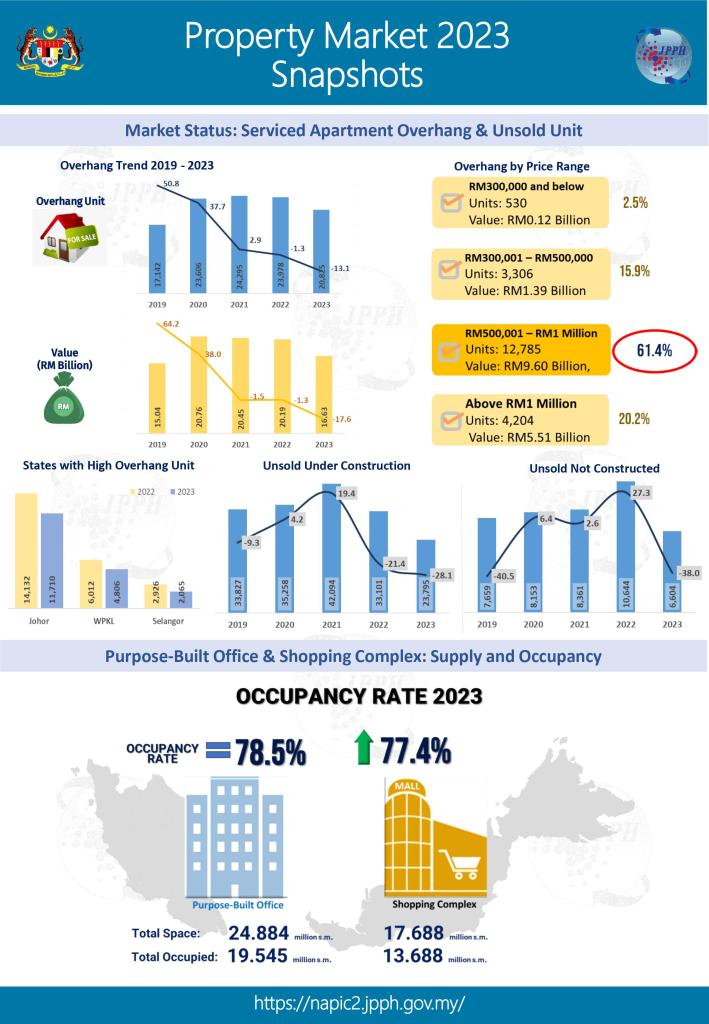
    In 2023, Malaysia’s property market surged, boasting more than 399,000 transactions totaling nearly RM200 billion, marking a notable 2.5% uptick in transactions and a substantial 9.9% increase in overall value compared to the previous year.

    Good news, there is a promising decline in unsold residential properties, dropping to 26,000 units valued at RM17.7 billion from 28,000 units worth RM18.41 billion in 2022.

    Further buoying this optimism, the Valuation and Property Management Department (JPPH) reported a palpable uptrend in property transactions across various subsectors. Residential transactions saw a notable 7.1% increase, while commercial, industrial, agricultural, and development land and other subsectors experienced growth rates of 17.5%, 13.1%, 4.6%, and 13.8%, respectively, compared to 2022.

    Moreover, JPPH noted a significant uptick in new residential launches, up by 4.4% to 56,526 units in 2023 compared to 54,118 units in 2022. Impressively, these launches exhibited improved sales performance, with a surge to 40.4% from 36% in the previous year.

    Meanwhile, the Malaysia House Price Index (MHPI) registered at 216.5 points (equating to RM467,144 per unit) in 2023, indicating moderate annual growth of 3.2%. This stable growth trajectory underscores the resilience and attractiveness of Malaysia’s property market amidst evolving economic dynamics.

    Here are the Property Market 2023 snapshot by JPPH

    From the desk of Miichael Yeoh

  • Mastering Your Financial Future: A Guide to Financial Planning

    Mastering Your Financial Future: A Guide to Financial Planning

    Financial planning is the cornerstone of a secure and prosperous future. It involves setting realistic goals, creating a roadmap to achieve them, and making informed decisions about your money. Whether you’re just starting your career or nearing retirement, having a solid financial plan in place is essential for building wealth, managing risks, and achieving financial independence. In this article, we’ll explore the key components of financial planning and provide actionable tips to help you navigate your financial journey with confidence.

    1. Assess Your Current Financial Situation: The first step in financial planning is to assess your current financial situation. Take stock of your income, expenses, assets, and liabilities. Create a detailed budget to track your spending habits and identify areas where you can save money. Calculate your net worth by subtracting your liabilities from your assets. This snapshot of your finances will help you understand where you stand and identify areas for improvement.

    2.Set SMART Financial Goals: Once you have a clear understanding of your financial situation, it’s time to set SMART (Specific, Measurable, Achievable, Relevant, Time-bound) financial goals. Whether it’s buying a home, saving for your children’s education, or planning for retirement, clearly define your goals and prioritize them based on their importance and urgency. Break down each goal into smaller, manageable milestones to track your progress along the way.

    3.Create a Budget and Stick to It: A budget is a powerful tool that helps you allocate your income towards your financial goals while ensuring that you live within your means. Start by listing your fixed expenses such as rent/mortgage, utilities, and loan payments, then allocate a portion of your income towards savings and investments. Be mindful of discretionary spending and look for opportunities to cut unnecessary expenses. Regularly review and adjust your budget as your financial situation changes.

    4. Build an Emergency Fund: Life is unpredictable, and unexpected expenses can derail your financial plans if you’re not prepared. That’s why it’s crucial to build an emergency fund to cover unforeseen expenses such as medical emergencies, car repairs, or job loss. Aim to save at least three to six months’ worth of living expenses in a liquid, accessible account like a savings account or money market fund. Having an emergency fund provides peace of mind and financial security during challenging times.

      5. Manage Debt Wisely: Debt can be a significant obstacle to achieving your financial goals if not managed wisely. Prioritize paying off high-interest debt such as credit cards and personal loans to minimize interest payments and improve your financial health. Consider consolidating debt or negotiating lower interest rates to accelerate your debt repayment journey. Avoid taking on new debt unless absolutely necessary and use credit responsibly to build a positive credit history.

      6. Invest for the Future: Investing is a powerful wealth-building tool that allows your money to grow over time through the power of compounding. Determine your risk tolerance and investment objectives, then develop a diversified investment portfolio tailored to your goals and timeline. Consider investing in a mix of stocks, bonds, mutual funds, and other asset classes to spread risk and maximize returns. Regularly review and rebalance your portfolio to ensure it remains aligned with your objectives.

      7. Plan for Retirement: Retirement may seem far off, but it’s never too early to start planning for your golden years. Take advantage of employer-sponsored retirement plans such as 401(k)s or IRAs to save for retirement tax-efficiently. Contribute enough to qualify for employer matching contributions and increase your contributions over time as your income grows. Consider working with a financial advisor to develop a personalized retirement plan and explore options such as annuities or pension plans to supplement your retirement income.

      8. Protect Yourself and Your Loved Ones: Insurance is an essential component of financial planning that provides protection against unforeseen events such as illness, disability, or death. Review your insurance coverage regularly to ensure it adequately protects you and your loved ones. Consider policies such as health insurance, life insurance, disability insurance, and long-term care insurance based on your needs and circumstances. Don’t overlook estate planning, including drafting a will and establishing powers of attorney to protect your assets and ensure your wishes are carried out.

      Financial planning is a lifelong journey that requires diligence, discipline, and adaptability. By following these key principles and incorporating them into your financial strategy, you can take control of your finances, build wealth, and achieve your long-term goals. Remember that financial planning is not a one-time event but a continuous process that evolves with your life circumstances. Stay proactive, stay informed, and stay committed to securing your financial future.

      From the Desk of

      Miichael Yeoh

    1. What is Reserve Mortgage?

      What is Reserve Mortgage?

      What exactly is a reverse mortgage, and could it be introduced in Malaysia? This financial product, which has been in use in the West for quite some time, allows senior citizens who own property to leverage it for a loan without the burden of monthly repayments. Instead of the borrower making payments to the bank, the bank pays the borrower based on a percentage of the property’s value, typically around 50 to 60%. Repayment is due upon the borrower’s passing, property sale, or refinancing.

      How does the bank pay me?

      Homeowners can choose one of three ways to obtain their borrowing from the bank: a fixed monthly payment with a predetermined number of months/years of payout, a lump sum payment upfront, or a combination of both.

      Who owns the house?

       Just like any mortgage taken from the bank, you are still the owner of the house. You mortgage the property to take out a loan. The agreement will terminate when the borrower passes away, sells the house, or refinances with another bank.

      How much does it cost?

      Here are some of the costs that you will need to pay: legal fees, valuation fees, mortgage insurance, and monthly maintenance fees. Depending on the bank you apply to, some will advance the costs and put them into the loan.

      Pros and Cons of Reverse Mortgage: In any mortgage borrowing, there are advantages and disadvantages. Borrowers are advised to choose wisely when applying.

      Pros:

      1. You do not need to pay monthly installments.
      2. Funds can help with living expenses such as medical bills and debt repayment.
      3. The fund can help homeowners enjoy their retirement.
      4. With the fund, homeowners will be able to maintain their current lifestyle.

      Cons:

      1. The closing costs, such as legal fees and insurance, can be steep.
      2. The property will be mortgaged with the bank.

      Will Reverse Mortgage come to Malaysia?

      Banks need a healthy mortgage portfolio, and reverse mortgage could provide them with a new avenue to expand their products. Currently, in Malaysia, it is under Cagamas (Mortgage Corporation of Malaysia) and is called Skim Saraan Bercagar (SSB) and SSB Islamic (SSB-i).

      Here are the criteria for borrowers:

      a) Malaysian

      b) 55 years old and above

      c) Owner or joint owners of a residential property

      d) For a joint loan, the joint borrower can be a partner, parent, sibling, or child, subject to age limit

      Do take note of the property criteria:

      a) Residential property in Malaysia held in Borrower’s or joint borrowers’ name(s).

      b) For a joint Skim Saraan Bercagar Loan, joint ownership of property is required.

      c) Property must be owner-occupied and be the primary place of residence.

      d) Freehold property or leasehold property with remaining lease tenure not less than 90 years

      e) Free from encumbrances such as mortgage and other financial liabilities.

      For more detailed information on SSB and SSB-i, interested individuals can visit https://ssb.cagamas.com.my/. It’s essential to thoroughly understand the terms and conditions before applying for a reverse mortgage.

      From the Desk of Miichael Yeoh