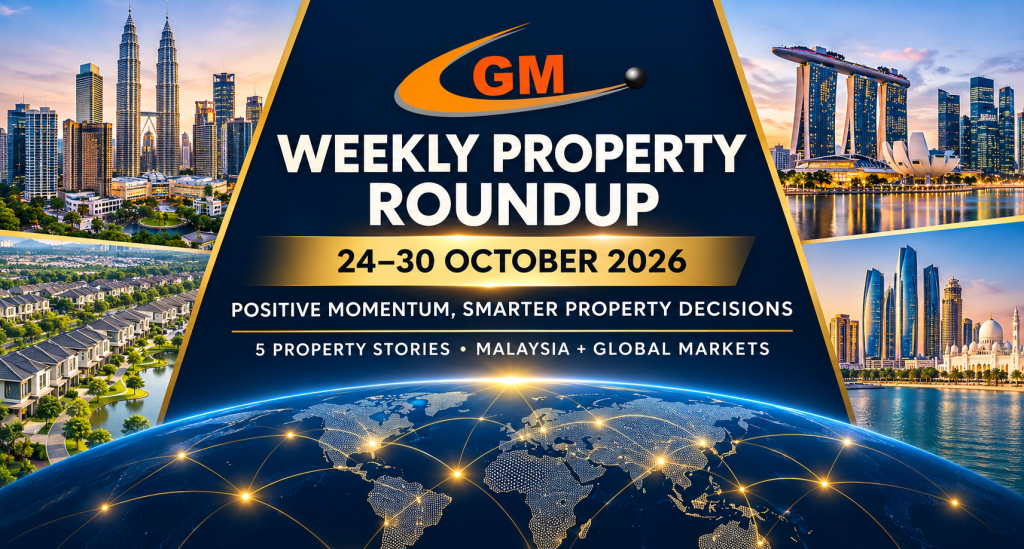
24–30 October 2026
Positive Momentum. Smarter Property Decisions.
Five developments worth paying attention to this week — three from Malaysia and two from international markets.
🇲🇾 MALAYSIA PROPERTY MARKET
Story 1 — GDB Secures RM1.02 Billion Desa ParkCity Construction Contract
What Happened?
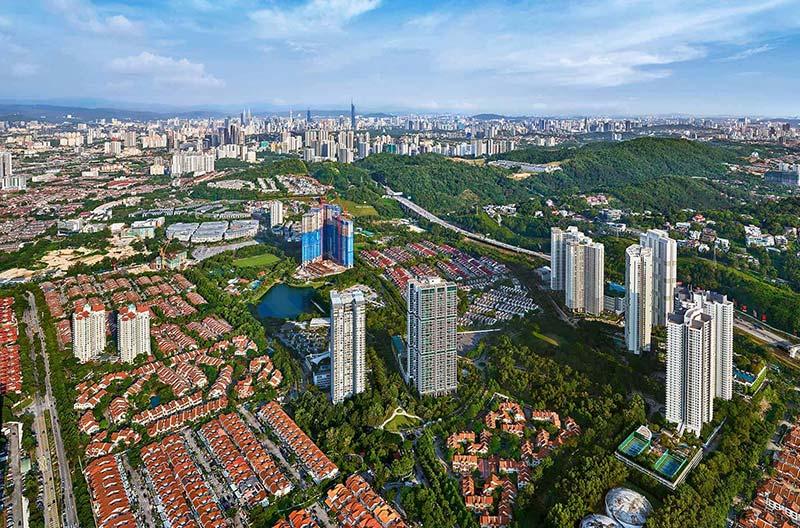
Malaysian construction group GDB Holdings Berhad secured a RM1.02 billion construction contract from Perdana ParkCity to build ParkCity Residences in Desa ParkCity, Kuala Lumpur.
The development comprises:
- Two residential blocks.
- 433 apartments.
- A seven-storey podium with amenities and parking.
- Two basement parking levels.
Construction is scheduled to begin in November 2026, with completion targeted for August 2031.
Following this award, GDB’s year-to-date contract wins increased to RM1.81 billion, while its outstanding order book reached approximately RM2.05 billion. EdgeProp
Source: EdgeProp — GDB secures RM1.02b ParkCity Residences contract.
Why It Matters
This is a significant construction award that provides greater visibility over GDB’s future workload.
It also reflects continued investment in established residential townships, where infrastructure, amenities and community planning have already helped create a recognised residential environment.
However, a large contract value does not automatically translate into profit. Construction costs, project execution, payment schedules and delivery timelines remain important.
Miichael’s Review
I find this development interesting because it highlights the importance of the relationship between developers and experienced construction partners.
A successful development requires more than good land and an attractive concept. Execution capability, cost management and timely delivery are equally important.
For buyers, the track record of the developer and its delivery partners deserves attention.
My view: A property’s value is influenced not only by its location and design, but also by the ability of the development team to deliver what was promised.

Story 2 — Tropicana Launches Avisa Residences Phase 2 After Strong First-Phase Take-up
What Happened?
Tropicana Corporation Berhad introduced the second phase of Avisa Residences at Tropicana Alam, Puncak Alam, on 29 October.
The launch follows reported sales take-up of more than 90% for Phase 1, which comprised 431 units. StarProperty
Source: StarProperty — Tropicana unveils Avisa Residences Phase 2.
Why It Matters
The first-phase take-up is an encouraging indicator of buyer interest in the development.
For developers, successful sales performance can provide confidence to proceed with subsequent phases.
However, sales take-up should be interpreted carefully. It is important to distinguish between bookings, signed sale and purchase agreements and completed transactions.
We should also consider the profile of buyers, cancellation rates and the actual affordability of the units.
Miichael’s Review
This is a useful example of why we should look beyond the launch itself.
A development that achieves strong take-up may indicate that its product positioning, pricing and target market are aligned.
But I would still ask:
- Who are the actual buyers?
- Are they buying for own occupation or investment?
- Is the pricing supported by comparable transactions?
- What is the surrounding supply pipeline?
- Can the location support long-term demand?
My view: Strong sales are encouraging, but sustainable demand is what ultimately matters. A successful first phase is a positive starting point, not a guarantee of future performance.
Story 3 — Matrix Concepts Proposes RM169.3 Million Kulai Land Acquisition
What Happened?
Matrix Concepts Holdings Berhad proposed acquiring 57 parcels of vacant agricultural land in Kulai, Johor, for approximately RM169.31 million.
The combined land area is approximately:
- 431.88 acres.
- 174.77 hectares.
- 57 separate parcels.
Matrix’s preliminary feasibility assessment estimates a potential gross development value of approximately RM2.1 billion for a mixed development.
The proposed acquisition is subject to conditions including title rectifications, transfer approvals and estate documentation. The agreements are interconditional, meaning the parcels must complete together. EdgeProp
Source: EdgeProp — Matrix proposes RM169.3m Kulai land buy.
Why It Matters
Johor continues to attract attention from property developers looking to expand their landbanks.
A large land acquisition gives a developer the opportunity to plan a development over multiple phases, potentially responding to changing demand and infrastructure improvements.
But the estimated RM2.1 billion GDV is a feasibility projection, not guaranteed revenue or profit.
The ultimate success will depend on approvals, development costs, infrastructure, market demand and the timing of future launches.
Miichael’s Review
Landbank expansion is an important part of a developer’s long-term strategy.
However, acquiring land is only the first step. The more important question is whether the developer can transform that land into a viable development that meets the needs of the surrounding population.
I would pay particular attention to employment growth, accessibility, competing supply and the affordability of the eventual products.
My view: The best landbank opportunities are not necessarily the cheapest. They are the ones where location, planning, infrastructure and genuine future demand come together.
🌏 INTERNATIONAL PROPERTY WATCH

This week we’re looking at Singapore and the United Arab Emirates — two markets showing encouraging investment activity.
🇸🇬 Story 4 — Asia-Pacific Property Investment Reaches US$65.6 Billion in Q3
What Happened?
Knight Frank reported that Asia-Pacific commercial real estate investment reached US$65.6 billion in Q3 2026, representing:
- 17.9% growth quarter-on-quarter.
- 7.3% growth year-on-year.
- Second-highest quarterly investment volume on record.
Year-to-date investment reached US$183.4 billion, up 29.3% year-on-year.
Singapore was the region’s second-largest destination for cross-border investment, attracting US$3.4 billion, an increase of 75.9% year-on-year.
Major transactions involving Paragon and Wheelock Place reflected investor interest in prime retail and commercial properties. Global
Source: Knight Frank — Asia-Pacific Q3 2026 investment report, 30 October.
Why It Matters
This is an encouraging signal for the regional commercial property sector.
Investors are returning to selected markets, particularly established gateway cities with strong tenant demand and limited supply of quality assets.
Singapore’s performance demonstrates the continued appeal of well-located commercial properties.
However, Knight Frank also cautioned that higher borrowing costs are putting pressure on investment returns and liquidity.
Miichael’s Review
What interests me most is the type of properties attracting capital.
Investors are not simply buying property because the market is growing. They are looking for assets that can generate reliable income.
This is an important distinction.
A prime commercial building with strong occupancy and quality tenants may offer a more attractive risk profile than an asset with uncertain rental demand.
My view: Property investment is increasingly about income quality, asset fundamentals and financial discipline. The ability to generate sustainable rental income remains a major consideration.
🇦🇪 Story 5 — Aldar Reports 19% Growth in Nine-Month Net Profit
What Happened?
Abu Dhabi-based developer Aldar Properties reported strong financial performance for the first nine months of 2026.
Key figures include:
| Financial measure | 9M 2026 |
|---|---|
| Revenue | AED26.2 billion |
| Revenue growth | +11% |
| Net profit | AED7.1 billion |
| Net profit growth | +19% |
| Development sales | AED18.9 billion |
| Development backlog | AED71.6 billion |
The company also reported that its UAE sales to overseas and expatriate resident buyers reached AED11.3 billion, representing 78% of total UAE sales.
Its investment business recorded adjusted EBITDA growth of 21% to AED2.8 billion, supported by high occupancy and rental growth. Aldar
Source: Aldar — Q3 2026 financial results, 27 October.
Why It Matters
Aldar’s results show how a property group can build its business through a combination of development sales and recurring rental income.
Its development backlog of AED71.6 billion also provides a degree of revenue visibility over the coming years, although actual conversion depends on project delivery and market conditions.
The strong contribution from overseas and expatriate resident buyers also highlights the international dimension of Abu Dhabi’s property market.
Miichael’s Review
I find Aldar’s business model particularly interesting because it combines two important areas:
- Property development, which generates revenue through project sales.
- Investment properties, which provide recurring rental income.
These two activities can complement each other and help diversify a property group’s earnings.
For developers, it is a reminder that long-term business resilience should not depend entirely on launching and selling new projects.
My view: A strong property company needs more than sales momentum. It needs a balanced portfolio, disciplined financial management and the ability to generate recurring income.
WORTH WATCHING
| Market | Development to monitor | Why it matters |
|---|---|---|
| Malaysia | GDB’s ParkCity Residences construction progress | Delivery execution and construction pipeline |
| Malaysia | Tropicana Avisa Phase 2 | Whether first-phase demand carries into the next phase |
| Johor | Matrix Concepts’ Kulai land acquisition | Approval, land assembly and future development plans |
| Singapore | Commercial property investment activity | Whether investor confidence remains strong |
| UAE | Aldar’s development backlog and recurring income | Whether current growth translates into sustainable earnings |
MY TAKEAWAY THIS WEEK
This week’s roundup gives us several encouraging signals.
Malaysia continues to see development activity, with a major construction award in Kuala Lumpur, strong reported take-up for a residential project in Selangor and further landbank expansion in Johor.
Internationally, Singapore continues to attract commercial property investment, while Aldar’s results demonstrate the potential of combining development sales with recurring property income.
But there is one common lesson across all five stories.
A property opportunity should always be evaluated beyond its headline numbers.
A large construction contract, high sales take-up, attractive GDV or strong corporate earnings can be encouraging. However, we still need to understand the underlying fundamentals.
For buyers, it is affordability and genuine housing needs.
For investors, it is rental income, asset quality and financial sustainability.
For developers, it is the ability to match product, location and pricing with actual market demand.
That is why I continue to believe that better property decisions begin with better property understanding.
Look beyond the price. Discover better. Decide smarter.
Miichael Yeoh
PROPERTY STRATEGIST
http://www.miichaelyeoh.com