A different way to think about property buyers, developers and better decisions
When people start looking for a property, the first question is often:
“Which property should I buy?”
Perhaps we should be asking a different question first:
“What am I actually looking for?”
It sounds like a small difference.
It isn’t.
Today, property buyers have access to more information than ever before. They can compare prices online, watch property tours, read reviews, study locations, look at transaction data and explore dozens of projects without leaving home.
Yet having more information does not necessarily mean making better decisions.
In fact, sometimes it creates another problem.
Information overload.
A buyer may know the price, size, facilities, tenure and estimated rental yield of a property — but still not know whether the property actually makes sense for them.
And this is where I believe the property conversation needs to change.
Start With the Buyer, Not the Project
Most property journeys begin with a project.
A buyer sees an advertisement.
A friend recommends a development.
A property consultant introduces a new launch.
A developer presents an attractive package.
The project becomes the starting point of the conversation.
From there, the buyer begins asking:
Is the price good?
Is the location good?
Will it appreciate?
Can I rent it out?
Is this a good investment?
But there is an important question that often comes much earlier:
Good for whom?
A property can be an excellent project and still be the wrong property for a particular buyer.
The location may be excellent, but unsuitable for the buyer’s lifestyle.
The rental potential may look attractive, but the numbers may not work after financing costs and expenses.
The future development potential may be strong, but the buyer may need liquidity much sooner.
The property itself may be good.
The decision may still be wrong.
The Developer Sees the Property Differently
This isn’t necessarily because developers are doing something wrong.
Developers have a responsibility to present their projects — the location, design, facilities, specifications, pricing and value proposition.
They need buyers to understand what they are offering.
But buyers are looking at the same property through a completely different lens.
They are asking:
“What does this mean for me?”
That is where the gap can appear.
Developers communicate the value of the project.
Buyers are trying to understand the value of the decision.
Those two things are related — but they are not exactly the same.
And perhaps there is an opportunity to bring them closer together.

Better Questions Can Lead to Better Decisions
I have spent many years working across banking, investment, property and education, and one thing has become increasingly clear to me:
The quality of a property decision often depends on the quality of the questions being asked.
Instead of immediately asking:
“Is this a good property?”
we could ask:
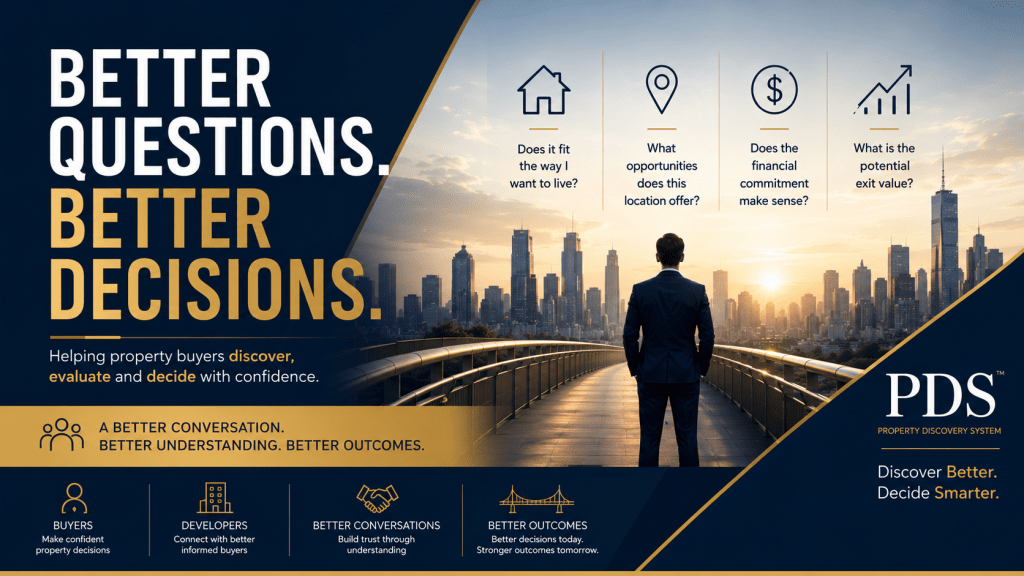
- Does it fit the way I intend to live?
- What opportunity does this location create?
- Can I comfortably afford it?
- What happens if my circumstances change?
- What is the potential exit value?
- What risks am I overlooking?
- Am I buying because the property makes sense — or because I am being persuaded that it makes sense?
These questions do not make the buying process more complicated.
They make it more meaningful.
This Is Where Property Discovery System™ Comes In
This thinking was one of the reasons I developed the Property Discovery System™ (PDS).
PDS is not designed to tell a buyer which property to buy.
Instead, it provides a structured way to discover, evaluate and understand a property before making the decision.
At the heart of the system is the HOME™ Property Assessment Framework:
H — Habitability
Does the property and its environment make sense for the way it will actually be used?
O — Opportunity
What does the location, market and surrounding environment potentially offer?
M — Money
Does the financial commitment make sense based on affordability, cash flow and overall financial considerations?
E — Exit Value
If circumstances change, what potential options and value does the property offer when the buyer eventually needs to exit?
The objective is not to produce a magical number that says “buy” or “don’t buy.”
Property decisions are rarely that simple.
The objective is to help a buyer think more clearly before deciding.
And What About Developers?
This approach is not only useful for buyers.
I believe it can also create value for developers.
Imagine a buyer arriving at a project presentation already understanding:
- what they are looking for;
- what matters to them;
- how the location fits their needs;
- what financial considerations they need to evaluate;
- and what questions they should be asking.
The developer can then spend less time simply trying to convince the buyer that the project is attractive.
Instead, the conversation can move towards:
“Let us show you why this project may — or may not — fit what you are looking for.”
That is a different kind of conversation.
And I believe it is a healthier one.
Perhaps Buyers and Developers Are Not Opposite Sides
The property industry sometimes makes it appear as though buyers and developers sit on opposite sides of the table.
I don’t see it that way.
A responsible buyer wants to make a sound decision.
A good developer wants its project to attract the right buyers and deliver what it promises.
Both sides benefit when the buyer understands the decision better.
That is why I see PDS not as another property sales tool, but as a bridge between property discovery and property decision-making.
The developer still presents the project.
The buyer still makes the decision.
But the conversation starts from a more informed place.
Maybe We Have Been Starting Too Late
Perhaps the property buying journey should not begin when a buyer walks into a show gallery.
Perhaps it should begin much earlier.
Before the brochure.
Before the show unit.
Before the sales presentation.
Before the question:
“How much is it?”
It should begin with:
“What am I trying to achieve?”
Then:
“What should I be looking for?”
And only after that:
“Which property fits?”
That is the thinking behind Property Discovery System™.
Because I don’t believe people need more property projects to choose from.
They need a better way to discover which properties deserve their attention in the first place.
Discover Better. Decide Smarter.
That, to me, is where a better property journey begins.
From The Desk Of
Miichael Yeoh